. 1998 Jun;180(11):2975-82.
doi: 10.1128/JB.180.11.2975-2982.1998.

Phylogeny of dissimilatory sulfite reductases supports an early origin of sulfate respiration

Affiliations

Phylogeny of dissimilatory sulfite reductases supports an early origin of sulfate respiration

M Wagner et al. J Bacteriol. 1998 Jun.

Abstract

Microorganisms that use sulfate as a terminal electron acceptor for anaerobic respiration play a central role in the global sulfur cycle. Here, we report the results of comparative sequence analysis of dissimilatory sulfite reductase (DSR) genes from closely and distantly related sulfate-reducing organisms to infer the evolutionary history of DSR. A 1.9-kb DNA region encoding most of the alpha and beta subunits of DSR could be recovered only from organisms capable of dissimilatory sulfate reduction with a PCR primer set targeting highly conserved regions in these genes. All DNA sequences obtained were highly similar to one another (49 to 89% identity), and their inferred evolutionary relationships were nearly identical to those inferred on the basis of 16S rRNA. We conclude that the high similarity of bacterial and archaeal DSRs reflects their common origin from a conserved DSR. This ancestral DSR was either present before the split between the domains Bacteria, Archaea, and Eucarya or laterally transferred between Bacteria and Archaea soon after domain divergence. Thus, if the physiological role of the DSR was constant over time, then early ancestors of Bacteria and Archaea already possessed a key enzyme of sulfate and sulfite respiration.


Figures
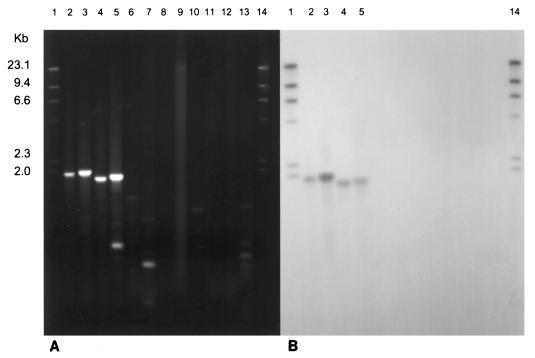
FIG. 1
FIG. 1
PCR specificity determinations using the DSR primer pair DSR1F-DSR4R with genomic DNA from Desulfovibrio vulgaris ATCC 29579 (lane 2), Desulfomicrobium baculatus DSM 1743 (lane 3), Desulfotomaculum ruminis ATCC 23193 (lane 4), Thermodesulfovibrio yellowstonii (provided by R. Devereux) (lane 5), E. coli (provided by the University of Illinois [UI]) (lane 6), Shewanella putrefaciens ATCC 8071 (lane 7), Nitrosomonas sp. strain C56 (provided by J. Waterbury) (lane 8), Thiobacillus denitrificans ATCC 25259 (lane 9), Arthrobacter globiformis ATCC 8010 (lane 10), Beggiatoa sp. strain MS 81-1-C (provided by D. Nelson) (lane 11), Chromatium vinosum ATCC 17899 (lane 12), and Methanosarcina acetivorans (UI) (lane 13) Lanes 1 and 14 contain molecular weight markers. (A). In addition, genomic DNA obtained from the following bacteria was used for further specificity evaluation of the DSR primer set (data not shown): Fe reducer TT4B (provided by L. Krumholtz), Nitrospira briensis C128 (provided by Waterbury), Nitrobacter hamburgensis 14X (provided by J. Waterbury), Nitrosovibrio tenuis C141 (provided by J. Waterbury), Oxalobacter formigenes ATCC 35274, Zoogloea ramigera ATCC 19623, Fibrobacter succinogenes ATCC 19169, Bacillus subtilis ATCC 6051, a Streptomyces sp. (UI), Streptococcus pyogenes ATCC 12344, Pseudomonas aeruginosa (UI), Beggiatoa sp. strain OH-75-2a (provided by D. Nelson), and Methanobacterium thermoautotrophicum (UI). A fragment of the expected length was exclusively obtained with DNA from the sulfate reducers (Desulfovibrio vulgaris, Desulfovibrio baculatus, Desulfotomaculum ruminis, and Thermodesulfovibrio yellowstonii). Sufficient quality of each genomic DNA for successful PCR amplification was demonstrated in control reactions with conserved 16S rDNA-targeted primers (data not shown). The identity of the amplified products was confirmed by Southern hybridization with a DNA probe targeting a conserved region in the α subunit of DSR (B).
FIG. 2
FIG. 2
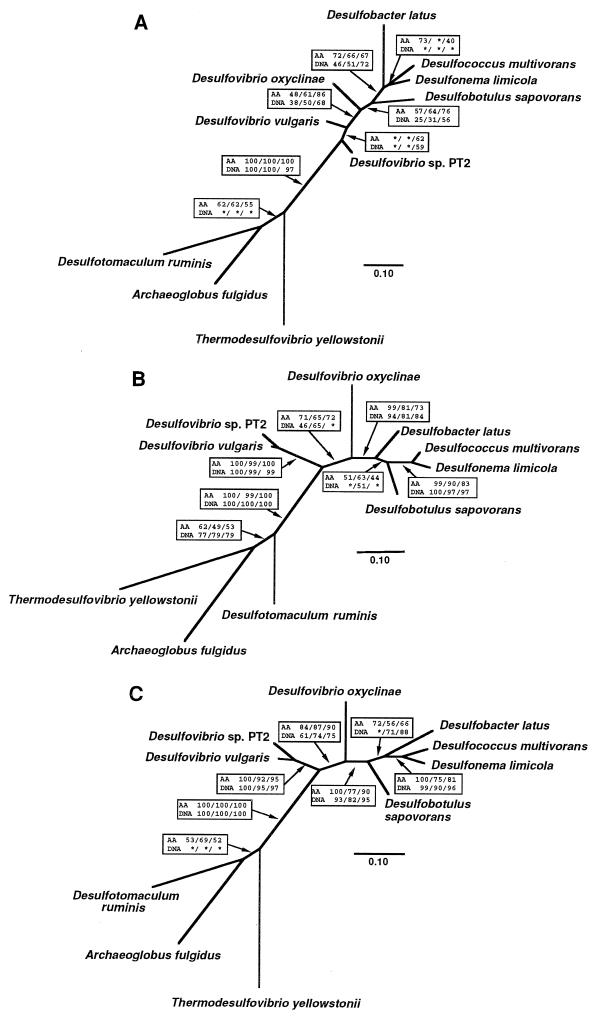
Phylogenetic trees reflecting the relationships of the analyzed sulfate-reducing prokaryotes based on DSR sequences. Tree topologies and branch lengths were obtained from protein maximum-likelihood analysis of the DSR α-subunit (log likelihood = −2046.54) (A), β-subunit (log likelihood = −2116.25) (B), and α- and β-subunit data sets (log likelihood = −4188.60) (C) with the JTT-f amino acid substitution model. Bootstrap values for branches are reported in boxes with arrows pointing to the relevant branch. Bootstrap values are reported in the order distance/parsimony/likelihood for both amino acid (AA) and DNA data sets. Asterisks indicate that the branch in question was not recovered in the majority of bootstrap replicates by the phylogenetic method. The scale bar indicates the number of expected amino acid substitutions per site per unit of branch length.
FIG. 3
FIG. 3
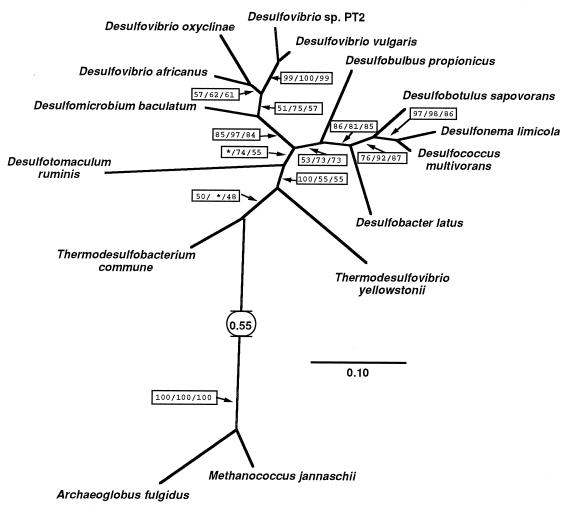
Phylogenetic relationships between Archaea and Bacteria inferred from comparisons of 16S rRNA genes. The tree topology and branch lengths (log likelihood = −6573.00) were obtained by the maximum-likelihood method with the HKY model with a discrete gamma-invariant-site model with an alpha shape parameter (α) of 0.48, a proportion of invariant sites of 0.20, and a transition/transversion ratio of 1.54 (parameters were obtained by maximum-likelihood optimization). Bootstrap values are shown in boxes with arrows indicating the relevant branch. Bootstrap values are reported in the order distance/parsimony/likelihood, and asterisks indicate that the branch in question was not recovered in the majority of bootstrap replicates with the phylogenetic method used. The scale bar indicates expected nucleotide substitutions per site per unit of branch length. A section of the branch connecting the Archaea and Bacteria has been removed for ease of presentation. The length of this section is reported in an ellipse on the branch.

References

    1. Achenbach-Richter L, Gupta R, Stetter K O, Woese C R. Were the original eubacteria thermophiles? Syst Appl Microbiol. 1987;9:34–39. - PubMed
    1. Adachi J, Hasegawa M. Computer science monographs, no. 28. MOLPHY version 2.3: programs for molecular phylogenetics based on maximum likelihood. Tokyo, Japan: Institute of Statistics and Mathematics; 1996.
    1. Arendsen A F, Verhagen M F J M, Wolbert R B G, Pierik A J, Stams A J M, Jetten M S M, Hagen W R. The dissimilatory sulfite reductase from Desulfosarcina variabilis is a desulforubidin containing uncoupled metalated sirohemes and S=9/2 iron-sulfur clusters. Biochemistry. 1993;32:10323–10330. - PubMed
    1. Boehringer Mannheim Corporation. Genius system user’s guide for membrane hybridization, version 3.0. Indianapolis, Ind: Boehringer Mannheim Corporation; 1994.
    1. Boom R, Sol C J A, Salimans M M M, Jansen C L, Wertheim-van Dillen P M E, van der Noordaa J. Rapid and simple method for purification of nucleic acids. J Clin Microbiol. 1990;28:495–503. - PMC - PubMed

Publication types

MeSH terms

LinkOut - more resources