doi: 10.1128/CDLI.5.3.294-298.1998.
Use of lytic bacteriophage for control of experimental Escherichia coli septicemia and meningitis in chickens and calves
Affiliations
- PMID: 9605979
- PMCID: PMC104512
- DOI: 10.1128/CDLI.5.3.294-298.1998
Item in Clipboard
Use of lytic bacteriophage for control of experimental Escherichia coli septicemia and meningitis in chickens and calves
Clin Diagn Lab Immunol.
1998 May.
Abstract
A lytic bacteriophage, which was previously isolated from sewage and which attaches to the K1 capsular antigen, has been used to prevent septicemia and a meningitis-like infection in chickens caused by a K1+ bacteremic strain of Escherichia coli. Protection was obtained even when administration of the phage was delayed until signs of disease appeared. The phage was able to multiply in the blood. In newly borne colostrum-deprived calves given the E. coli orally, intramuscular inoculation of phage delayed appearance of the bacterium in the blood and lengthened life span. With some provisos there is considerable potential for this approach to bacterial-disease therapy.
Figures
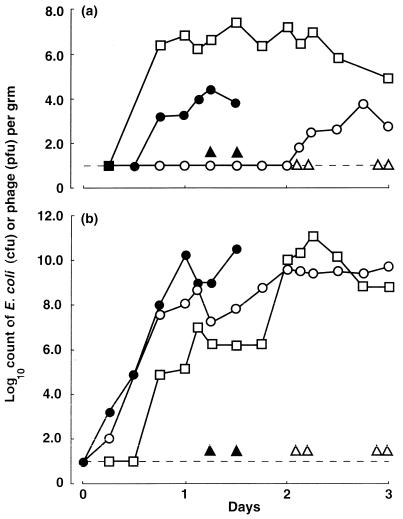
E. coli and bacteriophage R in blood (a) and feces (b) of colostrum-deprived calves. •, E. coli in control (untreated) animals; ○, E. coli in animals to which phage was administered intramuscularly 8 h after E. coli infection; □, bacteriophage counts in phage-treated animals. Triangles indicate time at which control (▴) or treated (▵) calves were killed. Dashed lines indicate the limit of sensitivity of the bacterial counting method.
References
-
- Asheshov I N, Wilson J, Topley W W C. The effect of an anti-Vi bacteriophage on typhoid infection in mice. Lancet. 1937;i:319–320.
-
- Barrow P A. Bacteriophages mediating somatic antigenic conversion in Salmonella cholerae-suis; their isolation from sewage and other Salmonella serotypes possessing the somatic 6 antigen. J Gen Microbiol. 1986;132:835–837. - PubMed
-
- Barrow P A. Novel approaches to control of bacterial infections in animals. Acta Vet Hung. 1997;45:317–329. - PubMed
-
- Barrow P A, Soothill J S. Bacteriophage therapy and prophylaxis: rediscovery and renewed assessment of potential. Trends Microbiol. 1997;5:268–271. - PubMed
-
- Berchieri, A., Jr., and P. Barrow. Unpublished data.
Publication types
MeSH terms
LinkOut - more resources
Full Text Sources
Other Literature Sources
Medical