A bereavement support group intervention is longitudinally associated with salutary effects on the CD4 cell count and number of physician visits
- PMID: 9605995
- PMCID: PMC104528
- DOI: 10.1128/CDLI.5.3.382-391.1998
A bereavement support group intervention is longitudinally associated with salutary effects on the CD4 cell count and number of physician visits
Abstract
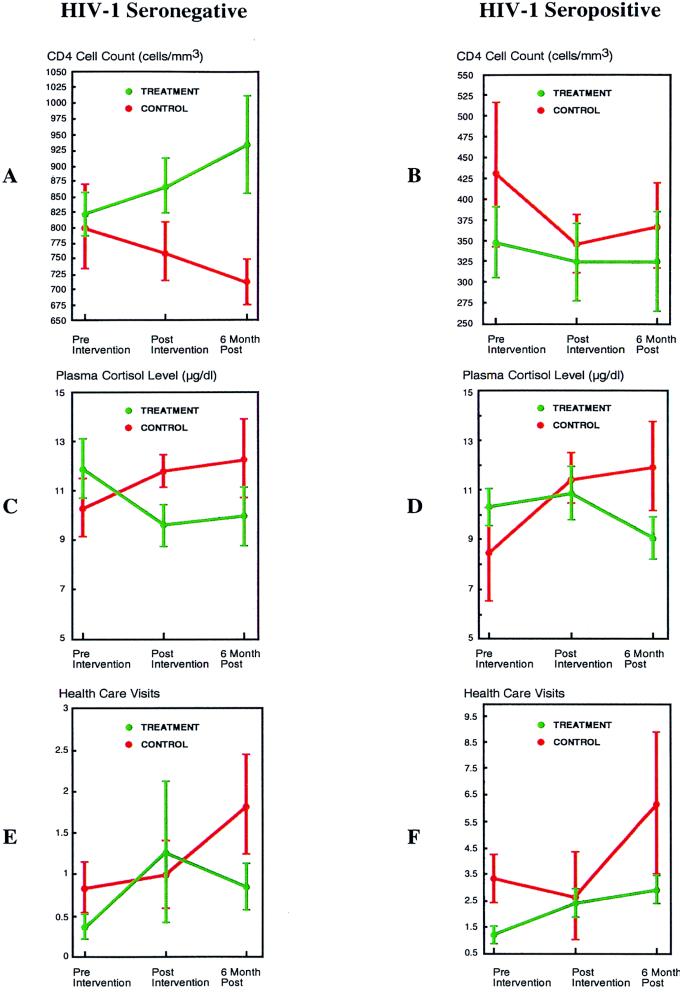
A randomized, controlled, clinical trial was conducted to examine the impact of a semistructured, 10-week, once weekly, 90-min/session bereavement support group intervention on immunological, neuroendocrine, and clinical health status in human immunodeficiency virus type 1-seropositive (HIV-1+) and HIV-1-seronegative (HIV-1-) homosexual men, compared to a standard of care control condition. A total of 119 homosexual men (74 HIV-1+ and 45 HIV-1-) were assessed at baseline, 10 weeks, and 6 months follow-up. At the 6-month follow-up assessment, the intervention groups exhibited significant beneficial effects compared to controls on changes in CD4 cell, total T-lymphocyte, and total lymphocyte counts, when baseline levels, antiretroviral medication use, CDC stage of disease, and other potentially confounding factors were accounted for. There was no statistically significant effect on the CD4/CD8 ratio or on the CD8 cell count. The effect on CD4 cell count was associated with group attendance and with changes in plasma cortisol level. Plasma cortisol levels decreased significantly among intervention subjects, compared to controls. A significantly reduced number of health care visits over the 6-month follow-up period among the intervention subjects supported the clinical relevance of the immunological changes observed for both HIV-1+ and HIV-1- individuals. These results indicate that behavioral interventions may have salutary immunological and clinical health effects following bereavement among HIV-1-infected individuals. The effect in HIV-1- individuals suggests that this bereavement support group intervention might have similar salutary effects in the general population. Potential effects of such interventions on clinical HIV disease progression are of interest and should be studied.
Figures
References
-
- American Psychiatric Association. Diagnostic and statistical manual of mental disorders III—revised. Washington, D.C: American Psychiatric Association; 1987.
-
- Antoni M H, Baggett L, Ironson G, LaPerriere A, August S, Klimas N, Schneiderman N, Fletcher M A. Cognitive-behavioral stress management intervention buffers distress responses and immunological changes following notification of HIV-1 antibody seropositivity. J Consult Clin Psychol. 1991;59:906–915. - PubMed
-
- Bartrop R W, Luckhurst L, Lazarus L, Kiloh L G, Penny R. Depressed lymphocyte function after bereavement. Lancet. 1977;i:834–836. - PubMed
-
- Burack J H, Barrett D C, Stall R D, Chesney M A, Ekstrand M L, Coates T J. Depressive symptoms and CD4 lymphocyte decline among HIV-infected men. JAMA. 1993;270:2568–2573. - PubMed
-
- Cao Y, Qin L, Zhang L, Safrit J, Ho D D. Virologic and immunologic characterization of long-term survivors of human immunodeficiency virus type 1 infection. N Engl J Med. 1995;332:201–208. - PubMed
Publication types
MeSH terms
Substances
Grants and funding
LinkOut - more resources
Full Text Sources
Medical
Research Materials