


Cross-lineage expression of Ig-beta (B29) in thymocytes: positive and negative gene regulation to establish T cell identity
- PMID: 9618498
- PMCID: PMC22652
- DOI: 10.1073/pnas.95.12.6831
Cross-lineage expression of Ig-beta (B29) in thymocytes: positive and negative gene regulation to establish T cell identity
Abstract
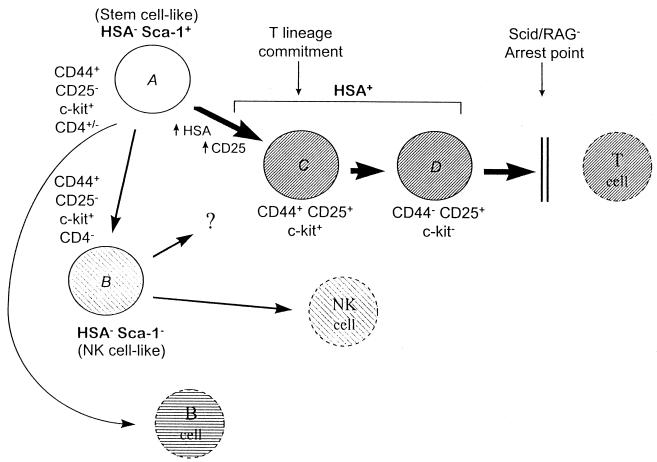
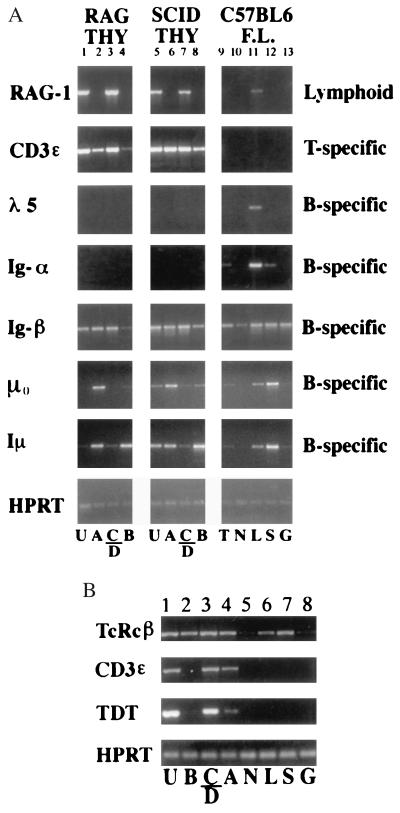
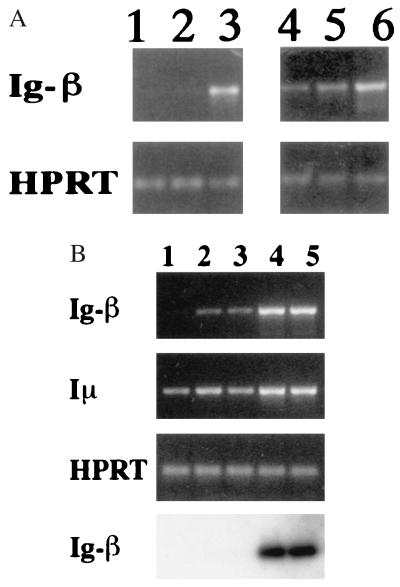
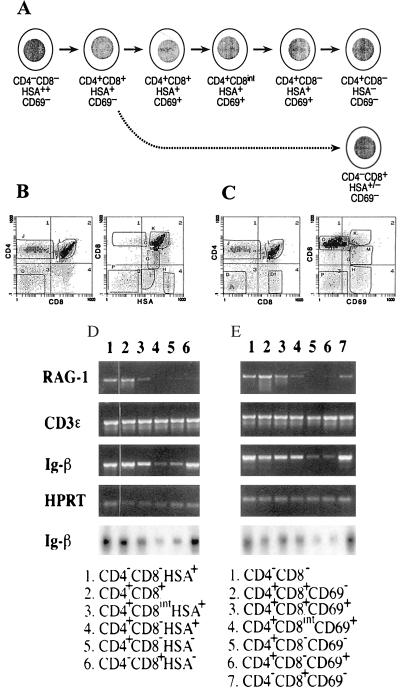
Developmental commitment involves activation of lineage-specific genes, stabilization of a lineage-specific gene expression program, and permanent inhibition of inappropriate characteristics. To determine how these processes are coordinated in early T cell development, the expression of T and B lineage-specific genes was assessed in staged subsets of immature thymocytes. T lineage characteristics are acquired sequentially, with germ-line T cell antigen receptor-beta transcripts detected very early, followed by CD3epsilon and terminal deoxynucleotidyl transferase, then pTalpha, and finally RAG1. Only RAG1 expression coincides with commitment. Thus, much T lineage gene expression precedes commitment and does not depend on it. Early in the course of commitment to the T lineage, thymocytes lose the ability to develop into B cells. To understand how this occurs, we also examined expression of well defined B lineage-specific genes. Although lambda5 and Ig-alpha are not expressed, the mu 0 and I mu transcripts from the unrearranged IgH locus are expressed early, in distinct patterns, then repressed just before RAG1 expression. By contrast, RNA encoding the B cell receptor component Ig-beta was found to be transcribed in all immature thymocyte subpopulations and throughout most thymocyte differentiation. Ig-beta expression is down-regulated only during positive selection of CD4(+)CD8(-) cells. Thus several key participants in the B cell developmental program are expressed in non-B lineage-committed cells, and one is maintained even through commitment to an alternative lineage, and repressed only after extensive T lineage differentiation. The results show that transcriptional activation of "lymphocyte-specific" genes can occur in uncommitted precursors, and that T lineage commitment is a composite of distinct positive and negative regulatory events.
Figures
References
-
- Kee B L, Paige C J. Intl Rev Cytol. 1995;157:129–179. - PubMed
-
- Lin H, Grosschedl R. Nature (London) 1995;376:263–267. - PubMed
-
- Nuez B, Michalovich D, Bygrave A, Ploemacher R, Grosveld F. Nature (London) 1995;375:316–318. - PubMed
-
- Olson M C, Scott E W, Hack A A, Su G H, Tenen D G, Singh H, Simon M C. Immunity. 1995;3:703–714. - PubMed
Publication types
MeSH terms
Substances
Grants and funding
LinkOut - more resources
Full Text Sources
Research Materials
