. 1998 Jun 9;95(12):7000-5.
doi: 10.1073/pnas.95.12.7000.

Expression of a beta-adrenergic receptor kinase 1 inhibitor prevents the development of myocardial failure in gene-targeted mice

Affiliations

Expression of a beta-adrenergic receptor kinase 1 inhibitor prevents the development of myocardial failure in gene-targeted mice

H A Rockman et al. Proc Natl Acad Sci U S A. .

Abstract

Heart failure is accompanied by severely impaired beta-adrenergic receptor (betaAR) function, which includes loss of betaAR density and functional uncoupling of remaining receptors. An important mechanism for the rapid desensitization of betaAR function is agonist-stimulated receptor phosphorylation by the betaAR kinase (betaARK1), an enzyme known to be elevated in failing human heart tissue. To investigate whether alterations in betaAR function contribute to the development of myocardial failure, transgenic mice with cardiac-restricted overexpression of either a peptide inhibitor of betaARK1 or the beta2AR were mated into a genetic model of murine heart failure (MLP-/-). In vivo cardiac function was assessed by echocardiography and cardiac catheterization. Both MLP-/- and MLP-/-/beta2AR mice had enlarged left ventricular (LV) chambers with significantly reduced fractional shortening and mean velocity of circumferential fiber shortening. In contrast, MLP-/-/betaARKct mice had normal LV chamber size and function. Basal LV contractility in the MLP-/-/betaARKct mice, as measured by LV dP/dtmax, was increased significantly compared with the MLP-/- mice but less than controls. Importantly, heightened betaAR desensitization in the MLP-/- mice, measured in vivo (responsiveness to isoproterenol) and in vitro (isoproterenol-stimulated membrane adenylyl cyclase activity), was completely reversed with overexpression of the betaARK1 inhibitor. We report here the striking finding that overexpression of this inhibitor prevents the development of cardiomyopathy in this murine model of heart failure. These findings implicate abnormal betaAR-G protein coupling in the pathogenesis of the failing heart and point the way toward development of agents to inhibit betaARK1 as a novel mode of therapy.


Figures
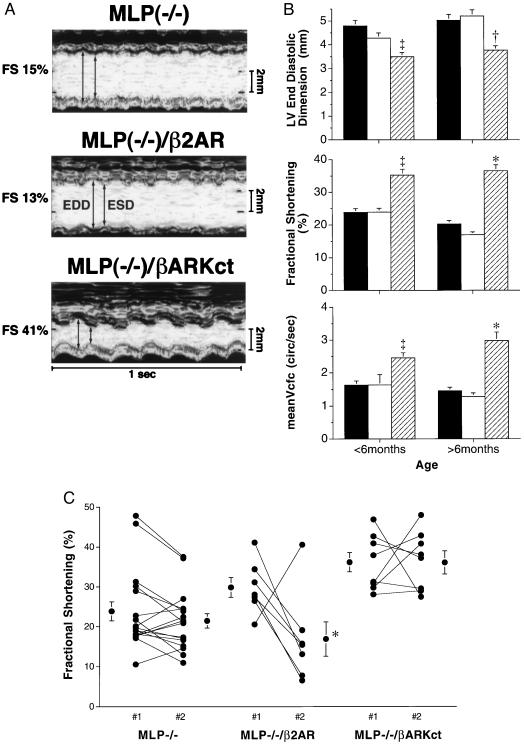
Figure 1
Figure 1
Analysis of cardiac function by echocardiography. (A) Transthoracic M-mode echocardiographic tracings in a MLP−/− (Top), MLP−/−2AR (Middle), and a MLP−/−/βARKct mouse (Bottom). Left ventricular dimensions are indicated by the double-sided arrows. EDD, end diastolic dimension; ESD, end systolic dimension. Both the MLP−/− and MLP−/−2AR mice have chamber dilatation with reduced wall motion indicating depressed cardiac function, whereas chamber size and cardiac function are normal in the MLP−/−/βARKct mouse. (B) Echocardiographic findings in mice under 6 months of age: MLP−/− (solid bar, mean age 4.1 ± 0.4 months, n = 18), MLP−/−2AR (open bar, mean age 4.3 ± 0.4 months, n = 8), and MLP−/−/βARKct (hatched bar, mean age 4.7 ± 0.7 months, n = 9); and more than 6 months of age: MLP−/− (solid bar, mean age 7.0 ± 0.5 months, n = 17), MLP−/−2AR (open bar, mean age 7.3 ± 0.7 months, n = 3), and MLP−/−/βARKct (hatched bar, mean age 6.9 ± 0.77 months, n = 8). Data represent serial echocardiograms in the same mouse at different ages except if the mouse died during the interval between studies. ∗, P < 0.005; †, P < 0.01; ‡, P < 0.05 MLP−/−/βARKct vs. MLP−/− and MLP−/−2AR, one-factor ANOVA. (C) Change in cardiac function over a 2.5- to 3-month period in the three groups of gene-targeted mice. #1, early study (mean age, 3.9 months); #2, later study (mean age, 6.4 months). For comparison, normal values obtained in MLP+/+ mice are shown in Table 1.
Figure 2
Figure 2
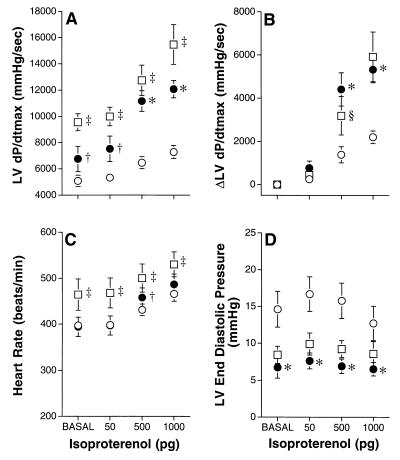
In vivo assessment of β-AR responsiveness. Cardiac catheterization was performed in intact, anesthetized mice. Parameters are shown at baseline and after progressive infusion of isoproterenol in MLP−/− (○), n = 15, MLP−/−/βARKct (•), n = 7, and wild-type MLP+/+ (□), n = 6, mice. (A) Maximal first derivative of LV pressure, LV dP/dtmax. (B) The difference from baseline for LV dP/dtmax, ΔLV dP/dtmax. (C) Heart rate. (D) LV end diastolic pressure. ∗, P < 0.0005; †, P < 0.01 MLP−/−/βARKct vs. MLP−/−; ‡, P < 0.005; §, P < 0.05 wild-type MLP+/+ vs. MLP−/−/βARKct. A significant between-group main effect in response to isoproterenol was found for LV dP/dtmax, P < 0.00001 (A); heart rate, P = 0.05 (C); and LV end diastolic pressure, P < 0.05 (D). The pattern of change between groups was statistically significantly for LV dP/dtmax, P < 0.00001 (A) and ΔLV dP/dtmax, P < 0.00001 (B).
Figure 3
Figure 3
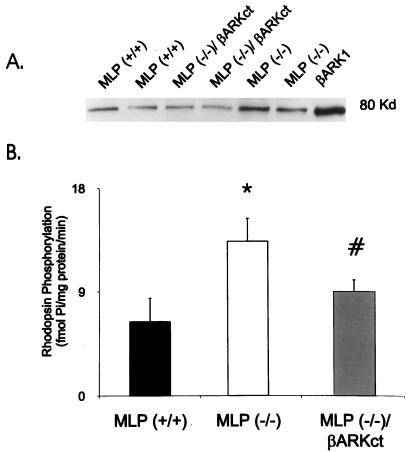
Assessment of myocardial βARK1 levels and activity. (A) βARK1 protein levels of myocardial extracts were determined by protein immunoblotting. Shown is a representative experiment with two hearts from each gene-targeted mouse. Similar results were obtained in two more hearts in each group. βARK1 protein levels were ≈2-fold higher in the MLP−/− hearts compared with MLP+/+ hearts (P < 0.05) whereas myocardial βARK1 levels in the MLP−/−/βARKct hearts were not significantly different than wild-type hearts. (B) Rhodopsin-enriched rod outer segment membranes were used as a substrate for membrane myocardial GRK activity and 32P incorporation was quantified from dried gels. The data represent a sample size of four to six hearts in each group. ∗, P < 0.05 vs. MLP+/+; #, P < 0.03 vs. MLP−/−.
Figure 4
Figure 4
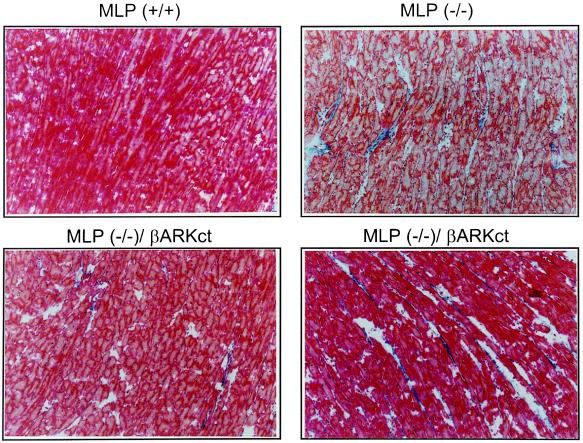
Histological analysis of gene-targeted mouse hearts. Representative sections stained with Masson’s trichrome are shown from MLP+/+ and MLP−/− hearts and two MLP−/−/βARKct hearts.

References

    1. Inglese J, Freedman N J, Koch W J, Lefkowitz R J. J Biol Chem. 1993;268:23735–23738. - PubMed
    1. Lefkowitz R J. Cell. 1993;74:409–412. - PubMed
    1. Pitcher J A, Inglese J, Higgins J B, Arriza J L, Casey P J, Kim C, Benovic J L, Kwatra M M, Caron M G, Lefkowitz R J. Science. 1992;257:1264–1267. - PubMed
    1. Koch W J, Inglese J, Stone W C, Lefkowitz R J. J Biol Chem. 1993;268:8256–8260. - PubMed
    1. Bristow M R, Ginsburg R, Minobe W, Cubicciotti R S, Sageman W S, Lurie K, Billingham M E, Harrison D C, Stinson E B. N Engl J Med. 1982;307:205–211. - PubMed

Publication types

MeSH terms

Substances