


Cloning and expression of the 44-kilodalton major outer membrane protein gene of the human granulocytic ehrlichiosis agent and application of the recombinant protein to serodiagnosis
- PMID: 9620397
- PMCID: PMC104897
- DOI: 10.1128/JCM.36.6.1666-1673.1998
Cloning and expression of the 44-kilodalton major outer membrane protein gene of the human granulocytic ehrlichiosis agent and application of the recombinant protein to serodiagnosis
Erratum in
-
Correction for Zhi et al., "Cloning and Expression of the 44-Kilodalton Major Outer Membrane Protein Gene of the Human Granulocytic Ehrlichiosis Agent and Application of the Recombinant Protein to Serodiagnosis".J Clin Microbiol. 2023 Oct 24;61(10):e0070323. doi: 10.1128/jcm.00703-23. Epub 2023 Sep 7. J Clin Microbiol. 2023. PMID: 37676012 Free PMC article. No abstract available.
Abstract
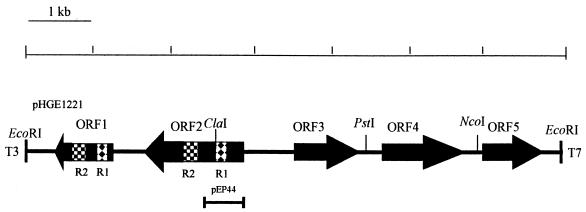
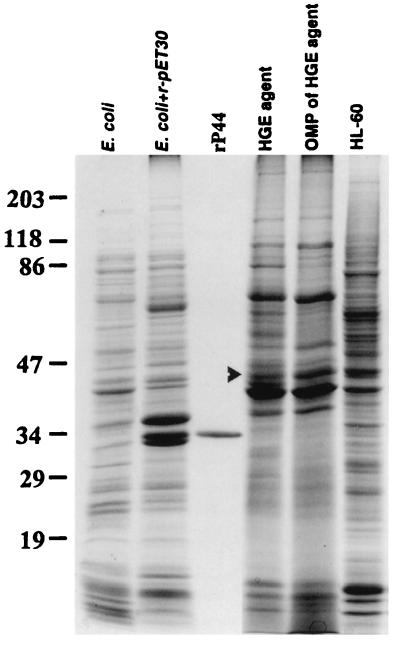
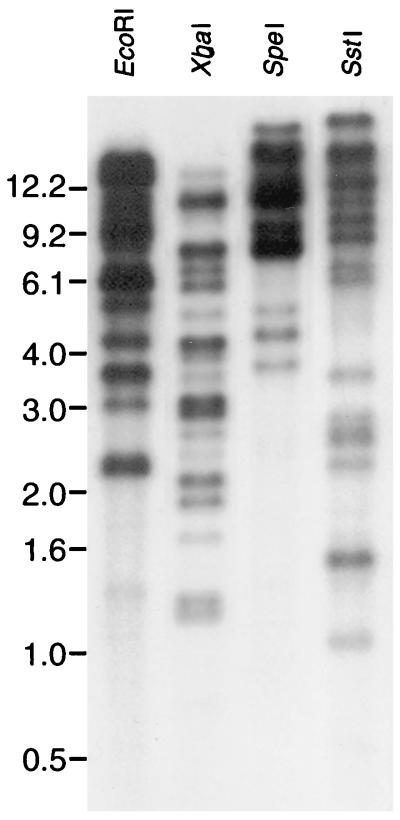
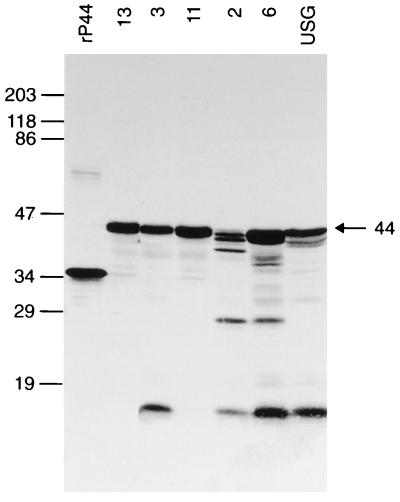
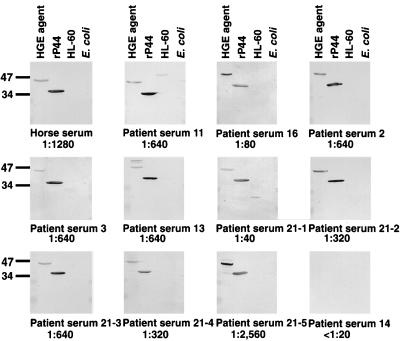
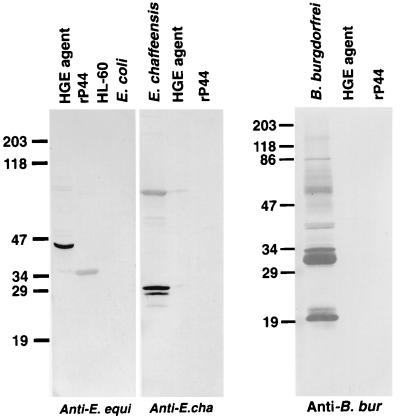
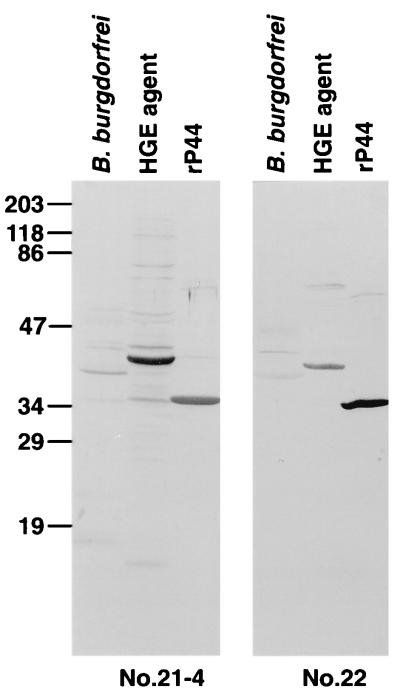
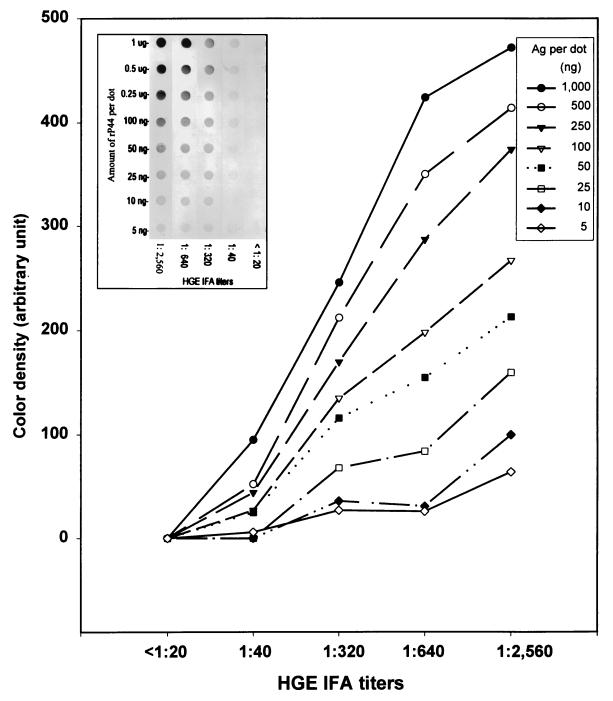
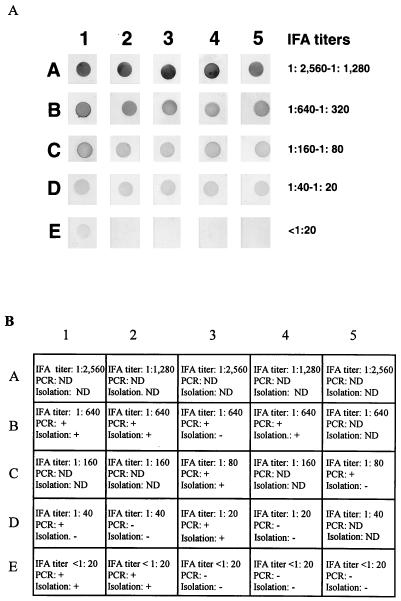
A 44-kDa major outer membrane protein of the human granulocytic ehrlichiosis (HGE) agent is an immunodominant antigen in human infection. A gene encoding this protein was cloned and sequenced. Southern blot results revealed the existence of multigenes homologous to the P44 gene in the genome of the HGE agent. The recombinant 44-kDa protein (rP44) was expressed by using expression vector pET30a. The reactivity of the affinity-purified rP44 was evaluated by Western immunoblot analysis and dot blot immunoassay. Western immunoblot analysis showed that mouse anti-rP44 serum reacted with 44- to 42-kDa proteins in six different HGE agent strains tested except strain 2, in which three proteins of 42, 40, and 38 kDa were recognized. Eleven HGE patient serum samples, a horse anti-HGE serum, and a horse anti-Ehrlichia equi serum recognized the rP44 protein. This suggests that rP44 is an HGE-E. equi group-specific antigen. Neither human anti-Ehrlichia chaffeensis serum nor rabbit anti-Borrelia burgdorferi serum reacted with rP44. Sera from two patients coinfected with the HGE agent and B. burgdorferi reacted positively with rP44 and the HGE agent. Sera from 20 HGE patients with indirect fluorescent-antibody (IFA) titers ranging from 1:20 to 1:2,560 gave distinct positive reactions in a dot immunoblot assay. There was a positive correlation between the color densities of the dot reactions and the IFA titers when greater than 50 ng of recombinant antigen per dot was used. The use of the affinity-purified rP44 protein as antigen would provide a more specific, consistent, and simpler serodiagnosis for HGE than the use of whole infected cells or purified HGE agents.
Figures
References
-
- Aguero-Rosenfeld M E, Horowitz H W, Wormser G P, Mckenna D F, Nowakowski J, Munoz J, Dumler J S. Human granulocytic ehrlichiosis: a case series from a medical center in New York State. Ann Intern Med. 1996;125:904–908. - PubMed
-
- Altschul S F, Gish W, Miller W, Myers E W, Lipman D J. Basic local alignment search tool. J Mol Biol. 1990;215:403–410. - PubMed
-
- Asanovich K M, Bakken J S, Madigan J E, Aguero-Rosenfeld M, Wormser G P, Dumler J S. Antigenic diversity of granulocytic Ehrlichia isolates from humans in Wisconsin and New York and a horse in California. J Infect Dis. 1997;176:1029–1034. - PubMed
-
- Bakken J S, Krueth J, Tilden R L, Dumler J S, Kristansen B E. Serological evidence of human granulocytic ehrlichiosis in Norway. Eur J Clin Microbiol Infect Dis. 1997;15:829–832. - PubMed
Publication types
MeSH terms
Substances
Associated data
- Actions
Grants and funding
LinkOut - more resources
Full Text Sources
Other Literature Sources
