. 1998 Jun;180(12):3031-8.
doi: 10.1128/JB.180.12.3031-3038.1998.

The developmentally regulated alb1 gene of Aspergillus fumigatus: its role in modulation of conidial morphology and virulence

Affiliations

The developmentally regulated alb1 gene of Aspergillus fumigatus: its role in modulation of conidial morphology and virulence

H F Tsai et al. J Bacteriol. 1998 Jun.

Abstract

Aspergillus fumigatus, an important opportunistic pathogen which commonly affects neutropenic patients, produces conidia with a bluish-green color. We identified a gene, alb1, which is required for conidial pigmentation. The alb1 gene encodes a putative polyketide synthase, and disruption of alb1 resulted in an albino conidial phenotype. Expression of alb1 is developmentally regulated, and the 7-kb transcript is detected only during the conidiation stage. The alb1 mutation was found to block 1,3,6,8-tetrahydroxynaphthalene production, indicating that alb1 is involved in dihydroxynaphthalene-melanin biosynthesis. Scanning electron microscopy studies showed that the alb1 disruptant exhibited a smooth conidial surface, whereas complementation of the alb1 deletion restored the echinulate wild-type surface. Disruption of alb1 resulted in a significant increase in C3 binding on conidial surfaces, and the conidia of the alb1 disruptant were ingested by human neutrophils at a higher rate than were those of the wild type. The alb1-complemented strain producing bluish-green conidia exhibited inefficient C3 binding and neutrophil-mediated phagocytosis quantitatively similar to those of the wild type. Importantly, the alb1 disruptant had a statistically significant loss of virulence compared to the wild-type and alb1-complemented strains in a murine model. These results suggest that disruption of alb1 causes pleiotropic effects on conidial morphology and fungal virulence.


Figures
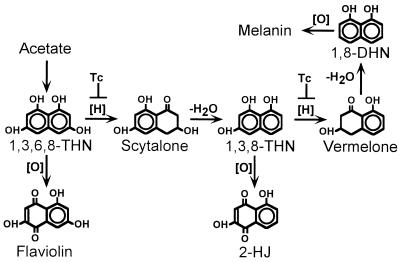
FIG. 1
FIG. 1
Biosynthetic pathway of DHN-melanin in brown and black fungi. [H], a reduction step; [O], an oxidation step; −H2O, a dehydration step; Tc, a reduction step which can be inhibited by the fungicide tricyclazole.
FIG. 2
FIG. 2
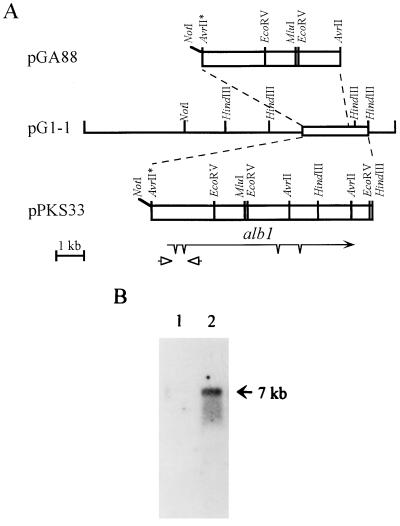
Structure and expression of alb1. (A) Restriction enzyme map and structure of alb1. The asterisk indicates an AvrII site destroyed during cloning. The alb1 transcript is represented by an arrow, and introns are marked with spikes. Arrowheads represent the two oligonucleotides used to amplify cDNA in the RT-PCR. (B) Northern analysis of alb1 expression at different developmental stages. Twelve micrograms of total RNA from strain B-5233 harvested at 0 h (lane 1) or 14 h (lane 2) after induction of conidiation was fractionated on a 1% formaldehyde–agarose gel. The 5-kb AvrII DNA fragment was used as a probe. The size of the hybridizing signal is indicated by an arrow.
FIG. 3
FIG. 3
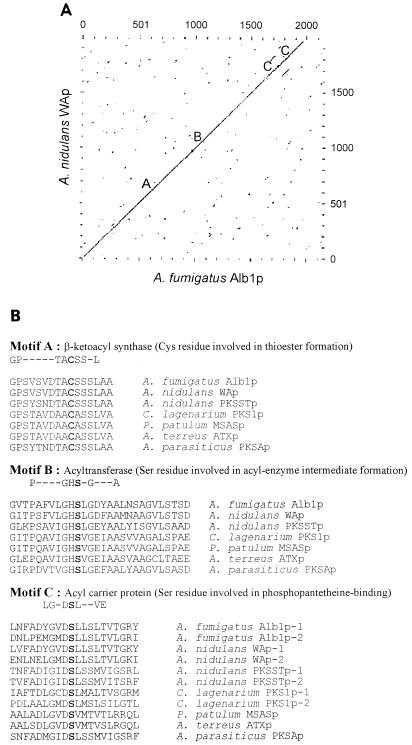
Comparison of Alb1p and other polyketide synthases. (A) Dot plot matrix of Alb1p and the A. nidulans WA protein (WAp) (EMBL accession no. X65866) (29). The locations of the conserved active sites among polyketide synthases are labeled as follows: A, β-ketoacyl synthase; B, acyltransferase; and C, acyl carrier protein. Parameters used for the comparison were a window size of 10 and a stringency of 16. (B) Alignment of Alb1p with active sites of other polyketide synthases. GenBank accession numbers for the corresponding genes are as follows: A. nidulans pksST, L39121 (67); Aspergillus terreus atx, D85860 (12); Aspergillus parasiticus pksA, Z47198 (6); C. lagenarium pks1, D83643 (49); and Penicillium patulum msas, X55776 (4). Conserved active-site residues important for enzyme function are in boldfaced letters, and their functions are indicated.
FIG. 4
FIG. 4
Disruption of alb1 in strain B-5233. (A) Diagram of gene replacement via double-crossover recombination. White boxes represent A. fumigatus DNA; black boxes represent hph genes. The alb1 region deleted during construction of pRGD12 is shown as a hatched box. Arrows aligned with boxes represent transcripts, with spikes indicating introns. Asterisks indicate the destroyer restriction enzyme sites. (B) Southern blot analysis. Total DNA from strain B-5233/RGD12-8 (lane 1) or strain B-5233 (lane 2) was digested with AvrII and fractionated on a 0.8% agarose gel. The membrane was hybridized with the 1.5-kb MluI-AvrII fragment probe (hatched box, panel A) (I) or pRGD12 (II). The sizes of hybridizing signals are indicated by arrows.
FIG. 5
FIG. 5
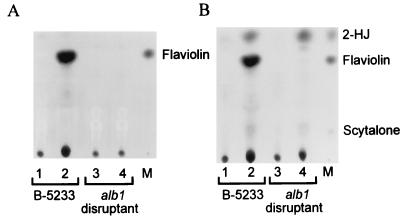
TLC analysis of scytalone metabolism. A. fumigatus was grown on ASA medium without (A) or with (B) scytalone supplementation. The extract samples were obtained from a mixture of mycelia and agar medium by an ethyl acetate extraction procedure. Lanes: 1 and 3, extract samples from cultures without tricyclazole; 2 and 4, extract samples from cultures with tricyclazole; M, standards.
FIG. 6
FIG. 6
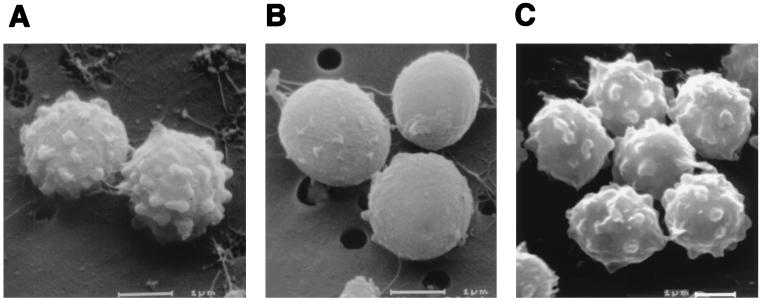
SEM study of conidial surface structure. Conidia were from 7-day-old cultures. (A) B-5233, the wild-type strain; (B) B-5233/RGD12-8, the alb1 gene disruptant; (C) RGD12-8/PKS33-3, the alb1-complemented strain. Bars, 1 μm.
FIG. 7
FIG. 7
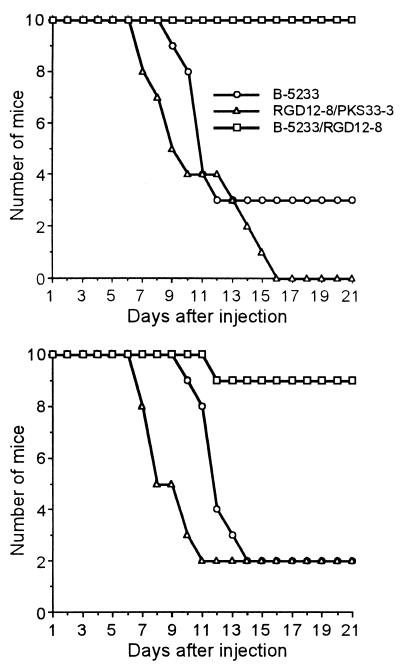
Virulence studies. Each study included 10 mice per strain in two independent experiments. Mice were injected intravenously with 1.5 × 10⁵ conidia. Mouse mortality was monitored daily for 21 days. Strains: B-5233, the wild-type strain; B-5233/RGD12-8, the alb1 disruptant; RGD12-8/PKS33-3, the alb1-complemented strain. P < 0.05 for comparison of the alb1 disruptant to B-5233 or the alb1-complemented strain (Kaplan-Meier analysis).
FIG. 8
FIG. 8
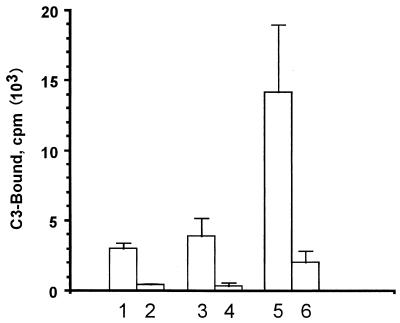
Complement component C3 binding analysis. Strains are as follows: lanes 1 and 2, wild-type strain B-5233; lanes 3 and 4, the alb1-complemented strain, RGD12-8/PKS33-3; and lanes 5 and 6, the alb1 disruptant strain, B-5233/RGD12-8. Lanes 1, 3, and 5 were with 5% fresh serum, while lanes 2, 4, and 6 were with heat-inactivated serum. Data represent means ± standard deviations (n = 4). P < 0.05 by Student’s t test for comparison of the alb1 disruptant to strain B-5233 or the alb1-complemented strain.
FIG. 9
FIG. 9
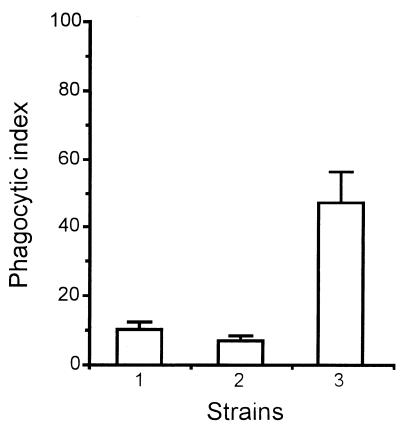
Phagocytosis assay. Strains are as follows: lane 1, wild-type strain B-5233; lane 2, the alb1-complemented strain, RGD12-8/PKS33-3; and lane 3, the alb1 disruptant strain, B-5233/RGD12-8. Data represent phagocytic index means ± standard deviations for three experiments performed in duplicate. P < 0.05 for comparison of the alb1 disruptant to strain B-5233 or the alb1-complemented strain (Student’s t test).

References

    1. Agrios G N. Plant pathology. 4th ed. London, United Kingdom: Academic Press; 1997.
    1. Aramayo R, Timberlake W E. Sequence and molecular structure of the Aspergillus nidulans yA(laccase I) gene. Nucleic Acids Res. 1990;18:3415. - PMC - PubMed
    1. Aufauvre-Brown A, Mellado E, Gow N A R, Holden D W. Aspergillus fumigatus chsE: a gene related to CHS3 of Saccharomyces cerevisiaeand important for hyphal growth and conidiophore development but not pathogenicity. Fungal Genet Biol. 1997;21:141–152. - PubMed
    1. Beck J, Ripka S, Siegner A, Schiltz E, Schweizer E. The multifunctional 6-methylsalicylic acid synthase gene of Penicillium patulum—its gene structure relative to that of other polyketide synthases. Eur J Biochem. 1990;192:487–498. - PubMed
    1. Bell A A, Wheeler M H. Biosynthesis and functions of fungal melanins. Annu Rev Phytopathol. 1986;24:411–451.

Publication types

MeSH terms

Associated data

LinkOut - more resources