


Substitutions in a major histocompatibility complex class II-restricted human immunodeficiency virus type 1 gp120 epitope can affect CD4+ T-helper-cell function
- PMID: 9621044
- PMCID: PMC110386
- DOI: 10.1128/JVI.72.7.5840-5844.1998
Substitutions in a major histocompatibility complex class II-restricted human immunodeficiency virus type 1 gp120 epitope can affect CD4+ T-helper-cell function
Abstract
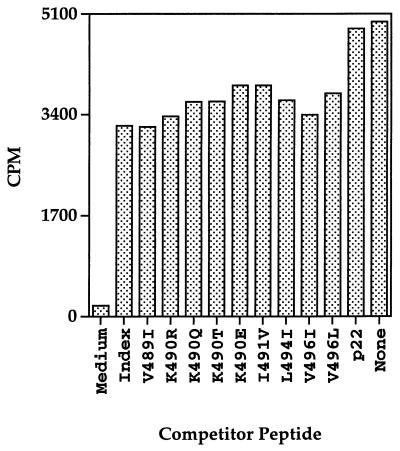
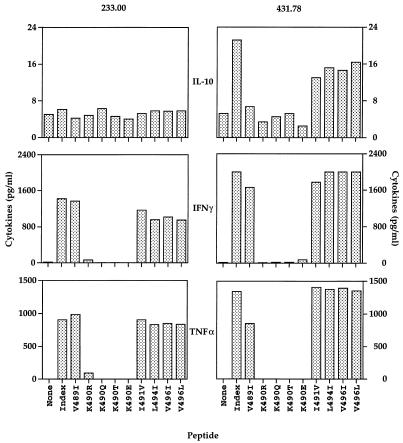
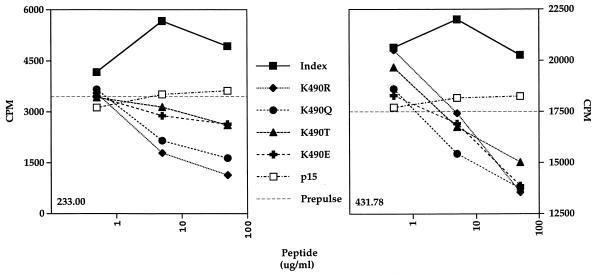
It has been suggested that the inability of the immune response to control human immunodeficiency virus type 1 (HIV-1) replication may be due, at least in part, to the capacity of this virus to escape from immune recognition through mutation. While there is increasing evidence for the importance of HIV-1-specific CD4+ T cells in containing HIV-1 spread in the infected individual, little is known about the consequences of HIV-1 mutation on virus-specific CD() T-cell function. The impact of HIV-1 sequence variation on CD4+ T-helper (Th)- cell function was assessed with a rhesus monkey model for immune recognition of the HIV-1 envelope (Env) glycoprotein. A series of HIV-1 Env(484-496) variant peptides were shown to retain the ability to bind to the appropriate rhesus monkey major histocompatibility complex class II DR molecule. Peptides bearing substitutions at position 490, however, failed to drive the proliferation or cytokine secretion of two well-characterized HXBc2 Env-specific rhesus monkey CD4+ Th-cell lines. Exogenous costimulation was ineffective in complementing the ability of the nonstimulatory peptides to induce [3H]thymidine incorporation by these cells. Finally, HIV-1 Env(484-496) variant peptides with substitutions at position 490 antagonized the HXBc2 Env peptide-induced proliferative response of the CD4+ Th-cell lines. Thus, HIV-1 variants appear to have the capacity to neutralize the function of virus-specific CD4+ T lymphocytes.
Figures
References
-
- Bertoletti A, Sette A, Chisari F V, Penna A, Levrero M, DeCarli M, Fiaccadori F, Ferrari C. Natural variants of cytotoxic epitopes are T-cell receptor antagonists for antiviral cytotoxic T cells. Nature. 1994;369:407–410. - PubMed
-
- Boehncke W-H, Takeshita T, Pendleton C D, Houghton R A, Sadegh-Nasseri S, Racioppi L, Berzofsky J A, Germain R N. The importance of dominant negative effects of amino acid side chain substitutions in peptide-MHC molecule interactions and T cell recognition. J Immunol. 1993;150:331–341. - PubMed
-
- Callahan K M, Fort M M, Obah E A, Reinherz E L, Siliciano R F. Genetic variability in HIV-1 gp120 affects interactions with HLA molecules and T cell receptor. J Immunol. 1990;144:3341–3346. - PubMed
-
- Calman A, Peterlin B. Mutant human B cell lines deficient in class II major histocompatibility complex transcription. J Immunol. 1987;139:2489–2495. - PubMed
-
- Clerici M, Shearer G M. A Th1-to-Th2 switch is a critical step in the etiology of HIV infection. Immunol Today. 1993;14:107–111. - PubMed
Publication types
MeSH terms
Substances
Grants and funding
LinkOut - more resources
Full Text Sources
Research Materials
