. 1998 Jul;72(7):6113-8.
doi: 10.1128/JVI.72.7.6113-6118.1998.

The orphan seven-transmembrane receptor apj supports the entry of primary T-cell-line-tropic and dualtropic human immunodeficiency virus type 1

Affiliations

The orphan seven-transmembrane receptor apj supports the entry of primary T-cell-line-tropic and dualtropic human immunodeficiency virus type 1

H Choe et al. J Virol. 1998 Jul.

Abstract

Human immunodeficiency virus type 1 (HIV-1) enters target cells by sequential binding to CD4 and specific seven-transmembrane-segment (7TMS) coreceptors. Viruses use the chemokine receptor CCR5 as a coreceptor in the early, asymptomatic stages of HIV-1 infection but can adapt to the use of other receptors such as CXCR4 and CCR3 as the infection proceeds. Here we identify one such coreceptor, Apj, which supported the efficient entry of several primary T-cell-line tropic (T-tropic) and dualtropic HIV-1 isolates and the simian immunodeficiency virus SIVmac316. Another 7TMS protein, CCR9, supported the less efficient entry of one primary T-tropic isolate. mRNAs for both receptors were present in phytohemagglutinin- and interleukin-2-activated peripheral blood mononuclear cells. Apj and CCR9 share with other coreceptors for HIV-1 and SIV an N-terminal region rich in aromatic and acidic residues. These results highlight properties common to 7TMS proteins that can function as HIV-1 coreceptors, and they may contribute to an understanding of viral evolution in infected individuals.


Figures
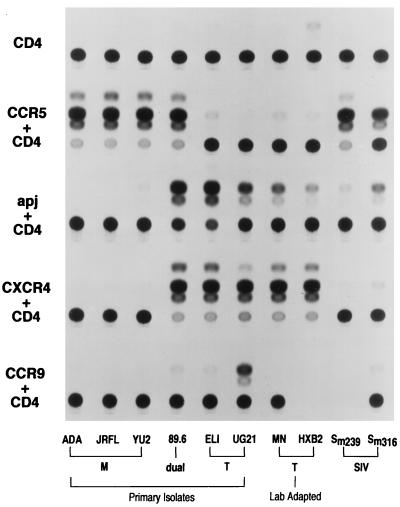
FIG. 1
FIG. 1
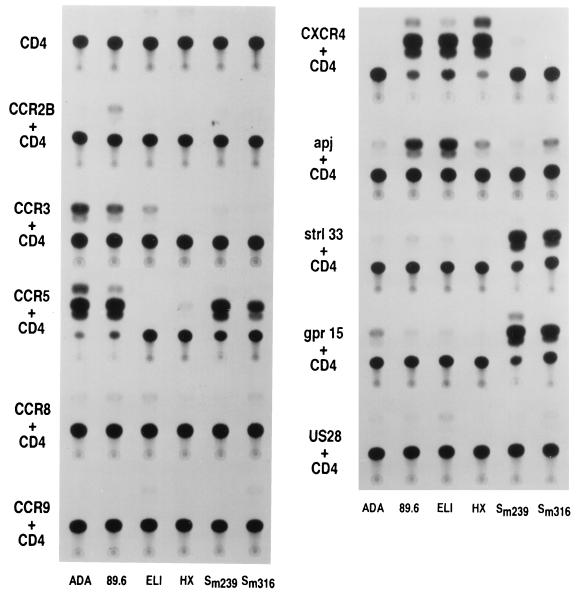
Dualtropic and T-tropic viruses use Apj or CCR9 as coreceptors. Cf2Th-CD4 cells were transfected with either the pcDNA3 vector only or pcDNA3 plasmids encoding CCR5, CXCR4, Apj, or CCR9. The transfected cells were incubated with recombinant CAT-expressing viruses containing the envelope glycoproteins of the M-tropic HIV-1 ADA, JR-FL, or YU2; the dualtropic HIV-1 89.6; the primary T-tropic HIV-1 ELI, or UG21; the laboratory-adapted T-tropic HIV-1 MN or HXBc2; or the SIV isolates SIVmac239 or SIVmac316. Entry was quantitated as the ratio of the acetylated forms of chloramphenicol (upper spots) to the unacetylated form (bottom spot). Samples in which conversion is greater than 60% were diluted 1:10 and reassayed for quantitative comparisons. Entry of viruses pseudotyped with 89.6, ELI, UG21, MN, or HXBc2 envelope glycoproteins into cells expressing Apj was 5.6 ± 0.2, 10.2 ± 0.1, 7.7 ± 0.4, 1.5, and 0.3% ± 0.1%, respectively, of that of the same viruses entering cells expressing CXCR4. The entry of the virus pseudotyped with the envelope glycoproteins of SIVmac316 into cells expressing Apj was 21.9% ± 4.7% of that observed for cells expressing CCR5. Entry of virus pseudotyped with UG21 envelope glycoproteins into cells expressing CCR9 was 6.2% ± 1.9% of that observed for cells expressing CXCR4.
FIG. 2
FIG. 2
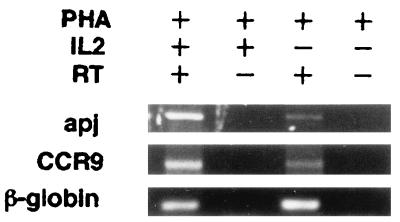
Expression of Apj and CCR9 in PBMC. mRNA was isolated from PBMC activated with PHA (right-hand lanes) or with PHA plus IL-2 (left-hand lanes) and reverse transcribed to cDNA. PCR was performed with primers bounding an approximately 1,100-bp fragment of the Apj or CCR9 gene, or a 200-bp fragment of the β-globin gene control. In the lanes labeled RT−, the PCR was performed with the same reaction mixes used in the other two lanes, but prepared without reverse transcriptase.
FIG. 3
FIG. 3
Comparison of virus entry by using Apj or other reported coreceptors. Cf2Th cells were transfected with a plasmid expressing CD4 and the pcDNA3 vector or plasmid expressing the indicated 7TMS receptor and incubated with recombinant viruses containing the ADA, 89.6, ELI, HXBc2, SIVmac239, or SIVmac316 envelope glycoproteins. CAT expression was analyzed in the target cells as described in Materials and Methods.
FIG. 4
FIG. 4
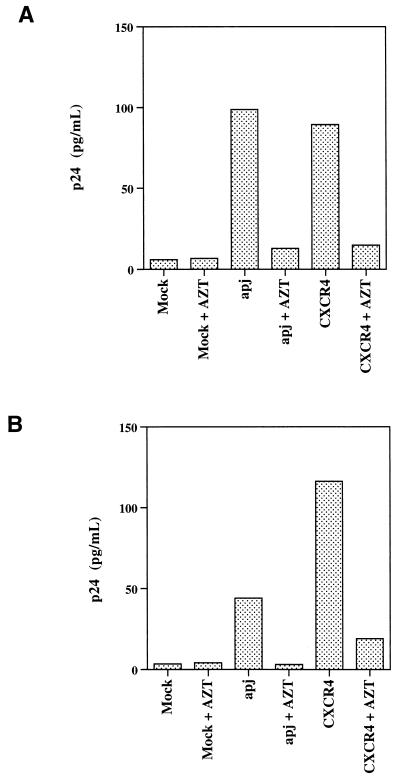
Apj supports the entry of replication-competent viruses. Replication-competent ELI (A) and 89.6 (B) HIV-1 isolates were incubated with Cf2Th cells transfected with CD4 and either a control plasmid or plasmids encoding Apj or CXCR4, in the presence or absence of 50 μM azidothymidine (AZT). The p24 values from 4 days after infection are given in picograms per milliliter, with a 1:5 dilution of cell supernatant.
FIG. 5
FIG. 5
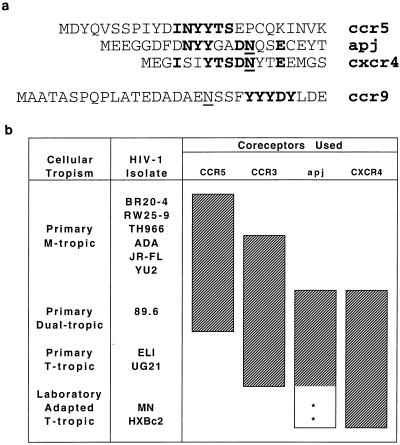
7TMS receptor sequences and coreceptor function. (a) Alignment of CCR5, Apj, and CXCR4 N-terminal sequences. The sequences of the N termini, beginning with the initiator methiones, of CCR5, Apj, and CXCR4 are shown. Tyrosines 10, 14, and 15, aspartic acid 11, asparagine 13, and glutamic acid 18 of CCR5 have been previously demonstrated to be important for M-tropic and dualtropic viral entry by using CCR5 (14). Common residues are shown in boldface type, and possible N-linked glycosylation sites are underlined. Also shown is the N terminus of CCR9, with a tyrosine-rich region indicated in bold. (B) Summary of the coreceptor usage of various HIV-1 isolates. The ability of various HIV-1 isolates to enter Cf2Th cells expressing CD4 and each of the four coreceptors shown to be most efficient in this study is indicated by shaded bars. Stars indicate relatively inefficient entry of laboratory-adapted T-tropic viruses into cells expressing the Apj receptor.

References

    1. Alkhatib G, Combadiere C, Broder C C, Feng Y, Kennedy P E, Murphy P M, Berger E A. CC CKR5: a RANTES, MIP-1alpha, MIP-1beta receptor as a fusion cofactor for macrophage-tropic HIV-1. Science. 1996;272:1955–1958. - PubMed
    1. Alkhatib G, Liao F, Berger E A, Farber J M, Peden K W. A new SIV co-receptor, STRL33. Nature. 1997;388:238. . (Letter.) - PubMed
    1. Barre-Sinoussi F, Chermann J C, Rey F, Nugeyre M T, Chamaret S, Gruest J, Dauguet C, Axler-Blin C, Vezinet-Brun F, Rouzioux C, Rozenbaum W, Montagnier L. Isolation of a T-lymphotropic retrovirus from a patient at risk for acquired immune deficiency syndrome (AIDS) Science. 1983;220:868–871. - PubMed
    1. Brand D, Srinivasan K, Sodroski J. Determinants of human immunodeficiency virus type 1 entry in the CDR2 loop of the CD4 glycoprotein. J Virol. 1995;69:166–171. - PMC - PubMed
    1. Choe H, Farzan M, Sun Y, Sullivan N, Rollins B, Ponath P D, Wu L, Mackay C R, LaRosa G, Newman W, Gerard N, Gerard C, Sodroski J. The beta-chemokine receptors CCR3 and CCR5 facilitate infection by primary HIV-1 isolates. Cell. 1996;85:1135–1148. - PubMed

Publication types