Comparative Study
. 1998 Jun;117(2):465-72.
doi: 10.1104/pp.117.2.465.

Coordinate accumulation of antifungal proteins and hexoses constitutes a developmentally controlled defense response during fruit ripening in grape

Affiliations
Comparative Study

Coordinate accumulation of antifungal proteins and hexoses constitutes a developmentally controlled defense response during fruit ripening in grape

R A Salzman et al. Plant Physiol. 1998 Jun.

Abstract

During ripening of grape (Vitis labruscana L. cv Concord) berries, abundance of several proteins increased, coordinately with hexoses, to the extent that these became the predominant proteins in the ovary. These proteins have been identified by N-terminal amino acid-sequence analysis and/or function to be a thaumatin-like protein (grape osmotin), a lipid-transfer protein, and a basic and an acidic chitinase. The basic chitinase and grape osmotin exhibited activities against the principal grape fungal pathogens Guignardia bidwellii and Botrytis cinerea based on in vitro growth assays. The growth-inhibiting activity of the antifungal proteins was substantial at levels comparable to those that accumulate in the ripening fruit, and these activities were enhanced by as much as 70% in the presence of 1 m glucose, a physiological hexose concentration in berries. The simultaneous accumulation of the antifungal proteins and sugars during berry ripening was correlated with the characteristic development of pathogen resistance that occurs in fruits during ripening. Taken together, accumulation of these proteins, in combination with sugars, appears to constitute a novel, developmentally regulated defense mechanism against phytopathogens in the maturing fruit.


Figures
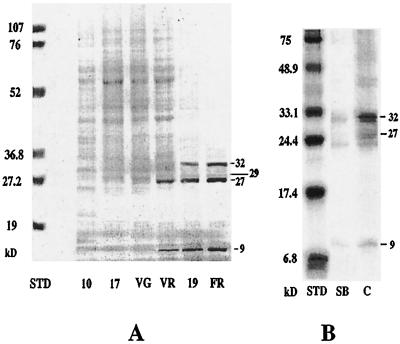
Figure 1
Figure 1
Pattern of protein accumulation in grape berries during ripening. A, Total protein accumulation profile in cv Concord. Total protein from fresh berries was extracted, separated by SDS-PAGE (15% gel), and visualized after staining with Coomassie blue R. Each lane was loaded with 25 μL of total protein extract. Proteins with molecular masses of 32, 29, 27, and 9 kD were detected at the onset of ripening. Molecular mass standards (STD) are indicated on the left. 10, Green berry, 10 mm in diameter; 17, green berry, 17 mm in diameter; VG, preveraison berry (green); VR, postveraison berry (red); 19, mid-ripe-stage berry, 19 mm in diameter; and FR, fully ripe berry. B, Comparison of total protein profiles of B. cinerea-resistant versus -sensitive grape genotypes. Total protein extracts were prepared from equal fresh weights of berries of the hybrid cv SV 5276, Seyval Blanc (sensitive), and of cv Concord (resistant), respectively, at the same ripening stage (fully ripe, equivalent to 1.8 m Glc). Equal volumes of the two extracts were separated by SDS-PAGE and stained as described above. SB, cv Seyval Blanc; C, cv Concord.
Figure 2
Figure 2
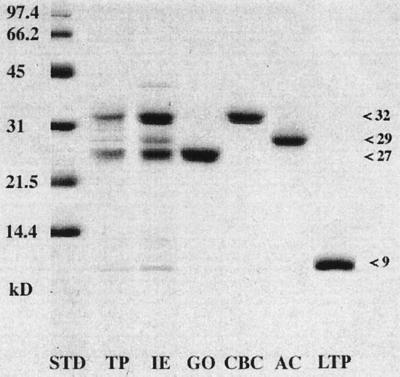
Purification of proteins that accumulate in grape berries during ripening. Proteins extracted from berries at the fully ripe stage were fractionated and separated by SDS-PAGE. Molecular mass standards (STD) are indicated on the left. TP, Total fruit protein extract from clarified juice; and IE, high-pH eluate from CG 50 cation-exchange chromatography of total juice proteins. Remaining proteins were purified from IE by cation-exchange HPLC on S-300 columns: GO, purified GO; CBC, purified CBC; AC, purified AC; and LTP, purified LTP.
Figure 3
Figure 3
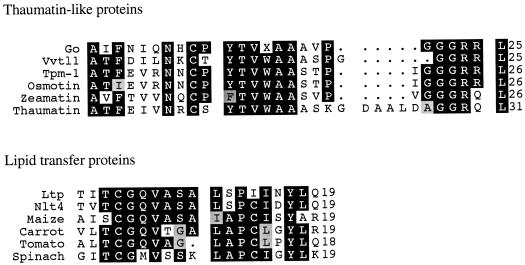
N-terminal amino acid sequence comparison identifies GO and LTP. GO had high sequence homology with thaumatin-like proteins: V. vinifera (Vvtl1) (GenBank [G] accession no. AF003007), tomato (Tpm-1) (SwissProt [SP] accession no. Q01591), osmotin (SP accession no. P14170), zeamatin (SP accession no. P33679), and thaumatin (SP accession no. P02883). The grape LTP had high sequence homology with LTPs from: Vitis sp. NLT4 (SP accession no. P80274), maize (SP accession no. P19656), carrot (SP accession no. P27631), tomato (SP accession no. P27056), and spinach (SP accession no. P10976). X represents unidentified amino acid residues and dots indicate gaps in the sequence comparisons. Shaded areas are consensus regions among proteins in each respective group; identical amino acids are darkly shaded and similar amino acids are lightly shaded.
Figure 4
Figure 4
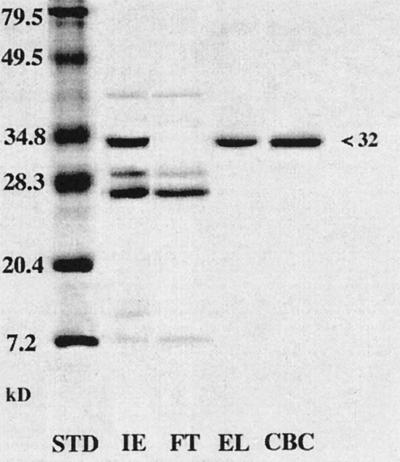
Ripe grape berries accumulate abundant quantities of CBC. Proteins from different fractions of colloidal chitin chromatography were separated by SDS-PAGE (15% gel) and stained with Coomassie blue R. Molecular mass standards (STD) are indicated on the left. Fractions are as follows: IE, high-pH eluate from CG 50 cation-exchange chromatography of clarified juice; FT, flow-through during column loading; EL, high-pH eluate (chitin-binding proteins); and CBC, CBC purified by HPLC.
Figure 5
Figure 5
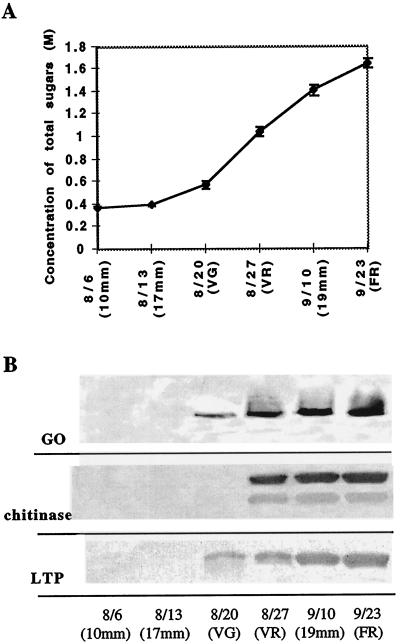
Antifungal proteins coordinately accumulate with sugars during grape berry ripening. A, Sugar accumulation during ripening. Grape berry sugar concentration was measured by refractometry, and effective molarity of total sugars was derived from a Glc standard curve. Values are means ± se from five samples of two berries each. B, Abundance of GO, CBC, AC, and LTP during ripening. Shown are immunoblots of total protein (15 μL loaded per lane from an equivalent fresh weight) of ripening berries. Proteins were separated by SDS-PAGE (15% gel) and reacted with tobacco anti-osmotin (Singh et al., 1985) (GO), tobacco anti-chitinase (Yun et al., 1996) (chitinase), or grape LTP antibodies (LTP). Harvest dates are indicated as day/month 10mm, Green berry, 10 mm in diameter; 17mm, green berry, 17 mm in diameter; VG, preveraison berry (green); VR, postveraison berry (red); 19mm, mid-ripe-stage berry, 19 mm in diameter; and FR, fully ripe berry.
Figure 6
Figure 6
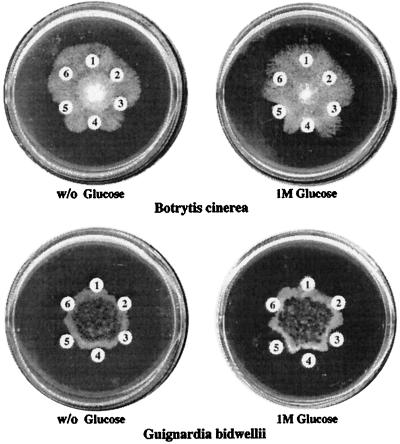
Hyphal growth inhibition of G. bidwellii and B. cinerea by GO and CBC is enhanced by Glc, although the sugar does not have antifungal activity. Hyphal plugs were inoculated onto medium without (w/o) or with 1 m Glc. After the fungal colony diameter had reached 1.5 cm, filter paper discs were placed onto medium around the edges of the colony containing: 1, water (no protein added); 2, boiled GO and CBC (100 μg each); 3, GO (100 μg); 4, CBC (100 μg); 5, GO and CBC (50 μg each); and 6, LTP (100 μg).
Figure 7
Figure 7
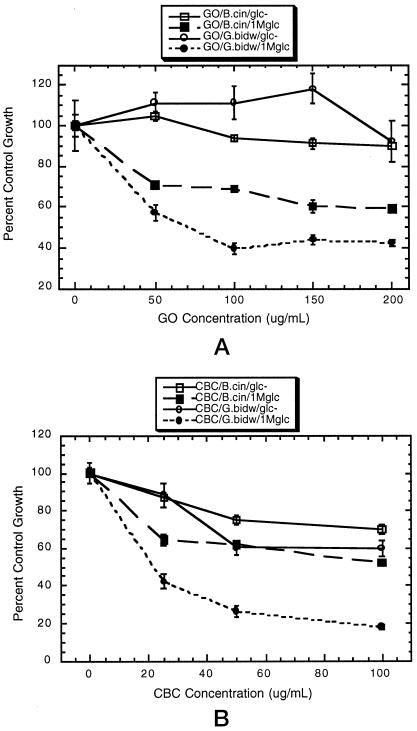
GO and CBC antifungal activities are facilitated by Glc. Hyphal growth of G. bidwellii (G.bidw) and B. cinerea (B.cin) was measured at time intervals on medium containing GO or CBC without (glc−) or with 1 m Glc (1Mglc). Values represent mean growth as a percentage of the control ± se, n = 6. Controls consisted of glc− or 1Mglc medium with boiled, denatured protein at the highest concentration. A, GO. B, CBC.

References

    1. Abad L, D'Urzo M, Liu D, Narasimhan M, Reuveni M, Zhu J, Niu X, Singh N, Hasegawa P, Bressan R. Antifungal activity of tobacco osmotin has specificity and involves plasma membrane permeabilization. Plant Sci. 1996;118:11–23.
    1. Arakawa T, Timasheff SN. Stabilization of protein structure by sugars. Biochemistry. 1982;21:6536–6544. - PubMed
    1. Cheng C, Acedo GN, Cristinsin M, Conkling MA. Sucrose mimics the light induction of Arabidopsis nitrate reductase gene transcription. Proc Natl Acad Sci USA. 1992;89:1861–1864. - PMC - PubMed
    1. Coutos-Thevenot P, Jouenne T, Maes O, Guerbette F, Grosbois M, La Caer JP, Boulay M, Deloire A, Kader JC, Guern J. Four 9-kDa proteins excreted by somatic embryos of grapevine are isoforms of lipid-transfer proteins. Eur J Biochem. 1993;217:885–889. - PubMed
    1. Delp C. Effect of temperature and humidity on the grape powdery mildew fungus. Phytopathology. 1954;44:615–626.

Publication types

MeSH terms

LinkOut - more resources