


Stepwise photoinhibition of photosystem II. Studies with Synechocystis species PCC 6803 mutants with a modified D-E loop of the reaction center polypeptide D1
- PMID: 9625701
- PMCID: PMC34968
- DOI: 10.1104/pp.117.2.483
Stepwise photoinhibition of photosystem II. Studies with Synechocystis species PCC 6803 mutants with a modified D-E loop of the reaction center polypeptide D1
Abstract
Several mutant strains of Synechocystis sp. PCC 6803 with large deletions in the D-E loop of the photosystem II (PSII) reaction center polypeptide D1 were subjected to high light to investigate the role of this hydrophilic loop in the photoinhibition cascade of PSII. The tolerance of PSII to photoinhibition in the autotrophic mutant DeltaR225-F239 (PD), when oxygen evolution was monitored with 2,6-dichloro-p-benzoquinone and the equal susceptibility compared with control when monitored with bicarbonate, suggested an inactivation of the QB-binding niche as the first event in the photoinhibition cascade in vivo. This step in PD was largely reversible at low light without the need for protein synthesis. Only the next event, inactivation of QA reduction, was irreversible and gave a signal for D1 polypeptide degradation. The heterotrophic deletion mutants DeltaG240-V249 and DeltaR225-V249 had severely modified QB pockets, yet exhibited high rates of 2,6-dichloro-p-benzoquinone-mediated oxygen evolution and less tolerance to photoinhibition than PD. Moreover, the protein-synthesis-dependent recovery of PSII from photoinhibition was impaired in the DeltaG240-V249 and DeltaR225-V249 mutants because of the effects of the mutations on the expression of the psbA-2 gene. No specific sequences in the D-E loop were found to be essential for high rates of D1 polypeptide degradation.
Figures
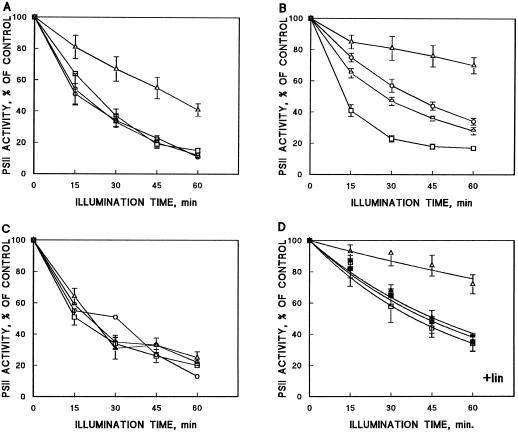
 ) of Synechocystis sp. PCC 6803. Results are the
means of three to five independent experiments from different cell
cultures, and are expressed as a percentage of oxygen-evolution
activity measured before the high-light treatment. Bars denote
) of Synechocystis sp. PCC 6803. Results are the
means of three to five independent experiments from different cell
cultures, and are expressed as a percentage of oxygen-evolution
activity measured before the high-light treatment. Bars denote
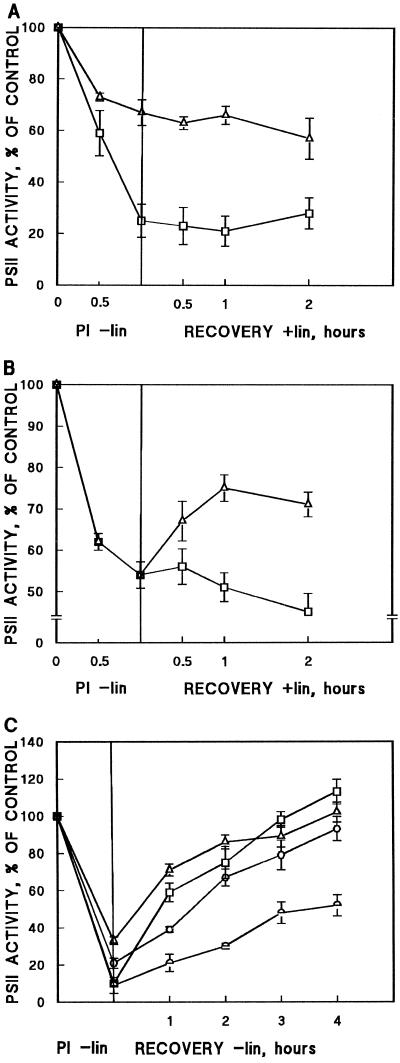 ) strains were illuminated at 1500 μmol
photons m−2 s−1 for 60 min (PI), and the
restoration of DCBQ-dependent oxygen evolution was followed at 40
μmol photons m−2 s−1. All treatments were
performed in the absence of lincomycin.
) strains were illuminated at 1500 μmol
photons m−2 s−1 for 60 min (PI), and the
restoration of DCBQ-dependent oxygen evolution was followed at 40
μmol photons m−2 s−1. All treatments were
performed in the absence of lincomycin.
References
-
- Aro E-M, Hundal T, Carlberg I, Andersson B. In vitro studies on light-induced inhibition of Photosystem II and D1-protein degradation at low temperatures. Biochim Biophys Acta. 1990;1019:269–275.
-
- Aro E-M, Virgin I, Andersson B. Photoinhibition of photosystem II: inactivation, protein damage and turnover. Biochim Biophys Acta. 1993;1143:113–134. - PubMed
-
- Blubaugh DJ, Cheniae GM. Kinetics of photoinhibition in hydroxylamine-extracted photosystem II membranes: relevance to photoactivation and sites of electron donation. Biochemistry. 1990;29:5109–5118. - PubMed
Publication types
MeSH terms
Substances
LinkOut - more resources
Full Text Sources
