


Importance of basolateral K+ conductance in maintaining Cl- secretion in murine nasal and colonic epithelia
- PMID: 9625880
- PMCID: PMC2231036
- DOI: 10.1111/j.1469-7793.1998.237bz.x
Importance of basolateral K+ conductance in maintaining Cl- secretion in murine nasal and colonic epithelia
Abstract
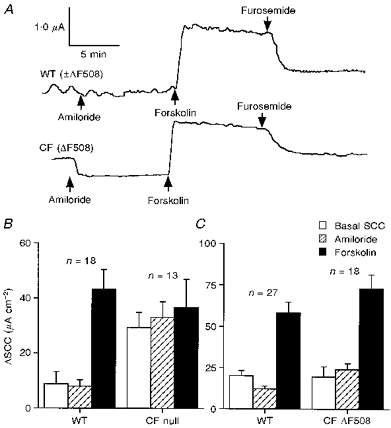
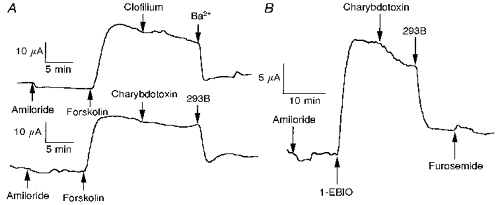
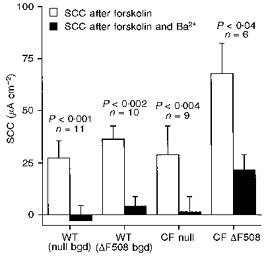
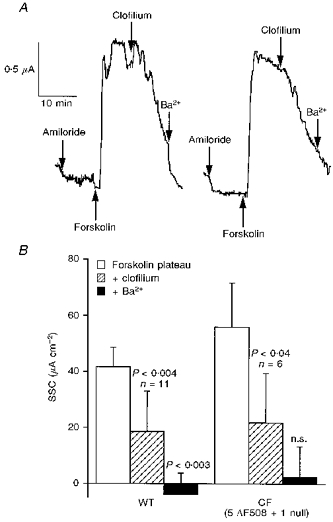
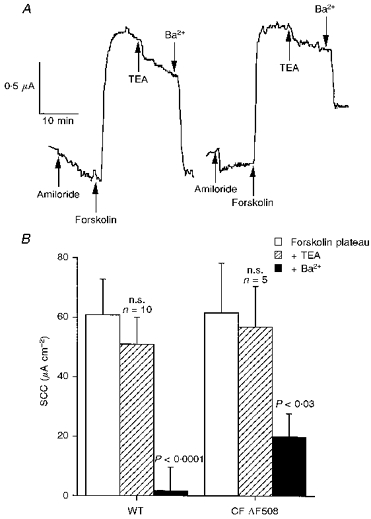
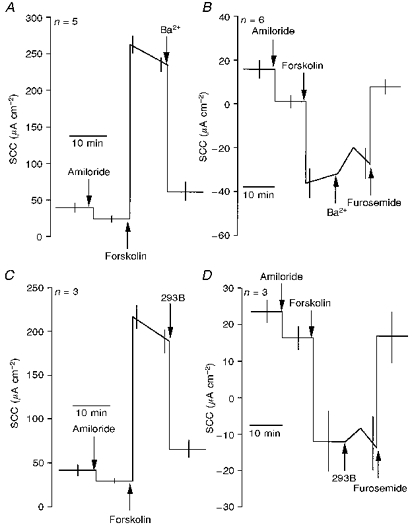
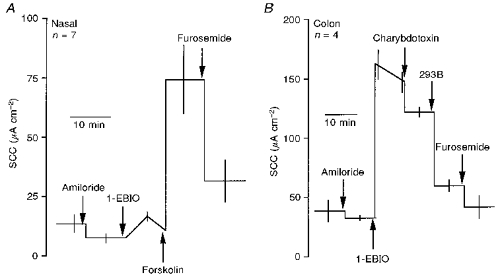
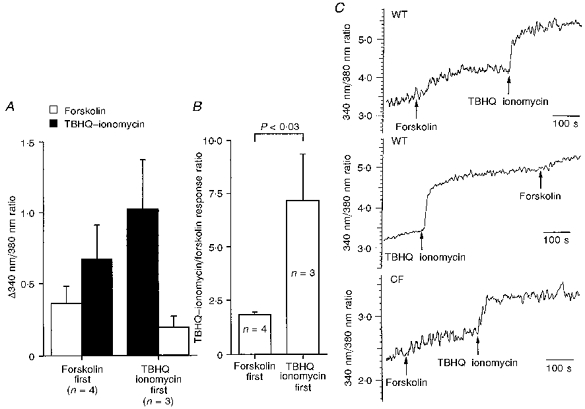
1. Epithelia lining the nasal passages and descending colon of wild-type and cystic fibrosis (CF) mice were examined by the short-circuit current technique. Additionally, intracellular Ca2+ ion determinations were made in nasal epithelial cells. Forskolin produced anion secretory currents in wild-type and CF nasal epithelia. It produced similar effects in wild-type colonic epithelia, but not in colonic epithelia from CF mice. 2. After electrogenic Na+ transport was blocked with amiloride and electrogenic Cl- secretion was stimulated with forskolin, the ability of K+ channel blockers to inhibit the forskolin-induced Cl- current was determined. The order of efficiency for nasal epithelium was: Ba2+ > clofilium >>> TEA = azimilide >>> trans-6-cyano-4-(N-ethylsulphonyl-N-methylamino)-3-hydroxy-2, 2-dimethyl-chromane (293B) = charybdotoxin, whereas for the colonic epithelium the order was: Ba2+ = 293B >>> azimilide = TEA >>> clofilium = charybdotoxin. 3. 1-Ethyl-2-benzimdazolinone (1-EBIO) was able to generate large Cl--secretory currents in colonic epithelia which were partially sensitive to charybdotoxin, with the remaining current being inhibited by 293B. In nasal epithelia 1-EBIO produced only a small transient effect on current. 4. Forskolin released intracellular Ca2+ in nasal epithelial cells; this activity was attenuated when more powerful Ca2+-releasing agents were applied first. 5. It is concluded that an action on basolateral cAMP-sensitive K+ channels is an important determinant of the maintained responses to forskolin in nasal and colonic epithelia, in addition to the effects on the cystic fibrosis transmembrane conductance regulator (CFTR) in the apical membrane. In CF nasal epithelia the activation of calcium-activated chloride channels (CACs) substitutes for the effect on CFTR. On the basis of the different orders of potency of the blocking agents and the differential response to 1-EBIO it is concluded that the cAMP-sensitive K+ channels are different in the airways and the gut.
Figures
References
-
- Barhanin J, Lesage F, Guillemare E, Fink M, Lazdunski M, Romey G. KVLQT1 and IsK (minK) proteins associate to form the IKs cardiac potassium current. Nature. 1996;384:78–80. - PubMed
-
- Bleich M, Briel M, Busch AE, Lang HJ, Gerlach U, Gogelein H, Greger R, Kunzelmann K. KVLQT1 channels are inhibited by the K+ channel blocker 293B. Pflügers Archiv. 1997;434:499–501. - PubMed
-
- Boat TF, Welsh MJ, Beaudet AL. In: The Metabolic Basis of Inherited Disease. Scriver CR, Beaudet AL, Sly WS, Valle D, Stansbury JB, Wyngaarden JB, Fredrickson DS, editors. New York: McGraw-Hill; 1989. pp. 2649–2680.
-
- Busch AE, Herzer T, Takumi T, Krippeit-Drews P, Waldegger S, Lang F. Blockade of human IsK channels expressed in Xenopus oocytes by the novel class III antiarrhythmic NE-10064. European Journal of Pharmacology. 1994;264:33–37. - PubMed
-
- Cheng SH, Gregory RJ, Marshall J, Paul S, Souza DW, White GA, O'Riordan CR, Smith AE. Defective intracellular transport and processing of CFTR is the molecular basis of most cystic fibrosis. Cell. 1990;63:827–834. - PubMed
Publication types
MeSH terms
Substances
Grants and funding
LinkOut - more resources
Full Text Sources
Medical
Miscellaneous
