. 1998 Jul;18(7):3900-6.
doi: 10.1128/MCB.18.7.3900.

Alternative splicing of the fibronectin EIIIB exon depends on specific TGCATG repeats

Affiliations

Alternative splicing of the fibronectin EIIIB exon depends on specific TGCATG repeats

L P Lim et al. Mol Cell Biol. 1998 Jul.

Abstract

The fibronectin EIIIB exon is alternatively spliced in a cell-type-specific manner, and TGCATG repeats in the intron downstream of EIIIB have been implicated in this regulation. Analysis of the intron sequence from several vertebrates shows that the pattern of repeats in the 3' half of the intron is evolutionarily conserved. Point mutations in certain highly conserved repeats greatly reduce EIIIB inclusion, suggesting that a multicomponent complex may recognize the repeats. Expression of the SR protein SRp40, SRp20, or ASF/SF2 stimulates EIIIB inclusion. Studies of the interplay between mutations in the repeats and SRp40-stimulated inclusion suggest that the repeats are recognized in many, if not all, cell types, and that EIIIB inclusion may be regulated by quantitative changes in multiple factors.


Figures
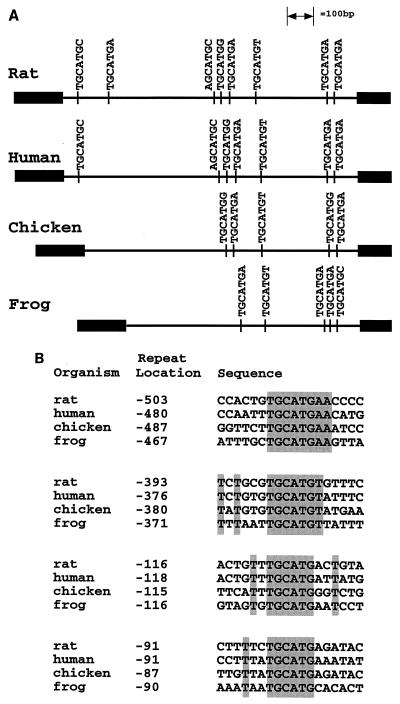
FIG. 1
FIG. 1
Conservation of TGCATG repeats among four vertebrates. (A) Diagram of all occurrences of the sequence NGCATGN in the intron following EIIIB for rat, human, chicken, and frog genes. The human intron sequence was obtained from GenBank accession no. X07717. The positions of the repeats are drawn to scale, with the EIIIB exon at the left. (B) Alignment of the four repeats most conserved in position. From the top, these correspond to the fifth, sixth, seventh, and eighth repeats of the rat intron. Locations are given as the number of nucleotides (inclusive) between the first T of the TGCATG sequence and the 3′ splice site.
FIG. 2
FIG. 2
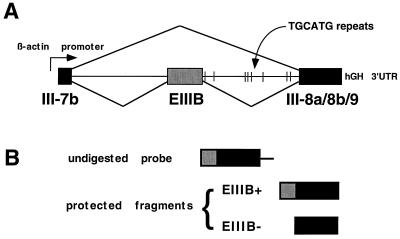
Minigene and RNase protection probe. (A) Schematic of the fibronectin EIIIB minigene described in detail in reference . hGH, human growth hormone; 3′UTR, 3′ untranslated region. (B) Illustration of RNase protection probe used in quantifying EIIIB inclusion. The transcribed probe was uniformly labeled and was complementary to III-8a/8b/9 and to 150 bases of EIIIB.
FIG. 3
FIG. 3
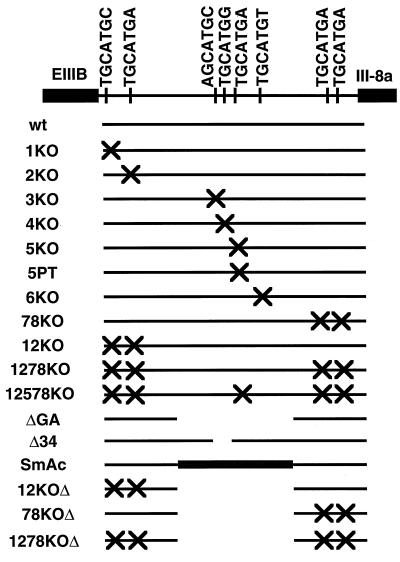
Schematic of mutations tested. The intron downstream of EIIIB is shown. An “X” corresponds to the mutation of a GCATG to a GACTG, with the exception of plasmid 5PT, in which GCATG was converted to ACATG. ΔGA is a 495-bp deletion. SmAc has an insertion of about 500 bp from the intron following exon III-9 into ΔGA. Both ΔGA and SmAc are described in reference . Δ34 replaces a 40-bp region containing repeats 3 and 4 with an MluI site.
FIG. 4
FIG. 4
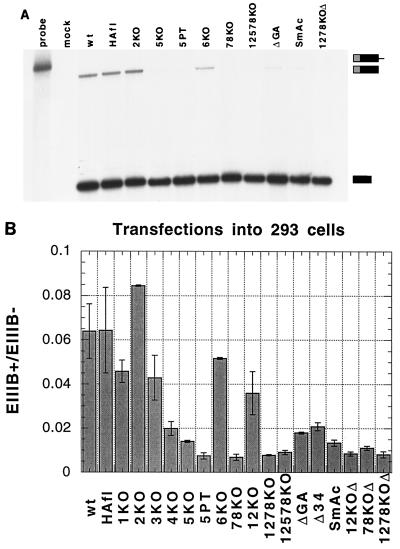
Mutational analysis of repeats in 293 cell transient transfections. (A) RNase protection analysis. Locations of undigested probe and protected fragments are indicated on the right. Lane 1, undigested probe; lane 2, mock-transfected 293 cells; lanes 3 to 13, transfections with indicated constructs. HAfl is a control showing that modifications of the BglII and AflII sites, which were used in constructing the mutants, had no effect on inclusion. (B) Quantitation of RNase protections. Means and standard deviations for two to three separate transfections are given.
FIG. 5
FIG. 5
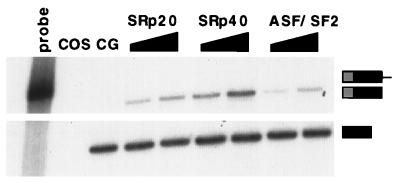
Stimulation of EIIIB inclusion in COS by cotransfection with plasmids encoding SR proteins. RNase protection assays were performed as for Fig. 4A. Lane 1, undigested probe; lane 2, untransfected COS; lane 3, wt minigene cotransfected with empty expression vector CG; lanes 4 to 9, wt minigene cotransfected with 2 or 4 μg of plasmid expressing the indicated cDNA.
FIG. 6
FIG. 6
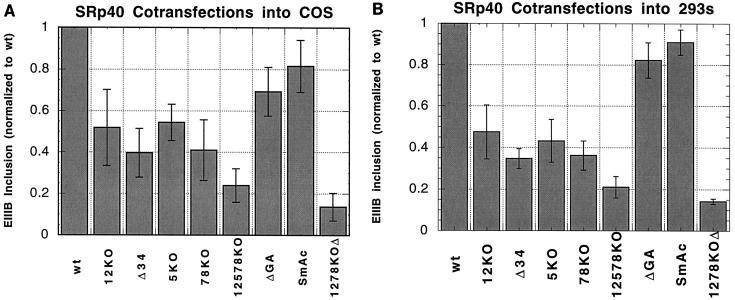
Mutational analysis of repeats in COS and 293 cells cotransfected with an SRp40 vector. (A) COS cells. Indicated minigenes were cotransfected with 2 μg of SRp40-expressing plasmid and analyzed by RNase protection. Due to substantial day-to-day fluctuations in the absolute amount of stimulation by cotransfection, the inclusion levels of each set of transfections were normalized to that of the wt minigene from that set. Means and standard deviations for two to six sets of transfection are given. The average EIIIB+/EIIIB ratio of the wt minigene in these experiments was 0.13. (B) 293 cells. The indicated minigenes were cotransfected with 1 μg of SRp40 expressing plasmid and analyzed by RNase protection. For comparison with COS cells, inclusion levels are again normalized to that of the wt minigene. Means and standard deviations for two experiments are given. The average EIIIB+/EIIIB ratio of the wt minigene in these experiments was 0.59 ± 0.05.
FIG. 7
FIG. 7
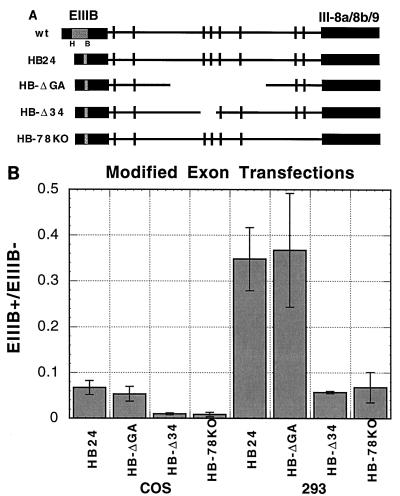
Mutational analysis of repeats in COS and 293 cells after modification of EIIIB. (A) The relevant parts of the plasmids constructed are diagrammed. HB24 deleted the HB region in EIIIB and replaced it with a 24-bp polylinker. This exonic mutation was combined with ΔGA, Δ34, and 78KO, as shown. (B) The indicated minigenes were transfected into either COS or 293 cells and analyzed by RNase protection. Means and standard deviations for two experiments are given.

References

    1. Ayane M, Preuss U, Kohler G, Nielsen P. A differentially expressed murine RNA encoding a protein with similarities to two types of nucleic acid binding motifs. Nucleic Acids Res. 1991;19:1273–1278. - PMC - PubMed
    1. Barone M, Henchcliffe C, Baralle F, Paolella G. Cell type specific trans-acting factors are involved in alternative splicing of human fibronectin pre-mRNA. EMBO J. 1989;8:1079–1085. - PMC - PubMed
    1. Black, D. Personal communication.
    1. Caceres J, Stamm S, Helfman D, Krainer A. Regulation of alternative splicing in vivo by overexpression of antagonistic splicing factors. Science. 1994;265:1706–1709. - PubMed
    1. Caputi M, Casari G, Guenzi S, Tagliabue R, Sidoli A, Melo C, Baralle F. A novel bipartite splicing enhancer modulates the differential processing of the human fibronectin EDA exon. Nucleic Acids Res. 1994;22:1018–1022. - PMC - PubMed

Publication types

Associated data