. 1998 Jun 23;95(13):7379-84.
doi: 10.1073/pnas.95.13.7379.

Promotion of agonist activity of antiandrogens by the androgen receptor coactivator, ARA70, in human prostate cancer DU145 cells

Affiliations

Promotion of agonist activity of antiandrogens by the androgen receptor coactivator, ARA70, in human prostate cancer DU145 cells

H Miyamoto et al. Proc Natl Acad Sci U S A. .

Abstract

Although hormone therapy with antiandrogens has been widely used for the treatment of prostate cancer, some antiandrogens may act as androgen receptor (AR) agonists that may result in antiandrogen withdrawal syndrome. The molecular mechanism of this agonist response, however, remains unclear. Using mammalian two-hybrid assay, we report that antiandrogens, hydroxyflutamide, bicalutamide (casodex), cyproterone acetate, and RU58841, and other compounds such as genistein and RU486, can promote the interaction between AR and its coactivator, ARA70, in a dose-dependent manner. The chloramphenicol acetyltransferase assay further demonstrates that these antiandrogens and related compounds significantly enhance the AR transcriptional activity by cotransfection of AR and ARA70 in a 1:3 ratio into human prostate cancer DU145 cells. Our results suggest that the agonist activity of antiandrogens might occur with the proper interaction of AR and ARA70 in DU145 cells. These findings may provide a good model to develop better antiandrogens without agonist activity.


Figures
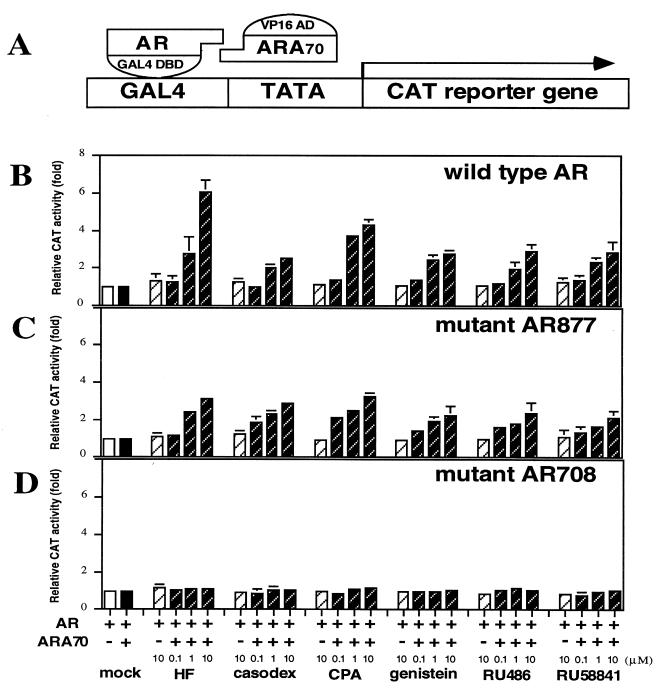
Figure 1
Figure 1
Demonstration of a physical interaction between AR and ARA70 by mammalian two-hybrid assay in DU145 cells. (A) Schematic representation of the mammalian two-hybrid system. (B–D) ARA70 interacts with ARs in the presence of antiandrogens. CAT activity was determined in DU145 cells cotransfected with pGAL0–wild-type AR (B), pGAL0–mAR877 (C), or pGAL0–mAR708 (D), pVP16–ARA70, and pG5CAT reporter gene. After transfection, 0.1, 1, or 10 μM of various antiandrogens and related compounds were added. CAT activity with the mock treatment was set as 1-fold. Values are the means (±SD) of at least three determinations.
Figure 2
Figure 2
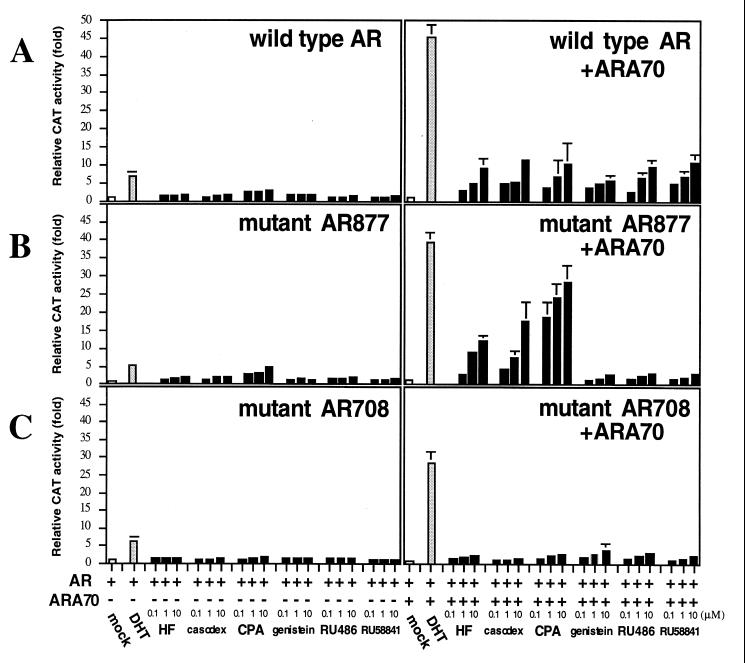
Transcriptional activity of the wild-type and mutant ARs in the presence of antiandrogens. CAT activity was determined in DU145 cells cotransfected with 3.5 μg of reporter plasmid MMTV–CAT and 1.5 μg of AR expression plasmids wild-type (A), mAR877 (B), or mAR708 (C) with or without 4.5 μg of ARA70. After transfection, cells were incubated without hormones (mock) or with 1 nM DHT or 0.1, 1, or 10 μM of various antiandrogens and related compounds for 24 h. The mock treatment was set as 1-fold. Values are the means (±SD) of at least three determinations.
Figure 3
Figure 3
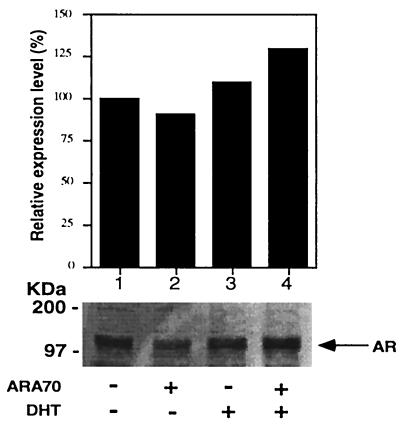
Western immunoblot analysis. Cell extracts from DU145 cells cotransfected with pSG5–wild-type AR with or without pSG5–ARA70 were analyzed on Western blots using a polyclonal antibody NH27 to the AR. The 110 kDa of protein was detected and quantitated. The expression level in lane 1 (mock treatment without cotransfection of ARA70) was set as 100%.
Figure 4
Figure 4
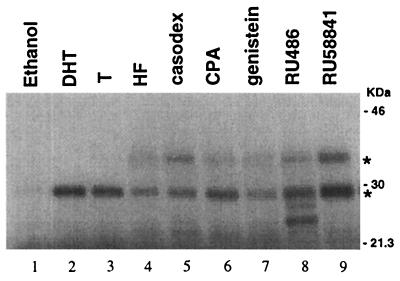
Androgen- and antiandrogen-specific conformational changes. In vitro translated AR was incubated with 10 nM DHT (lane 2), 100 nM testosterone (lane 3), various antiandrogens and related compounds (10 μM HF, 10 μM casodex, 1 μM CPA, 1 μM genistein, 1 μM RU486, and 1 μM RU58841, lanes 4 to 9), or 0.01% (vol/vol) ethanol (lane 1) for 30 min at room temperature prior to limited proteolytic digestion with trypsin. Digestion products were analyzed by electrophoresis on 12.5% SDS-polyacrylamide gels and visualized by autoradiography. Trypsin-resistant bands are indicated by asterisks. Molecular mass markers are indicated at the right.
Figure 5
Figure 5
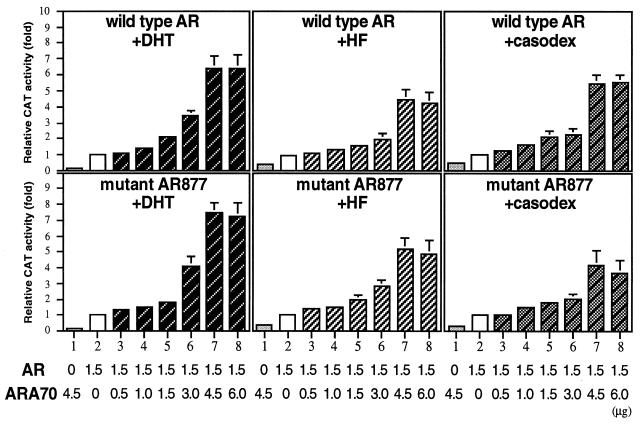
Effects of different AR:ARA70 ratios. Increasing amounts of pSG5-ARA70 (0.5, 1.0, 1.5, 3.0, 4.5, and 6.0 μg) were cotransfected with 1.5 μg of AR (wild-type AR or mAR877) in DU145 cells in the presence of 1 nM DHT, 1 μM HF, or 1 μM casodex. CAT activity was represented as fold increase over the base line seen in each lane 2. Values represent the means (±SD) of at least three determinations.

References

    1. Chang C, Kokontis J, Liao S T. Science. 1988;240:324–326. - PubMed
    1. Evans R M. Science. 1988;240:889–895. - PMC - PubMed
    1. Landis S H, Murray T, Bolden S, Wingo P A. Ca Cancer J Clin. 1998;48:6–29. - PubMed
    1. Huggins C, Hodges C V. Cancer Res. 1941;1:293–297.
    1. Crawford E D, Eisenberger M A, McLeod D G, Spaulding J-T, Benson R, Dorr F A, Blumenstein B A, Davis M A, Goodman P J. N Engl J Med. 1989;321:419–424. - PubMed

Publication types

MeSH terms