. 1998 Jun 23;95(13):7670-5.
doi: 10.1073/pnas.95.13.7670.

Molecular analysis of CaMnt1p, a mannosyl transferase important for adhesion and virulence of Candida albicans

Affiliations

Molecular analysis of CaMnt1p, a mannosyl transferase important for adhesion and virulence of Candida albicans

E T Buurman et al. Proc Natl Acad Sci U S A. .

Abstract

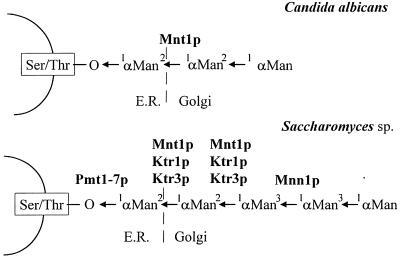
There is an immediate need for identification of new antifungal targets in opportunistic pathogenic fungi like Candida albicans. In the past, efforts have focused on synthesis of chitin and glucan, which confer mechanical strength and rigidity upon the cell wall. This paper describes the molecular analysis of CaMNT1, a gene involved in synthesis of mannoproteins, the third major class of macromolecule found in the cell wall. CaMNT1 encodes an alpha-1, 2-mannosyl transferase, which adds the second mannose residue in a tri-mannose oligosaccharide structure which represents O-linked mannan in C. albicans. The deduced amino acid sequence suggests that CaMnt1p is a type II membrane protein residing in a medial Golgi compartment. The absence of CaMnt1p reduced the ability of C. albicans cells to adhere to each other, to human buccal epithelial cells, and to rat vaginal epithelial cells. Both heterozygous and homozygous Camnt1 null mutants of C. albicans showed strong attenuation of virulence in guinea pig and mouse models of systemic candidosis, which, in guinea pigs, could be attributed to a decreased ability to reach and/or adhere internal organs. Therefore, correct CaMnt1p-mediated O-linked mannosylation of proteins is critical for adhesion and virulence of C. albicans.


Figures
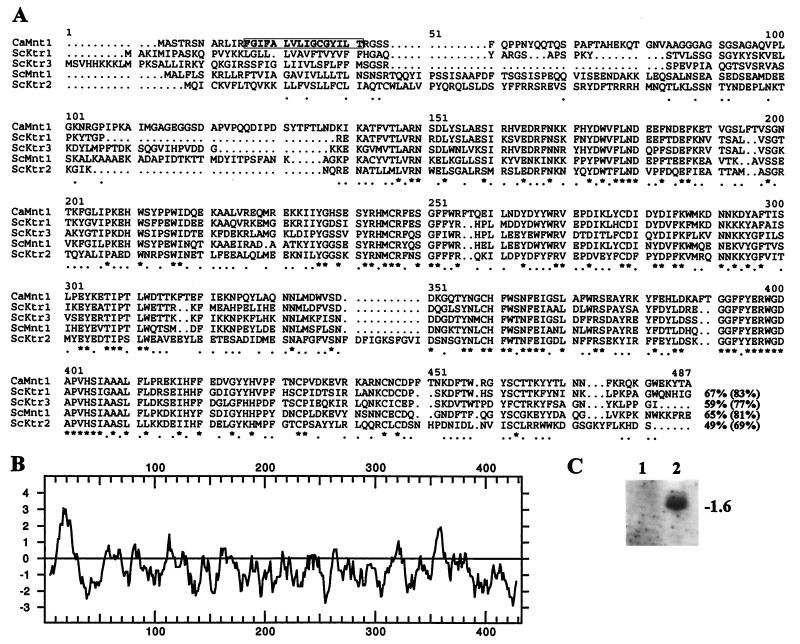
Figure 1
Figure 1
(A) Analysis of the deduced amino acid sequence of CaMNT1 of C. albicans CAI4 and comparison with S. cerevisiae sequences ScMnt1p and ScKtr1–3p using Seqnet GCG program. Positions of complete identity are indicated with asterisks and by full stops where three or more residues are conserved between any of the five sequences. Values for percentage similarities (parentheses) and identities between CaMnt1p and the other genes are given. (B) Hydrophobicity analysis (34) with a window of nine amino acids indicated a single transmembrane spanning region (box in A). (C) Northern analysis of total RNA obtained from C. albicans strains CAI4 and NGY24, respectively, hybridized with radiolabeled CaMNT1 probe. rRNA bands visible on ethidium bromide-stained gels (not shown) were used both as a loading control and molecular weight markers.
Figure 2
Figure 2
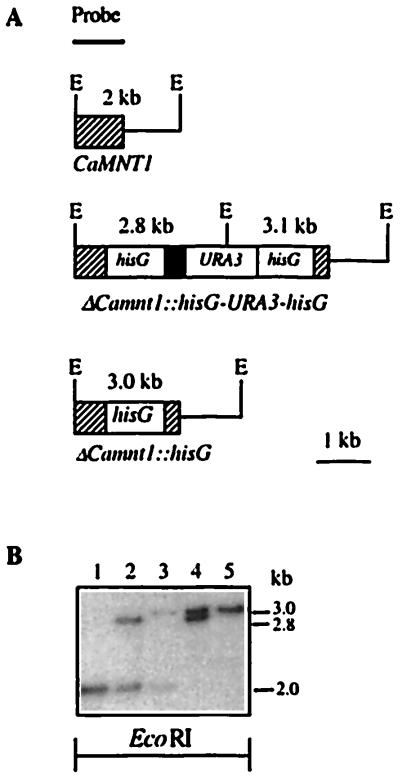
Sequential disruption of CaMNT1 using the ura-blaster technique. (A) Schematic representation of the construction of the CaMNT1, ΔCamnt1::hisG-URA3-hisG and the ΔCamnt1::hisG alleles. The probe used for Southern analysis was a 500-bp EcoRI–HindIII fragment of CaMNT1. E, EcoRI. (B) Southern analysis of EcoRI-digested chromosomal DNA obtained from Camnt1 mutant strains at various stages of construction of a homozygous Camnt1 disruptant strain. Lanes: 1, parental strain C. albicans CAI4; 2, primary transformant NGY21; 3, post-FOA progeny of NGY21, NGY22; 4, secondary transformant NGY23; 5, post-FOA progeny of NGY23, NGY24.
Figure 3
Figure 3
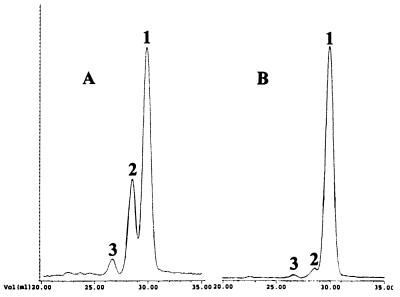
Biogel-P4 chromatogram of β-eliminated and reductively labeled mannan isolated from C. albicans CAI4 (A) and the Camnt1 disruptant strain NGY24 (B). Nonlabeled partially hydrolyzed dextrane was used as internal standard (not shown). 1, Man1; 2, Man2; 3, Man3.
Figure 4
Figure 4
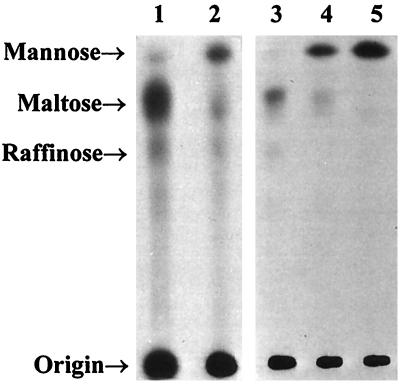
Autoradiogram of an HPTLC chromatogram of β-eliminated [3H]mannose-labeled mannan isolated from C. albicans CAI4 (lane 1) and the derived homozygous disruptant strain, NGY24 (lane 2). In a separate experiment, β-eliminated mannan isolated from C. albicans CAI4 was left undigested (lane 3) or digested with jack bean α-mannosidase (lane 5) or α-1,2-mannosidase of A. satoi (lane 4) prior to chromatography. Mannose, maltose, and raffinose were used as standards for Man1, Man2, and Man3, respectively, and visualized using sulfuric acid in ethanol spray (data not shown).
Figure 5
Figure 5
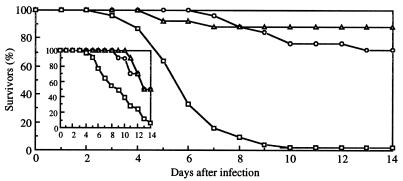
Survival of Pirbright guinea pigs (500 g) intravenously infected with 40000 CFU/g of C. albicans SC5314 (□) and prototrophic heterozygous and homozygous Camnt1 disruptant strains, NGY21 (○) and NGY23 (▵), respectively. Survival of Swiss white mice (25 g) intravenously infected with the same strains at 8000 CFU/g is shown in the inset.
Figure 6
Figure 6
Structure of O-linked mannan and gene products involved in O-linked glycosylation in C. albicans and S. cerevisiae as described in the text.

References

    1. Beck-Sagué C M, Jarvis W R. J Infect Dis. 1993;167:1247–1251. - PubMed
    1. Odds F C. Int J Antimicrob Agents. 1996;6:145–147. - PubMed
    1. Cabib E, Roberts R, Bowers B. Annu Rev Biochem. 1982;51:763–793. - PubMed
    1. McLellan W L, Jr, McDaniel L E, Lampen J O. J Bacteriol. 1970;102:261–270. - PMC - PubMed
    1. Hector R F, Schaller K. Antimicrob Agents Chemother. 1992;36:1284–1289. - PMC - PubMed

Publication types

Substances

Associated data

LinkOut - more resources