


Structure-activity study of the lantibiotic mutacin II from Streptococcus mutans T8 by a gene replacement strategy
- PMID: 9647795
- PMCID: PMC106391
- DOI: 10.1128/AEM.64.7.2335-2340.1998
Structure-activity study of the lantibiotic mutacin II from Streptococcus mutans T8 by a gene replacement strategy
Abstract
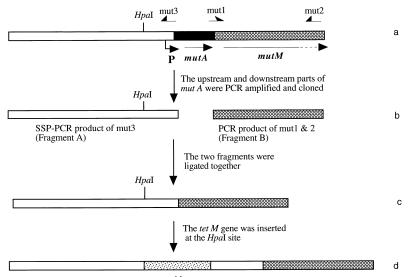
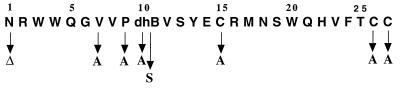
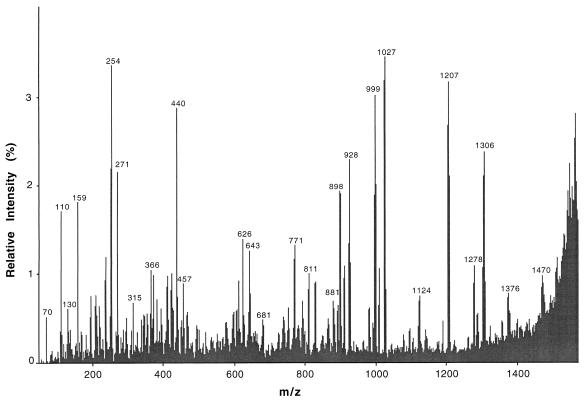
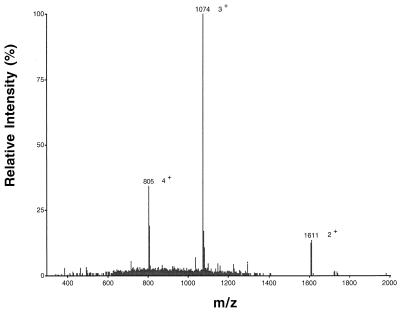
Mutacin II, elaborated by group II Streptococcus mutans, is a ribosomally synthesized and posttranslationally modified polypeptide antibiotic containing unusual thioether and didehydro amino acids. To ascertain the role of specific amino acid residues in mutacin II antimicrobial activity, we developed a streptococcal expression system that facilitates the replacement of the mutA gene with a single copy of a mutated variant gene. As a result, variants of mutacin II can be designed and expressed. The system was tested by constructing the following mutant peptides: delta N1, V7A, P9A, T10A, T10S, C15A, C26A, and C27A. All of these mutacin II variants except delta N1 and T10A, which were not secreted, were isolated, and their identities were verified by mass spectrometry. Variants P9A, C15A, C26A, and C27A failed to exert antimicrobial activity. Because the P9A and T10A variants comprise the "hinge" region of mutacin II, these observations suggest that in addition to the thioether and didehydro amino acids, the hinge region is essential for biological activity and biosynthesis or export of the peptide. Tandem mass spectrometry of the N-terminal part of the wild-type molecule and its C15A variant confirmed that the threonine at position 10 is dehydrated and present as a didehydrobutyrine residue. This analysis of the active T10S variant further suggested that a didehydro amino acid at this position is specific for antimicrobial activity and that the biosynthetic machinery does not discriminate between threonine and serine. In contrast, the lack of production of mutacin variants with alanine substituted for threonine at position 10, as well as the deletion of asparagine at the N terminus (delta N1), indicates that specific residues in the propeptide may be crucial for certain steps in the biosynthetic pathway of this lantibiotic.
Figures
References
-
- Chan W C, Bycroft B W, Lian L-Y, Roberts G C K. Isolation and characterization of two degradation products derived from the peptide antibiotic nisin. FEBS Lett. 1989;252:29–36.
Publication types
MeSH terms
Substances
Grants and funding
LinkOut - more resources
Full Text Sources
Other Literature Sources
Research Materials
