


Flow cytometry detection of infectious rotaviruses in environmental and clinical samples
- PMID: 9647805
- PMCID: PMC106401
- DOI: 10.1128/AEM.64.7.2392-2396.1998
Flow cytometry detection of infectious rotaviruses in environmental and clinical samples
Abstract
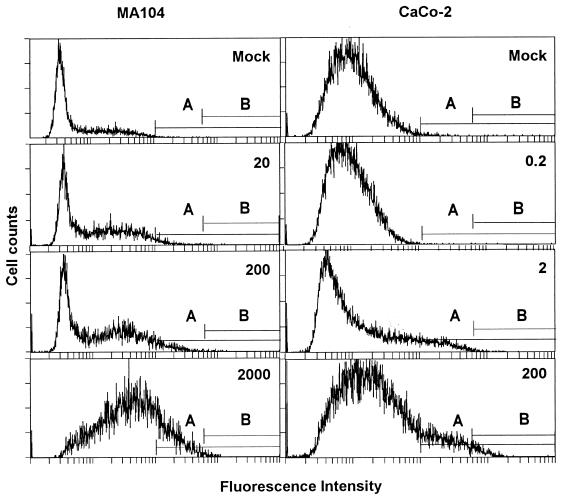
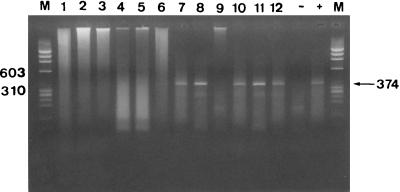
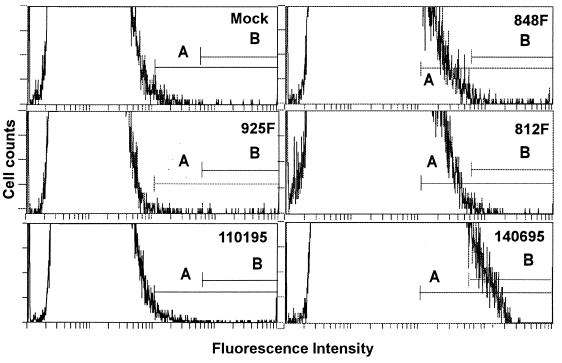
A method for the detection of infectious human rotaviruses based on infection of CaCo-2 cells and detection of infected cells by indirect immunofluorescence and flow cytometry (IIF-FC) has been developed. The technique was validated by performing a seminested reverse transcription-PCR assay with sorted cell populations. The efficiency of the procedure has been compared with that of the standard method of infection of MA104 cells and ulterior detection by IIF and optical microscopy (IIF-OM) and with that of infection of MA104 cells and detection by IIF-FC. The limit of sensitivity for the detection of the cell-adapted strain Ito(r) P13, expressed as the most probable number of cytopathogenic units, was established as 200 and 2 for MA104 and CaCo-2 cells, respectively, by the IIF-FC method. The ratio of infectious virus particles to total virus particles for a wild-type rotavirus was determined to be 1/2 x 10(6) and 1/2 x 10(4) for IIF-OM with MA104 cells and IIF-FC with CaCo-2 cells, respectively. The use of IIF-FC with CaCo-2 cells was tested with fecal and water samples and proved to be more effective than the standard procedure for rotavirus detection.
Figures
References
-
- Ansari S A, Springthorpe V S, Sattar S A. Survival and vehicular spread of human rotaviruses: possible relation to seasonality of outbreaks. Rev Infect Dis. 1991;13:448–461. - PubMed
-
- Bosch A, Lucena F, Diez J M, Gajardo R, Blasi M, Jofre J. Human enteric viruses and indicator microorganisms in a water supply associated with an outbreak of infectious hepatitis. J Am Water Works Assoc. 1991;83:80–83.
-
- Craun G F. Causes of waterborne outbreaks in the United States. Water Sci Tech. 1991;24:17–20.
-
- Doern G V, Herrman J E, Henderson P, Stobbs-Walro D, Perron D M, Blacklow N R. Detection of rotavirus with a new polyclonal antibody enzyme immunoassay (Rotazyme II) and a commercial latex agglutination test (Rotalex): comparison with a monoclonal antibody enzyme immunoassay. J Clin Microbiol. 1986;23:226–229. - PMC - PubMed
Publication types
MeSH terms
LinkOut - more resources
Full Text Sources
