. 1998 Jul;64(7):2585-95.
doi: 10.1128/AEM.64.7.2585-2595.1998.

Seasonal and spatial variability of bacterial and archaeal assemblages in the coastal waters near Anvers Island, Antarctica

Affiliations

Seasonal and spatial variability of bacterial and archaeal assemblages in the coastal waters near Anvers Island, Antarctica

A E Murray et al. Appl Environ Microbiol. 1998 Jul.

Abstract

A previous report of high levels of members of the domain Archaeal in Antarctic coastal waters prompted us to investigate the ecology of Antarctic planktonic prokaryotes. rRNA hybridization techniques and denaturing gradient gel electrophoresis (DGGE) analysis of the bacterial V3 region were used to study variation in Antarctic picoplankton assemblages. In Anvers Island nearshore waters during late winter to early spring, the amounts of archaeal rRNA ranged from 17.1 to 3.6% of the total picoplankton rRNA in 1996 and from 16.0 to 1.0% of the total rRNA in 1995. Offshore in the Palmer Basin, the levels of archaeal rRNA throughout the water column were higher (average, 24% of the total rRNA) during the same period in 1996. The archaeal rRNA levels in nearshore waters followed a highly seasonal pattern and markedly decreased during the austral summer at two stations. There was a significant negative correlation between archaeal rRNA levels and phytoplankton levels (as inferred from chlorophyll a concentrations) in nearshore surface waters during the early spring of 1995 and during an 8-month period in 1996 and 1997. In situ hybridization experiments revealed that 5 to 14% of DAPI (4',6-diamidino-2-phenylindole)-stained cells were archaeal, corresponding to 0.9 x 10(4) to 2.7 x 10(4) archaeal cells per ml, in late winter 1996 samples. Analysis of bacterial ribosomal DNA fragments by DGGE revealed that the assemblage composition may reflect changes in water column stability, depth, or season. The data indicate that changes in Antarctic seasons are accompanied by significant shifts in the species composition of bacterioplankton assemblages and by large decrease in the relative proportion of archaeal rRNA in the nearshore water column.


Figures

FIG. 1
FIG. 1
Sampling stations in the Anvers Island coastal region of the Antarctic Peninsula.
FIG. 2
FIG. 2
Variation in archaeal rRNA levels at Arthur Harbor station A. Samples were collected at a depth of 3 m. An rRNA hybridization analysis was performed with the 0.8- to 0.2-μm seawater fraction in 1995 (A) and with the 1.6- to 0.2-μm seawater fraction in 1996 (B). Symbols: ▪, archaeal HS1392; ▴, archaeal HS1390; ○, chlorophyll a concentration in unfiltered seawater.
FIG. 3
FIG. 3
Temporal changes in archaeal HS in the nearshore waters off Anvers Island in 1996 and 1997. (A) Station B archaeal HS1390 at the surface (▴) and at a depth of 50 m (▾) and the corresponding chlorophyll a concentrations at the surface (•) and at a depth of 50 m (○). (B) Annual variation in archaeal HS1390 (▪) and group I HS1390 (□) at station N.
FIG. 4
FIG. 4
Linear regression showing the relationship between archaeal rRNA HS normalized to universal probes 1390 and 1392 for all late winter-early spring samples in which both universal probes were used. The dashed line represents the 1:1 relationship. Y = 0.58X − 0.49; r2 = 0.90; n = 113.
FIG. 5
FIG. 5
Hydrographic, biological, and molecular data corresponding to depth profiles at station PB1. (A) Temperature profiles for 6 September (solid line), 29 September (dashed line), and 26 September (dotted line). (B) Archaeal HS1390 on 6 September (•) and 26 September (□). (C) Prokaryote concentrations, as determined by enumeration of DAPI-stained cells, on 6 September (•) and 29 September (○) and chlorophyll a concentrations on 6 September (▴) and 29 September (▵). (D) Levels of phototrophic nanoflagellates on 6 September (•) and 29 September (○) and levels of heterotrophic nanoflagellates on 6 September (▴) and 29 September (▵).
FIG. 6
FIG. 6
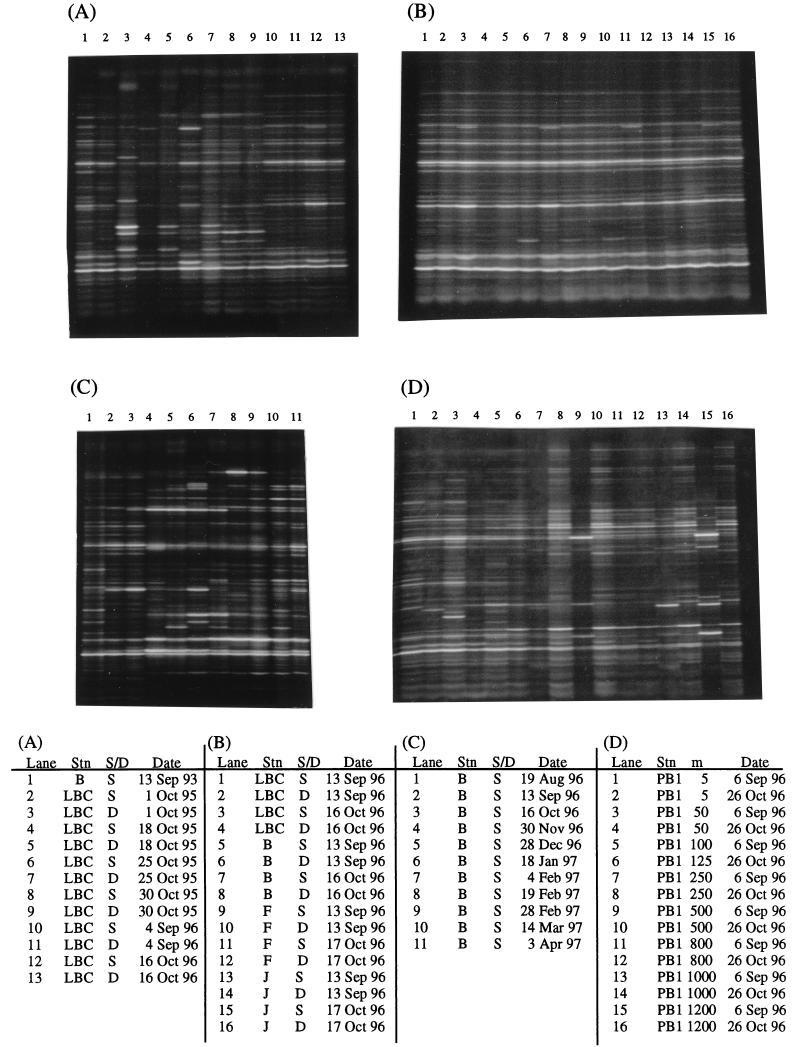
Ribotype profile analysis of bacterial V3 fragments by DGGE. (A) Comparison of bacterial assemblages obtained in 1993, 1995, and 1996 and short-time series analysis of surface assemblages (depth, 3 m) and deep assemblages (depth, 40 m in 1995 and 50 m in 1996) obtained in the late winter-early spring sampling period. (B) Spatial analysis of ribotype compositions at four stations, stations LBC, B, F, and J, sampled at the surface and depth on two dates in late winter-early spring. (C) Temporal analysis of variability in bacterial ribotype compositions at station B between 19 August 1996 and 3 April 1997. (D) Vertical profile of bacterial ribotype compositions in the Palmer Basin on two dates in late winter-early spring. Abbreviations: S, surface sample (depth, 3 m); D, sample obtained at a depth of 40 or 50 m; Stn, station.

References

    1. Bird D F, Karl D M. Spatial patterns of glutamate and thymidine assimilation in Bransfield Strait, Antarctica during and following the austral spring bloom. Deep Sea Res. 1991;38:1057–1075.
    1. Bowman J P, McCammon S A, Brown M V, Nichols D S, McMeekin T A. Diversity and association of psychrophilic bacteria in antarctic sea ice. Appl Environ Microbiol. 1997;63:3068–3078. - PMC - PubMed
    1. Christian, J. R., and D. M. Karl. Ectaminopeptidase specificity and regulation in Antarctic pelagic microbial communities. Aquat. Microb. Ecol., in press.
    1. Delille D, Rosiers C. Seasonal changes of antarctic marine bacterioplankton and sea ice bacterial assemblages. Polar Biol. 1995;16:27–34.
    1. Delille D. Biodiversity and function of bacteria in the Southern Ocean. Biodiv Conserv. 1996;5:1505–1523.

Publication types

LinkOut - more resources