


Membrane current induced by protein kinase C activators in rhabdomeric photoreceptors: implications for visual excitation
- PMID: 9651208
- PMCID: PMC6793473
- DOI: 10.1523/JNEUROSCI.18-14-05253.1998
Membrane current induced by protein kinase C activators in rhabdomeric photoreceptors: implications for visual excitation
Abstract
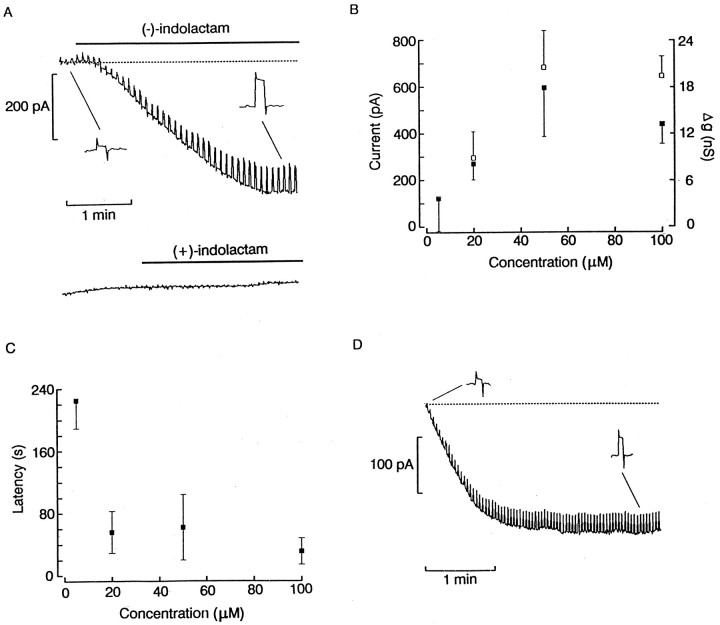
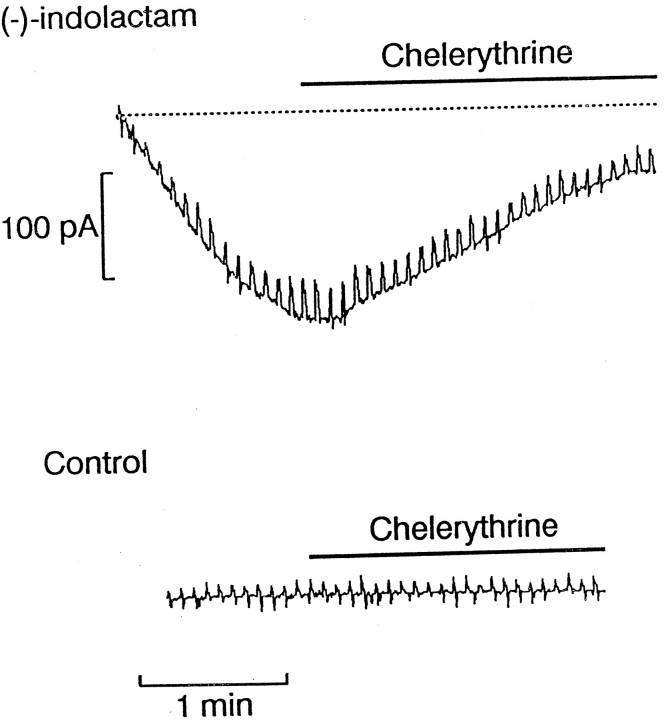
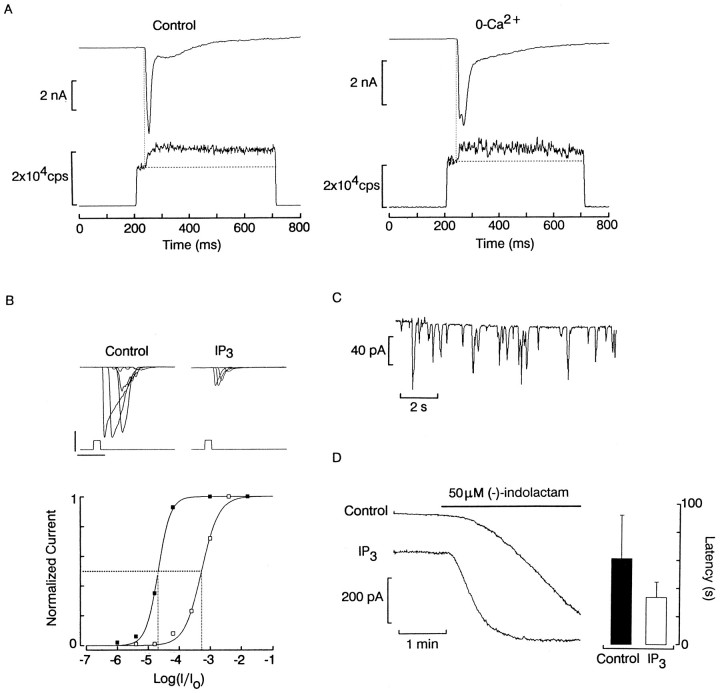
Visual excitation in rhabdomeric photoreceptors is thought to be mediated by activation of a light-regulated phospholipase C (PLC) and the consequent hydrolysis of phosphatidylinositol bisphosphate. Whereas much attention has been devoted to inositol trisphosphate (IP3) production and intracellular Ca2+ release, little is known about the possible role of the DAG branch in the generation of the light response. We have tested the effect of chemically distinct surrogates of DAG on isolated Lima photoreceptors. Application of the phorbol ester PMA (0.5-10 microM) or the alkaloid (-)-indolactam (20-100 microM) from a holding potential of -50 mV elicited an inward current, several hundred picoamperes in amplitude, accompanied by a pronounced increase in membrane conductance. The stereoisomers 4alpha-PMA and (+)-indolactam were both inactive, arguing for the specificity of the effects. Elevation of cytosolic Ca2+ by intracellular dialysis accelerated this current, whereas chelerythrine antagonized it, suggesting the involvement of PKC. The reversal potential of the membrane current induced by PKC activators was approximately +10 mV; replacement of extracellular Na with impermeant N-methyl-D-glucamine decreased its amplitude and shifted the reversal potential in the negative direction. Stimulation by PMA and (-)-indolactam was accompanied by a pronounced depression of light responsiveness; conversely, steady illumination reduced the size of the current elicited by these PKC activators. Taken together, these results support the notion that the DAG branch of the PLC cascade, in addition to its suggested participation in visual adaptation, may play a role in the activation of the photoresponse or a component thereof, probably in synergy with IP3-mediated Ca2+ release.
Figures




References
-
- Acharya JK, Jalink K, Hardy RW, Hartenstein V, Zuker CS. InsP3 receptor is essential for growth and differentiation but not for vision in Drosophila. Neuron. 1997;18:881–887. - PubMed
-
- Baer KM, Saibil HR. Light- and GTP-activated hydrolysis of phosphatidylinositol bisphosphate in squid photoreceptor membranes. J Biol Chem. 1988;263:17–20. - PubMed
-
- Bloomquist BT, Shortridge RD, Schneuwly S, Perdew M, Montell C, Steller H, Rubin G, Pak WL. Isolation of a putative phospholipase C gene of Drosophila, norpA, and its role in phototransduction. Cell. 1988;54:723–733. - PubMed
-
- Bode H-P, Göke B. Protein kinase C activates capacitative calcium entry in the insulin secreting cell line RINm5F. FEBS Lett. 1994;339:307–311. - PubMed
Publication types
MeSH terms
Substances
Grants and funding
LinkOut - more resources
Full Text Sources
Miscellaneous
