Review
. 1998 May;19(5):184-91.
doi: 10.1016/s0165-6147(98)01203-6.

Adenosine A3 receptors: novel ligands and paradoxical effects

Affiliations
Review

Adenosine A3 receptors: novel ligands and paradoxical effects

K A Jacobson. Trends Pharmacol Sci. 1998 May.

Abstract

The physiological role of the adenosine A3 receptor is being investigated using newly synthesized, selective ligands. Recently, in addition to agonists, selective antagonists have been developed that belong to three distinct, non-purine chemical classes: flavonoids, 1,4-dihydropyridine derivatives (e.g. MRS1191, which is 1300-fold selective for human adenosine A3 vs A1/A2A receptors, with a Ki value of 31 nM) and the triazoloquinazolines (e.g. MRS1220, which has a Ki value of 0.65 nM). The A3 receptor has proven enigmatic in terms of antagonist ligand specificity, coupling to second messengers, and biological effects in the CNS, inflammatory system and cardiovascular system. A3 receptors are also potentially involved in apoptosis. It appears that intense, acute activation of A3 receptors acts as a lethal input to cells, while low concentrations of A3 receptor agonists protect against apoptosis. Here, Kenneth Jacobson describes how A3 receptor agonists might be useful in treating inflammatory conditions, possibly through their inhibition of tumour necrosis factor alpha (TNF-alpha) release, which has been shown in macrophages. A3 receptor antagonists might be useful in treating asthma or acute brain ischaemia. Recently, the versatility of A3 receptor agonists, administered either before or during ischaemia, in eliciting potent cardioprotection has been shown.


Figures
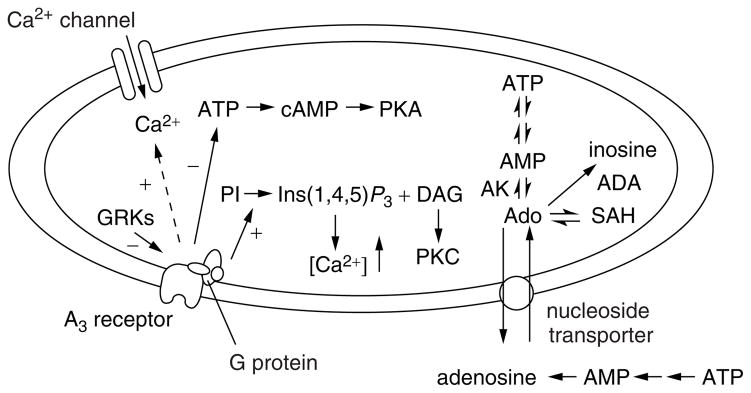
Fig. 1
Fig. 1
Processes of formation and degradation of adenosine in the cell and actions at A3 adenosine receptors. The dashed line indicates activity only at micromolar concentrations of IB-MECA. ADA, adenosine deaminase; AK, adenosine kinase; GRKs, G protein-coupled receptor kinases; Ins(1,4,5)P3, inositol (1,4,5)-trisphosphate; PI, phosphatidylinositol; PKA, cAMP-dependent protein kinase; SAH, S-adenosyl homocysteine.
Fig. 2
Fig. 2
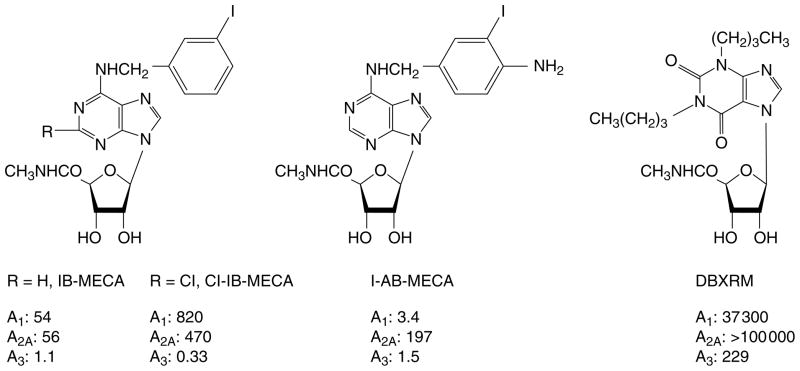
Structures of highly potent adenosine A3 receptor agonists. Abbreviations used in the text and receptor binding affinities at rat A1/A2A/A3 receptors (nM) are indicated. Cl-IB-MECA, chloro-N6-(3-iodobenzyl)-adenosine-5′-N-methyluronamide; DBXRM, 1,3-dibutylxanthine-7-riboside-5′-N-methyl-carboxamide; I-AB-MECA, [125I]N6-(4-aminobenzyl)-adenosine-5′-N-methyluronamide; IB-MECA, N6-(3-iodobenzyl)-adenosine-5′-N-methyluronamide.
Fig. 3
Fig. 3
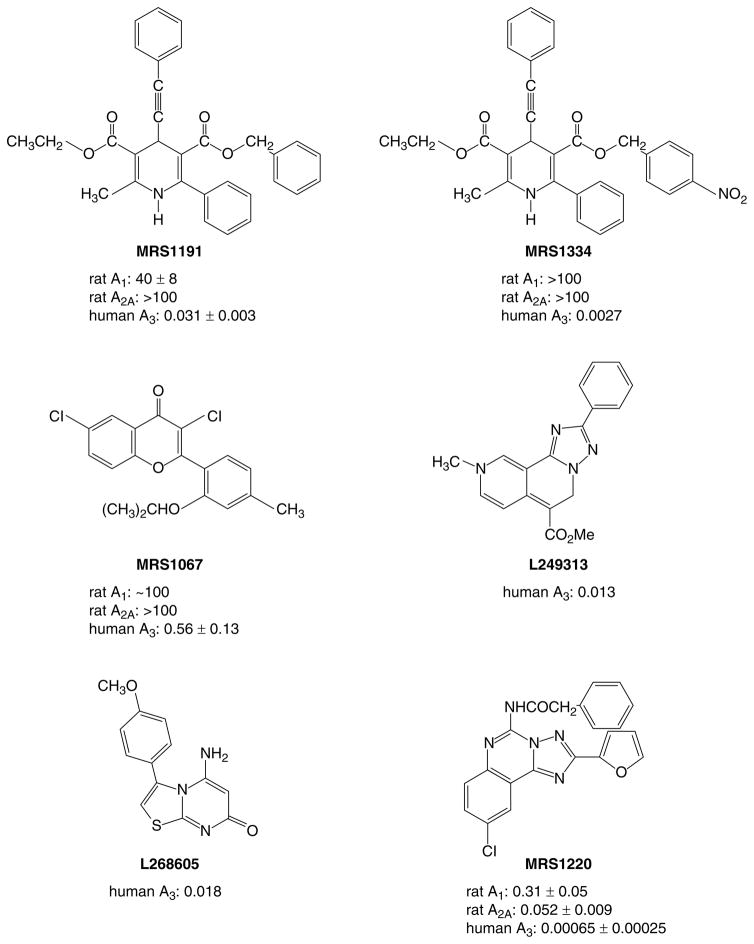
Structures of selective A3 adenosine receptor antagonists. Abbreviations used in the text and receptor binding affinities (μM) are indicated.
Fig. 4
Fig. 4
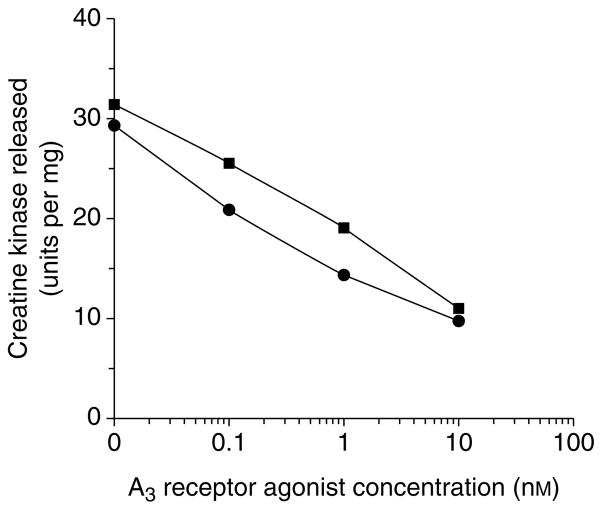
Cardioprotection elicited by the selective A3 adenosine receptor agonists, N6-(3-iodobenzyl)-adenosine-5′-N-methyluronamide (IB-MECA) and Cl-IB-MECA, during prolonged ischaemia (modified from Ref. 16). Cardiac ventricular myocytes were cultured from chick embryos 14 days in ovo, and cell injury was induced by a 90 min exposure of the culture to hypoxia with glucose deprivation. Release of creatine kinase into the medium was directly proportional to the degree of cell injury. Curves shown were measured in the presence of 1 μM 8-cyclopentyl-1,3-dipropylxanthine (DPCPX) (selective A1 adenosine receptor antagonist), which had no effect on the cardioprotection observed. The selective A3 adenosine receptor antagonist MRS1191 antagonized the cardio-protection provided by 10 nM Cl-IB-MECA, with an IC50 of ~10 nM. A3 adenosine agonists were also cardioprotective following a brief exposure, prior to ischaemia (Ref. 15). Squares, IB-MECA; circles, Cl-IB-MECA.

References

    1. Olah ME, Stiles GL. Annu Rev Pharmacol Toxicol. 1995;35:581–606. - PubMed
    1. Linden J. Trends Pharmacol Sci. 1994;15:298–306. - PubMed
    1. Jacobson KA, Suzuki F. Drug Dev Res. 1997;39:289–300. - PMC - PubMed
    1. Dunwiddie TV, Diao L, Kim HO, Jiang J-l, Jacobson KA. J Neurosci. 1997;17:607–614. - PMC - PubMed
    1. Abbracchio MP, et al. Biochem Biophys Res Commun. 1997;241:297–304. - PMC - PubMed

LinkOut - more resources