. 1998 Jul 7;95(14):8268-73.
doi: 10.1073/pnas.95.14.8268.

Cannabidiol and (-)Delta9-tetrahydrocannabinol are neuroprotective antioxidants

Affiliations

Cannabidiol and (-)Delta9-tetrahydrocannabinol are neuroprotective antioxidants

A J Hampson et al. Proc Natl Acad Sci U S A. .

Abstract

The neuroprotective actions of cannabidiol and other cannabinoids were examined in rat cortical neuron cultures exposed to toxic levels of the excitatory neurotransmitter glutamate. Glutamate toxicity was reduced by both cannabidiol, a nonpsychoactive constituent of marijuana, and the psychotropic cannabinoid (-)Delta9-tetrahydrocannabinol (THC). Cannabinoids protected equally well against neurotoxicity mediated by N-methyl-D-aspartate receptors, 2-amino-3-(4-butyl-3-hydroxyisoxazol-5-yl)propionic acid receptors, or kainate receptors. N-methyl-D-aspartate receptor-induced toxicity has been shown to be calcium dependent; this study demonstrates that 2-amino-3-(4-butyl-3-hydroxyisoxazol-5-yl)propionic acid/kainate receptor-type neurotoxicity is also calcium-dependent, partly mediated by voltage sensitive calcium channels. The neuroprotection observed with cannabidiol and THC was unaffected by cannabinoid receptor antagonist, indicating it to be cannabinoid receptor independent. Previous studies have shown that glutamate toxicity may be prevented by antioxidants. Cannabidiol, THC and several synthetic cannabinoids all were demonstrated to be antioxidants by cyclic voltametry. Cannabidiol and THC also were shown to prevent hydroperoxide-induced oxidative damage as well as or better than other antioxidants in a chemical (Fenton reaction) system and neuronal cultures. Cannabidiol was more protective against glutamate neurotoxicity than either ascorbate or alpha-tocopherol, indicating it to be a potent antioxidant. These data also suggest that the naturally occurring, nonpsychotropic cannabinoid, cannabidiol, may be a potentially useful therapeutic agent for the treatment of oxidative neurological disorders such as cerebral ischemia.


Figures
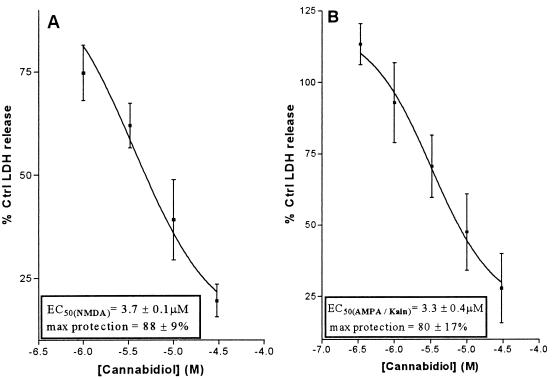
Figure 1
Figure 1
Effect of cannabidiol on NMDAr- (A) and AMPA/kainate receptor- (B) mediated neurotoxicity. Data shown represents mean values ± SEM from a single experiment with four replicates. Each experiment was repeated on at least four occasions with essentially the same results. Cannabinoids were present during (and, in the case of NMDAr mediated toxicity, after) the glutamate exposure periods. See Materials and Methods for further experimental details.
Figure 2
Figure 2
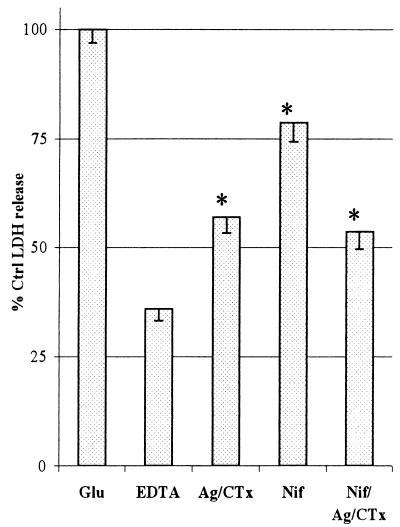
The involvement of calcium and calcium channels in AMPA/kainate-mediated toxicity. The effects of 2 mM EDTA and various combinations of the voltage-sensitive calcium channel inhibitors ω-Agatoxin IVa (Ag) (250 nM), ω-Conotoxin GVIa (CTx) (500 nM), and Nifedipine (Nif) (1 μM) were used to probe the role and source of calcium in AMPA/kainate receptor-mediated toxicity. Data represents mean values ± SEM from four experiments, each with four replicates. Cannabinoids were present throughout the glutamate exposure period. See Materials and Methods for further experimental details. Significant difference between EDTA and other treatments is indicated with an asterisk.
Figure 3
Figure 3
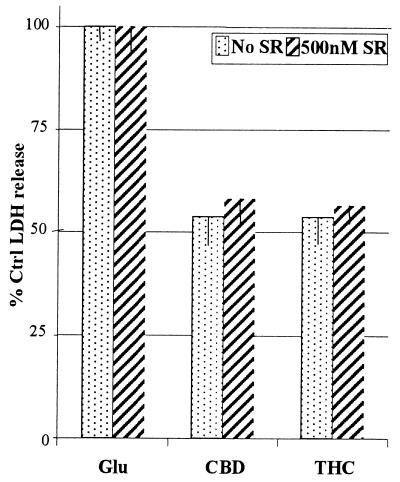
Effect of THC, cannabidiol, and cannabinoid receptor antagonist on glutamate induced neurotoxicity. Neurons exposed to glutamate in an AMPA/kainate receptor toxicity model were incubated with 10 μM cannabidiol or THC in the presence or absence of SR141716A (500nM). See Materials and Methods for experimental details. Data represents mean values ± SEM from four experiments, each with three replicates.
Figure 4
Figure 4
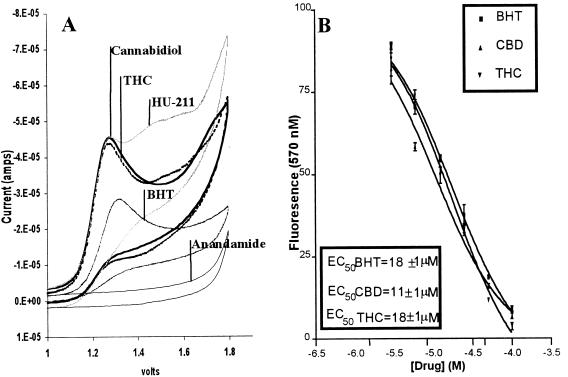
(A) A comparison of the oxidation potentials of cannabinoids and the antioxidant BHT. The oxidation profiles of (750 μM) BHT, cannabinoids, and anandamide were compared by cyclic voltametry. Anandamide, a cannabinoid receptor ligand with a noncannabinoid structure, was used as a nonresponsive control. Experiments were repeated three times with essentially the same results. See Materials and Methods for experimental details. (B) Effect of cannabidiol and THC on dihydrorhodamine oxidation. Cannabinoids were compared with BHT for their ability to prevent tert-butyl hydroperoxide-induced oxidation of dihydrorhodamine. See Materials and Methods for experimental details. Data represent mean values ± SEM from a single experiment with three replicates. This experiment was repeated four times with essentially the same results.
Figure 5
Figure 5
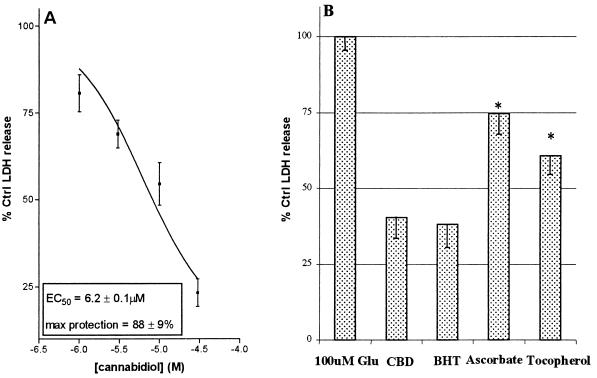
(A) The effect of cannabidiol on oxidative toxicity in neuronal cultures. Tert-butyl hydroperoxide-induced toxicity was examined in the presence or absence of cannabidiol. (B) Comparison of antioxidants and cannabidiol for their ability to prevent glutamate toxicity in neurons. The effects of cannabidiol, BHT, ascorbate, and α-tocopherol (10 μM) were examined in a model of AMPA/kainate receptor-dependent toxicity. All drugs were present throughout the glutamate exposure period. Each experiment represents the mean of four replicates repeated on three occasions. See Materials and Methods for further experimental details. Significant differences between cannabidiol and other antioxidants are indicated with an asterisk.

References

    1. Welch S P, Stevens D L. J Pharmacol ExpTher. 1992;262:8–10. - PubMed
    1. Merritt J C, Crawford W J, Alexander P C, Anduze A L, Gelbart S S. Ophthalmology. 1980;87:222–228. - PubMed
    1. Abrahamov A, Mechoulam R. Life Sci. 1995;56:2097–2102. - PubMed
    1. Choi D W, Koh J Y, Peters S. J Neurosci. 1988;8:185–196. - PMC - PubMed
    1. Ciani E, Groneng L, Voltattorni M, Rolseth V, Contestabile A, Paulsen R E. Brain Res. 1996;728:1–6. - PubMed