. 1998 Aug;72(8):6356-61.
doi: 10.1128/JVI.72.8.6356-6361.1998.

In vitro cell-free conversion of noninfectious Moloney retrovirus particles to an infectious form by the addition of the vesicular stomatitis virus surrogate envelope G protein

Affiliations

In vitro cell-free conversion of noninfectious Moloney retrovirus particles to an infectious form by the addition of the vesicular stomatitis virus surrogate envelope G protein

A Abe et al. J Virol. 1998 Aug.

Abstract

In the absence of envelope gene expression, retrovirus packaging cell lines expressing Moloney murine leukemia virus (MLV) gag and pol genes produce large amounts of noninfectious virus-like particles that contain reverse transcriptase, processed Gag protein, and viral RNA (gag-pol RNA particles). We demonstrate that these particles can be made infectious in an in vitro, cell-free system by the addition of a surrogate envelope protein, the G spike glycoprotein of vesicular stomatitis virus (VSV-G). The appearance of infectivity is accompanied by physical association of the G protein with the immature, noninfectious virus particles. Similarly, exposure in vitro of wild-type VSV-G to a fusion-defective pseudotyped virus containing a mutant VSV-G markedly increases the infectivity of the virus to titers similar to those of conventional VSV-G pseudotyped viruses. Furthermore, similar treatment of an amphotropic murine leukemia virus significantly allows infection of BHK cells not otherwise susceptible to infection with native amphotropic virus. The partially cell-free virus maturation system reported here should be useful for studies aimed at the preparation of tissue-targeted retrovirus vectors and will also aid in studies of nucleocapsid-envelope interactions during budding and of virus assembly and virus-receptor interactions during virus uptake into infected cells. It may also represent a potentially useful step toward the eventual development of a completely cell-free retrovirus assembly system.


Figures
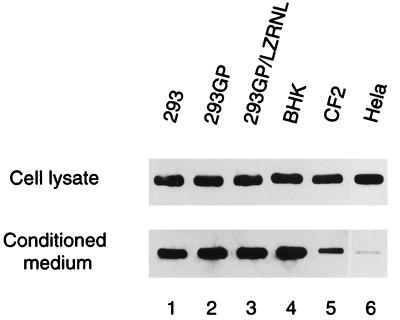
FIG. 1
FIG. 1
Intracellular and extracellular VSV-G in cell lines transfected with pCMV-G. Cells were grown in six-well plates and transfected with plasmid pCMV-G. VSV-G samples in the conditioned medium and cell lysate were examined by established Western blotting methods, using P5D4 monoclonal antibody to visualize VSV-G protein as described in Materials and Methods.
FIG. 2
FIG. 2
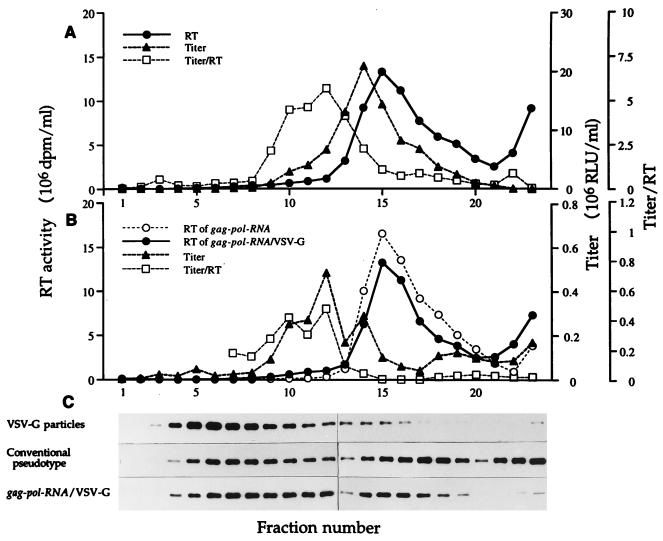
Analysis of virus particles by sucrose velocity gradient centrifugation. (A) Authentic pseudotyped LLRNL virus prepared by conventional methods from 293GP/LLRNL cells. (B) Untreated gag-pol RNA particles and gag-pol RNA particles made infectious by exposure to VSV-G for which 0.5-ml volumes of conditioned medium of 293 cells transfected with pCMV-G and of 293GP/LLRNL cells were mixed and centrifuged at 24,000 rpm at 4°C in Beckman SW28 rotor for 90 min. Pellets were resuspended with 1 ml of PBS and loaded onto the sucrose gradients. (C) Western blot analysis of VSV-G in gradient fractions containing the media from 293 cells transfected with pCMV-G, authentic mature pseudotyped LLRNL virus, and gag-pol RNA particles from 293GP/LLRNL cells made infectious by treatment with VSV-G as described above. RLU, relative luciferase units.
FIG. 3
FIG. 3
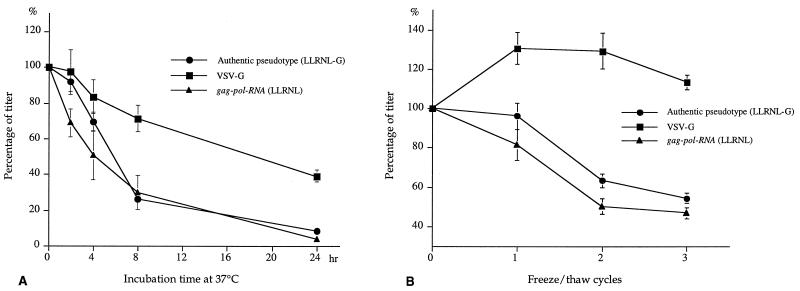
Stability of VSV-G, gag-pol RNA, and authentic pseudotyped virus particles. (A) Stability in incubation at 37°C. VSV-G-containing conditioned medium from 293 cells transfected with pCMV-G and gag-pol RNA (GP/LLRNL)-containing conditioned medium from 293GP/LLRNL cells (0.5 ml of each) were independently incubated at 37°C for the indicated time. After that, they were mixed with equal volumes of the other fresh components, centrifuged at 14,000 rpm for 1 h, and used to infect BHK cells. Authentic pseudotyped virus was made by the conventional method and incubated at 37°C. The activity of each component was determined by luciferase assay and expressed as the percentage of fresh-sample activity. An identical experiment in which samples were incubated at 4°C instead of 37°C resulted in a similar profile (data not shown). (B) Stability during freeze-thaw. Each sample (0.5 ml) was subjected to freezing at −80°C for 15 min and thawing at 37°C for 5 min, and each sample was kept at 4°C until the last samples were prepared. Then VSV-G or gag-pol RNA particles were mixed with equal volumes of fresh other components, centrifuged at 14,000 rpm for 1 h, and subjected to infection. Each value represents the percentage of fresh-sample activity. Results are the mean ± standard error of three independent experiments.

References

    1. Abe A, Miyanohara A, Friedmann T. Enhanced gene transfer with fusogenic liposomes containing vesicular stomatitis virus G glycoprotein. J Virol. 1998;72:6159–6163. - PMC - PubMed
    1. Balch W E, McCaffery J M, Plutner H, Farquhar M G. Vesicular stomatitis virus glycoprotein is sorted and concentrated during export from the endoplasmic reticulum. Cell. 1994;76:841–852. - PubMed
    1. Bassin R H, Phillips L A, Kramer M J, Haapala D K, Peebles P T, Nomura S, Fischinger P J. Transformation of mouse 3T3 cells by murine sarcoma virus: release of virus-like particles in the absence of replicating murine leukemia helper virus. Proc Natl Acad Sci USA. 1971;68:1520–1524. - PMC - PubMed
    1. Bolognesi D P, Montelaro R C, Frank H, Schafer W. Assembly of type C oncornaviruses: a model. Science. 1978;199:183–186. - PubMed
    1. Burns J C, Friedmann T, Driever W, Burrascano M, Yee J K. Vesicular stomatitis virus G glycoprotein pseudotyped retroviral vectors: concentration to very high titer and efficient gene transfer into mammalian and nonmammalian cells. Proc Natl Acad Sci USA. 1993;90:8033–8037. - PMC - PubMed

Publication types

LinkOut - more resources