. 1998 Jul;9(7):1757-71.
doi: 10.1091/mbc.9.7.1757.

Identification of novel temperature-sensitive lethal alleles in essential beta-tubulin and nonessential alpha 2-tubulin genes as fission yeast polarity mutants

Affiliations
Free PMC article

Identification of novel temperature-sensitive lethal alleles in essential beta-tubulin and nonessential alpha 2-tubulin genes as fission yeast polarity mutants

P Radcliffe et al. Mol Biol Cell. 1998 Jul.
Free PMC article

Abstract

We have screened for temperature-sensitive (ts) fission yeast mutants with altered polarity (alp1-15). Genetic analysis indicates that alp2 is allelic to atb2 (one of two alpha-tubulin genes) and alp12 to nda3 (the single beta-tubulin gene). atb2(+) is nonessential, and the ts atb2 mutations we have isolated are dominant as expected. We sequenced two alleles of ts atb2 and one allele of ts nda3. In the ts atb2 mutants, the mutated residues (G246D and C356Y) are found at the longitudinal interface between alpha/beta-heterodimers, whereas in ts nda3 the mutated residue (Y422H) is situated in the domain located on the outer surface of the microtubule. The ts nda3 mutant is highly sensitive to altered gene dosage of atb2(+); overexpression of atb2(+) lowers the restrictive temperature, and, conversely, deletion rescues ts. Phenotypic analysis shows that contrary to undergoing mitotic arrest with high viability via the spindle assembly checkpoint as expected, ts nda3 mutants execute cytokinesis and septation and lose viability. Therefore, it appears that the ts nda3 mutant becomes temperature lethal because of irreversible progression through the cell cycle in the absence of activating the spindle assembly checkpoint pathway.


Figures
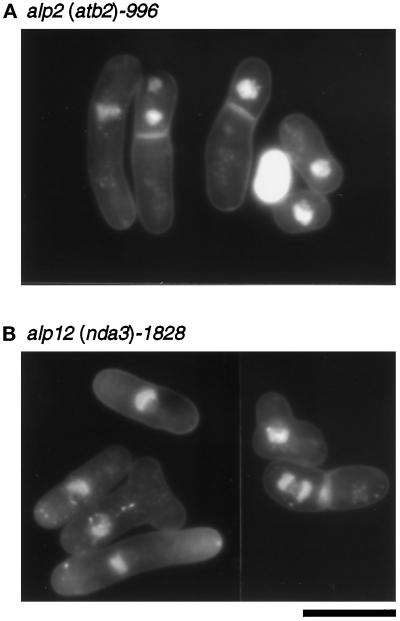
Figure 1
Figure 1
Nuclear staining of ts alp2 (atb2) and alp12 (nda3) cells. alp2 (atb2)-996 (A, DH1–7C; Table 1) or alp12 (nda3)-1828 cells (B, DH12) were grown exponentially at 26°C, shifted to 35.5°C, and incubated for 6 h. Cells were fixed and stained with DAPI. Bar, 10 μm.
Figure 2
Figure 2
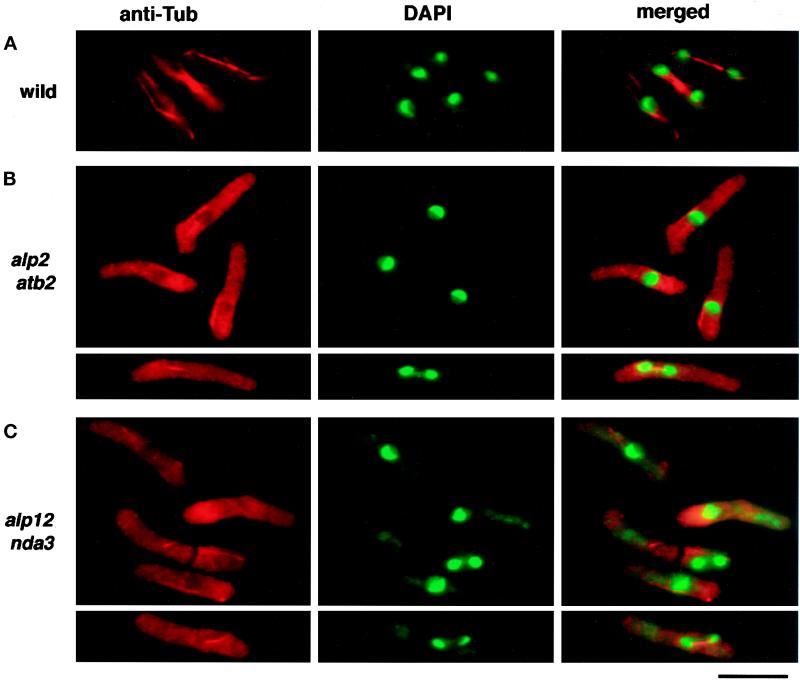
Microtubule staining in ts alp2 (atb2) and alp12 (nda3) cells. Mutant and wild-type cells were prepared as in Figure 1, fixed in methanol, and stained with anti-tubulin antibody (TAT-1, left panel) or DAPI (middle panel). Merged figures are shown in the right panel. Representative figures are shown for wild-type (top row), ts alp2 (atb2) (second and third rows), and alp12 (nda3) (fourth and fifth rows).
Figure 3
Figure 3
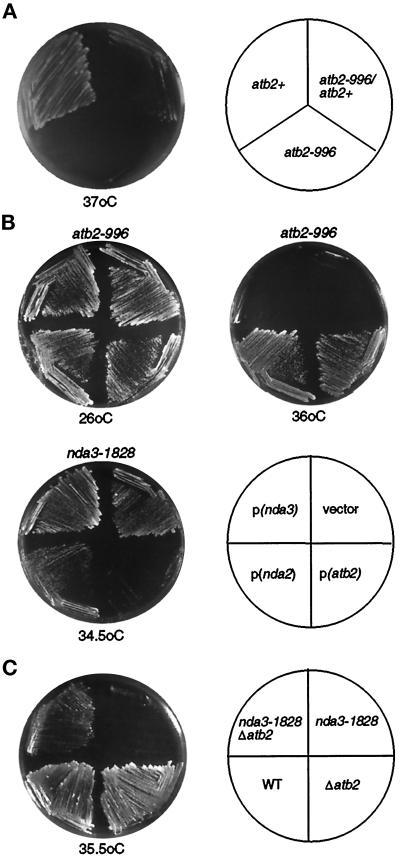
Genetic interaction between ts tubulin mutants and other tubulins. (A) Dominance–recessive test of ts atb2 mutation. Haploid wild-type (atb2+, TP71–7C; Table 1), ts atb2 (atb2-996, TPR19A), and a heterozygous diploid constructed by crossing these two strains (atb2-996/atb2+) were streaked on rich YPD plates and incubated at 37°C for 2 d. (B) atb2-996 mutant cells (top two plates) or nda3-1828 (bottom left plate) were transformed with an empty vector (vector), a multicopy plasmid containing atb2+ [pALA200, p(atb2)], nda2+ [pALB200, p(nda2)], or nda3+ [pCR9, p(nda3)]. Transformants were incubated at either 26°C (B, top left), 36°C (B, top right) or 34.5°C (bottom left) for 3 d. (C) Four strains (top left, nda3-1828Δatb2; top right, nda3-1828; bottom right, Δatb2; bottom left, wild type) were streaked on YPD plates and incubated at 35.5°C for 2 d.
Figure 4
Figure 4
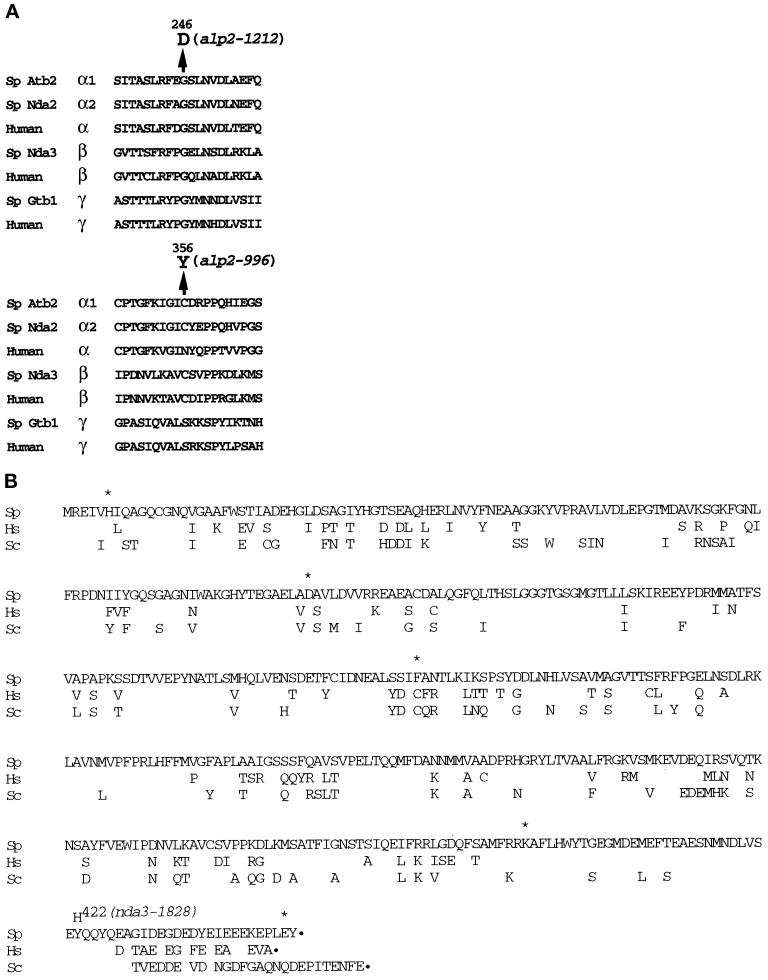
Determination of the mutation sites in the ts atb2 (alp2) and nda3 (alp12) mutants. Amino acid comparisons of α-tubulin (A) and β-tubulin (B) together with the amino acid substitution caused by a point mutation in each ts mutant are shown. Sp stands for fission yeast (S. pombe), Sc for budding yeast (S. cerevisiae), and Hs for human (H. sapiens). atb2-996 contains a single base change at nucleotide number 1065 (G to A, A of the initiator methionine is denoted as +1), resulting in an amino acid substitution of cysteine 356 with tyrosine. atb2-1212 contains a single base change at nucleotide 737 (G to A), which results in an amino acid substitution of glycine 246 with aspartate. nda3-1828 contains a single base change at position 1566 (from T to C), resulting in substitution of tyrosine 422 with histidine. Only nonconserved amino acid residues are shown in B for Hs and Sc. Asterisks show amino acids where the previously published data (Hiraoka et al., 1984) are incorrect because of sequencing errors.
Figure 5
Figure 5
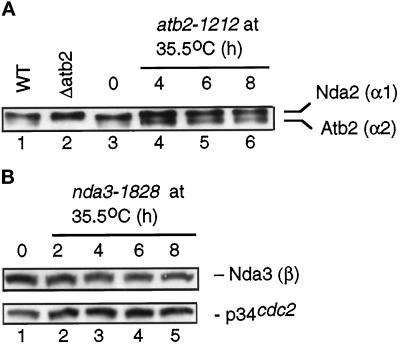
The level of tubulin proteins in ts atb2 and nda3 mutants. (A) Total cell extracts were prepared from wild type (HM123, lane 1; Table 1), deleted atb2 (Δatb2, lane 2), or ts atb2-1212 (1212, lanes 3–6). Cells were cultured at 26°C in lanes 1 and 2. atb2-1212 cells were first grown at 26°C (lane 3) and shifted to 35.5°C. Samples were collected at 4 (lane 4), 6 (lane 5), and 8 (lane 6) h. Protein (2 μg) from cell extracts was run in SDS-PAGE, and immunoblotting was performed with anti-α-tubulin antibody (TAT-1). (B) ts nda3-1828 cells (DH12) were grown as described in A, and samples were taken every 2 h after the shift. Cell extracts (20 μg) were run in SDS-PAGE, and immunoblotting was performed with mouse anti-β-tubulin antibody (Sigma) (top) or anti-Cdc2 antibody as a loading control (bottom).
Figure 6
Figure 6
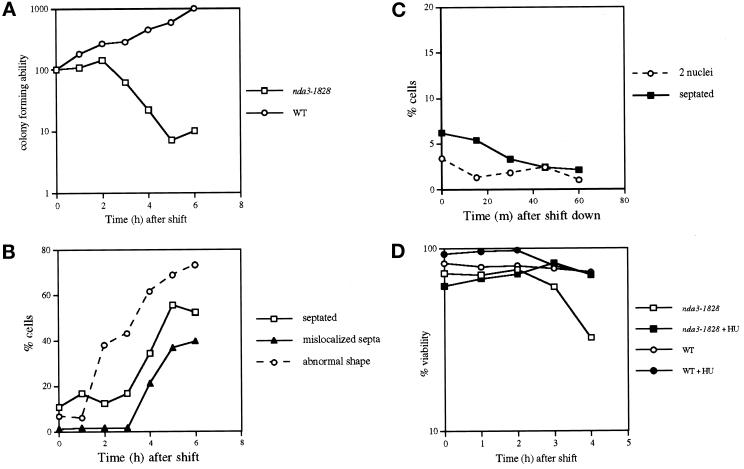
ts nda3 mutants proceed through the cell cycle and lose viability at the restrictive temperature. (A and B) ts nda3 mutant (DH12; Table 1) and wild-type (HM123) cells were grown at 26°C and shifted to 35.5°C, and aliquots were collected hourly. After appropriate dilution (10−4), cells were plated on rich YES plates to examine colony-forming ability per culture (A, the value at time 0 was taken as 100%; ○, wild type; □, ts nda3). Vertical axis (%) is shown logarithmically. Septation index and percentage of cells with abnormal cell morphology in the ts nda3 mutant (B, □ and ○, respectively) were observed with Calcofluor staining, and the percentage of cells that showed septa displaced from the center of the cell is also shown (▴). In wild-type cells, these abnormal cells were never observed (<0.1%). (C) For the reversibility experiments, ts nda3 cells incubated at 35.5°C for 2 h (note that viability is still high at this time point; see A) were shifted down to 26°C, and septation index (using Calcofluor, ▪) and the percentage of cells with two nuclei (using DAPI, ○) were scored at 15-min intervals for 1 h. (D) The same strains as in A (wild type shown as circles and ts nda3 as squares) were grown in the presence (closed symbols) or absence (open symbols) of 10 mM hydroxyurea in rich YPD for 3 h at 27°C and shifted to 35.5°C. Cell number was measured at each time point, and viability was examined by plating cells (10−4 dilution) on rich YES plates. After plates were incubated at 27°C, the number of colonies was counted, and viability at each time point was calculated by dividing the number of viable cells by the cell number. Vertical axis (%) is shown logarithmically.
Figure 7
Figure 7
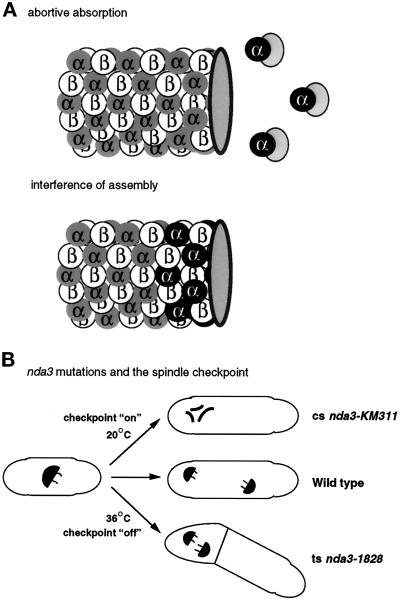
Possible models for novel ts mutations in tubulin genes. (A) ts Atb2 protein irreversibly absorbs proteins essential for microtubule biogenesis and assembly, which results in the disappearance of microtubules at the restrictive temperature (abortive absorption). ts Atb2 protein (α2-tubulin) is incorporated into microtubule structures, but interferes with the assembly of microtubules, which also results in microtubule disassembly (interference of assembly). ts Atb2 protein is shown as black circles with α in white letters, Nda2 (α1-tubulin) as gray circles with α in black letters. Hypothetical proteins that are essential for microtubule structures are shown in dotted circles bound to ts Atb2 proteins. (B) Differences in the defective phenotypes of cs nda3-KM311 and ts nda3-1828 mutants are shown. nda3 mutants arrest at mitosis with condensed chromosomes in which the spindle assembly checkpoint is activated (on), whereas ts nda3 mutants proceed through mitosis without activating the checkpoint (off), form septa, and eventually partial chromosome segregation occurs.

References

    1. Adachi Y, Toda T, Yanagida M. Differential expression of essential and nonessential α-tubulin genes in Schizosaccharomyces pombe. Mol Cell Biol. 1986;6:2168–2178. - PMC - PubMed
    1. Adams AEM, Pringle JR. Relationship of actin and tubulin distribution to bud growth in wild-type and morphogenetic-mutant Saccharomyces cerevisiae. J Cell Biol. 1984;98:934–945. - PMC - PubMed
    1. Alfa C, Fantes P, Hyams J, McLeod M, Warbrick E. Experiments with fission yeast: a laboratory course manual. Cold Spring Harbor, NY: Cold Spring Harbor Press; 1993.
    1. Ayscough K, Hajibagheri NM, Watson R, Warren G. Stacking of Golgi cisternae in Schizosaccharomyces pombe requires intact microtubules. J Cell Sci. 1993;106:1227–1237. - PubMed
    1. Bai R, Pei X-F, Boyé O, Getahun Z, Grover S, Bekisz J, Nguyen NY, Brossi A, Hamel E. Identification of cysteine 354 of β-tubulin as part of the binding site for the A ring of colchicine. J Biol Chem. 1996;271:12639–12645. - PubMed

Publication types