


Distribution of a glycosylphosphatidylinositol-anchored protein at the apical surface of MDCK cells examined at a resolution of <100 A using imaging fluorescence resonance energy transfer
- PMID: 9660864
- PMCID: PMC2133040
- DOI: 10.1083/jcb.142.1.69
Distribution of a glycosylphosphatidylinositol-anchored protein at the apical surface of MDCK cells examined at a resolution of <100 A using imaging fluorescence resonance energy transfer
Erratum in
- J Cell Biol 1998 Aug 10;142(3):following 881
Abstract
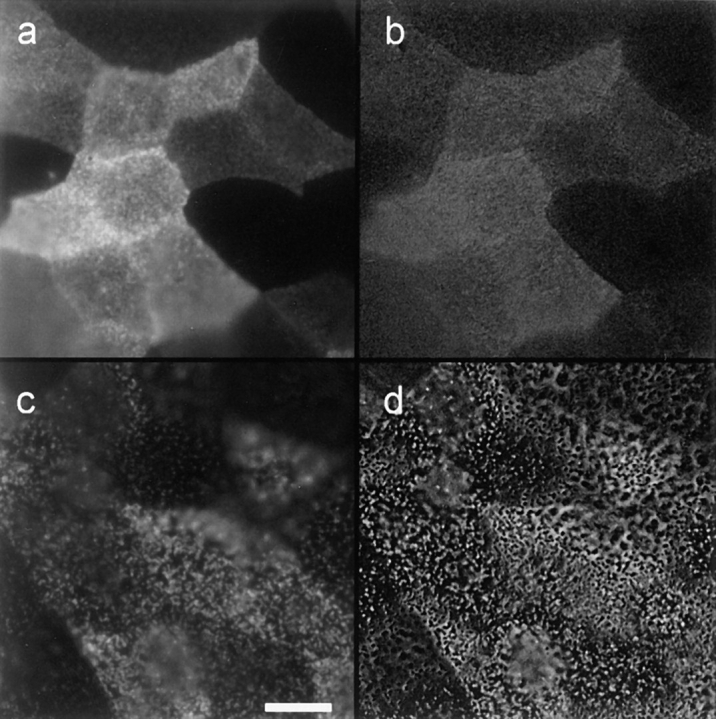
Membrane microdomains ("lipid rafts") enriched in glycosylphosphatidylinositol (GPI)-anchored proteins, glycosphingolipids, and cholesterol have been implicated in events ranging from membrane trafficking to signal transduction. Although there is biochemical evidence for such membrane microdomains, they have not been visualized by light or electron microscopy. To probe for microdomains enriched in GPI- anchored proteins in intact cell membranes, we used a novel form of digital microscopy, imaging fluorescence resonance energy transfer (FRET), which extends the resolution of fluorescence microscopy to the molecular level (<100 A). We detected significant energy transfer between donor- and acceptor-labeled antibodies against the GPI-anchored protein 5' nucleotidase (5' NT) at the apical membrane of MDCK cells. The efficiency of energy transfer correlated strongly with the surface density of the acceptor-labeled antibody. The FRET data conformed to theoretical predictions for two-dimensional FRET between randomly distributed molecules and were inconsistent with a model in which 5' NT is constitutively clustered. Though we cannot completely exclude the possibility that some 5' NT is in clusters, the data imply that most 5' NT molecules are randomly distributed across the apical surface of MDCK cells. These findings constrain current models for lipid rafts and the membrane organization of GPI-anchored proteins.
Figures




References
-
- Adair BD, Engelman DM. Glycophorin A helical transmembrane domains dimerize in phospholipid bilayers: a resonance energy transfer study. Biochemistry. 1994;33:5539–5544. - PubMed
-
- Adams SR, Harootunian AT, Buechler YJ, Taylor SS, Tsien RY. Fluorescence ratio imaging of cyclic AMP in single cells. Nature. 1991;349:694–697. - PubMed
-
- Ahmed SN, Brown DA, London E. On the origin of sphingolipid/ cholesterol-rich detergent-insoluble cell membranes: physiological concentrations of cholesterol and sphingolipid induce formation of a detergent- insoluble, liquid-ordered lipid phase in model membranes. Biochemistry. 1997;36:10944–10953. - PubMed
-
- Arreaza G, Melkonian KA, LaFevre-Bernt M, Brown DA. Triton X-100-resistant membrane complexes from cultured kidney epithelial cells contain the Src family protein tyrosine kinase p62yes. J Biol Chem. 1994;269:19123–19127. - PubMed
Publication types
MeSH terms
Substances
Grants and funding
LinkOut - more resources
Full Text Sources
Other Literature Sources
Research Materials
