. 1998 Jul;117(3):733-44.
doi: 10.1104/pp.117.3.733.

Evolution of C4 photosynthesis in flaveria species. Isoforms Of nadp-malic enzyme

Evolution of C4 photosynthesis in flaveria species. Isoforms Of nadp-malic enzyme

MF Drincovich et al. Plant Physiol. 1998 Jul.

Abstract

NADP-malic enzyme (NADP-ME, EC 1.1.1.40), a key enzyme in C4 photosynthesis, provides CO2 to the bundle-sheath chloroplasts, where it is fixed by ribulose-1,5-bisphosphate carboxylase/oxygenase. We characterized the isoform pattern of NADP-ME in different photosynthetic species of Flaveria (C3, C3-C4 intermediate, C4-like, C4) based on sucrose density gradient centrifugation and isoelectric focusing of the native protein, western-blot analysis of the denatured protein, and in situ immunolocalization with antibody against the 62-kD C4 isoform of maize. A 72-kD isoform, present to varying degrees in all species examined, is predominant in leaves of C3 Flaveria spp. and is also present in stem and root tissue. By immunolabeling, NADP-ME was found to be mostly localized in the upper palisade mesophyll chloroplasts of C3 photosynthetic tissue. Two other isoforms of the enzyme, with molecular masses of 62 and 64 kD, occur in leaves of certain intermediates having C4 cycle activity. The 62-kD isoform, which is the predominant highly active form in the C4 species, is localized in bundle-sheath chloroplasts. Among Flaveria spp. there is a 72-kD constitutive form, a 64-kD form that may have appeared during evolution of C4 metabolism, and a 62-kD form that is necessary for the complete functioning of C4 photosynthesis.


Figures
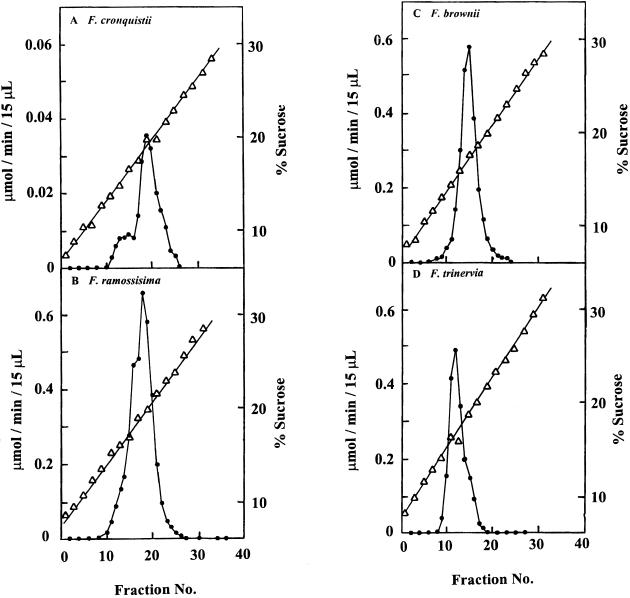
Figure 1
Figure 1
Resolution of leaf NADP-ME from representative species of different photosynthetic types of Flaveria spp. by Suc density gradient centrifugation. A, F. cronquistii (C3); B, F. ramosissima (C3-C4); C, F. brownii (C4-like); and D, F. trinervia (C4). The activity of NADP-ME (•) is shown on the left y-axes and the percent Suc in the gradient (Δ) is shown on the right y-axes.
Figure 2
Figure 2
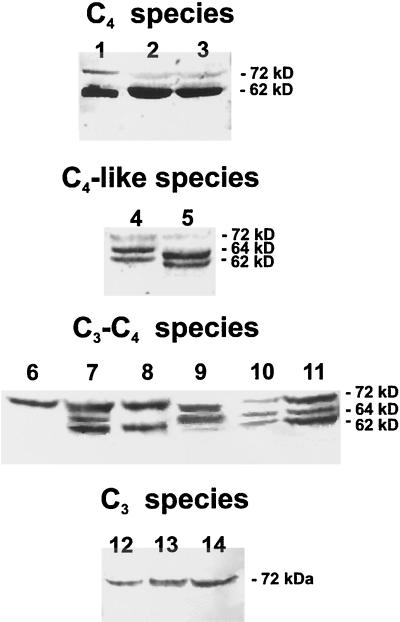
Immunoblot analysis of leaf total proteins extracted from different Flaveria spp. Leaf proteins of Flaveria spp. (60 μg) and maize (10 μg) were separated by SDS-PAGE, transferred onto nitrocellulose membranes, and probed with purified anti-maize 62-kD NADP-ME IgG. The lines indicate the position of the 72-, 64-, and 62-kD immunoreactive bands. The species used were C4: maize (lane 1); F. trinervia (lane 2); F. bidentis (lane 3). C4-like: F. brownii (lane 4); F. vaginata (lane 5). C3-C4: F. sonorensis (lane 6); F. oppositifolia (lane 7); F. angustifolia (lane 8); F. ramosissima (lane 9); F. floridana (lane 10); F. linearis (lane 11). C3: F. cronquistii (lane 12); F. pringlei (lane 13); F. robusta (lane 14).
Figure 3
Figure 3
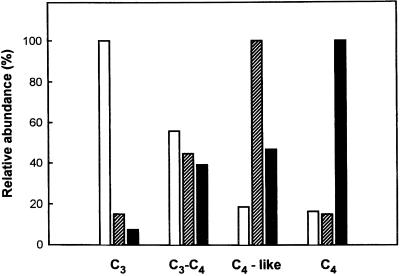
Relative abundance of the three monomeric isoforms of NADP-ME in the different photosynthetic types of Flaveria spp.. The western blots from the results in Figure 2 were scanned, the areas of the peaks corresponding to the monomeric forms were determined, the average of each form within each photosynthetic type was calculated, and the relative abundance was determined. Immunoblots were repeated three times with the same phenol extract for all species; duplicate extracts from separate leaves with a species representing each photosynthetic type gave similar results. The results are presented for each form as a percentage of the maximum, with the photosynthetic group having the maximum amount of that form taken as 100%. Very low levels of the 62-kD (black columns) and 64-kD (striped columns) forms were detected in scans of the C3 species, although they are not apparent in the immunoblots in Figure 2 (lanes 12–14). The white columns represent 72-kD forms.
Figure 4
Figure 4
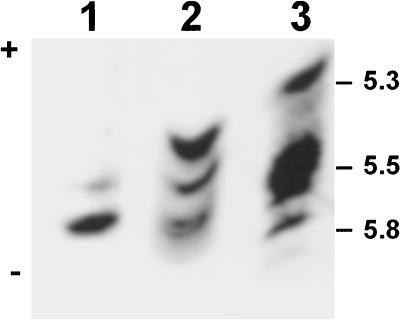
Activity staining of leaf NADP-ME from F. pringlei (C3), F. floridana (C3-C4 intermediate), and F. trinervia (C4) on native IEF gels. The pH gradient used for IEF was from 5.0 to 7.0. The calculated native pI of the reactive bands are between 5.3 and 5.8. Leaf protein extracts were made from F. pringlei (lane 1), F. floridana (lane 2), and F. trinervia (lane 3). The amount of protein loaded was equivalent to 1 milliunit of NADP-ME activity.
Figure 5
Figure 5
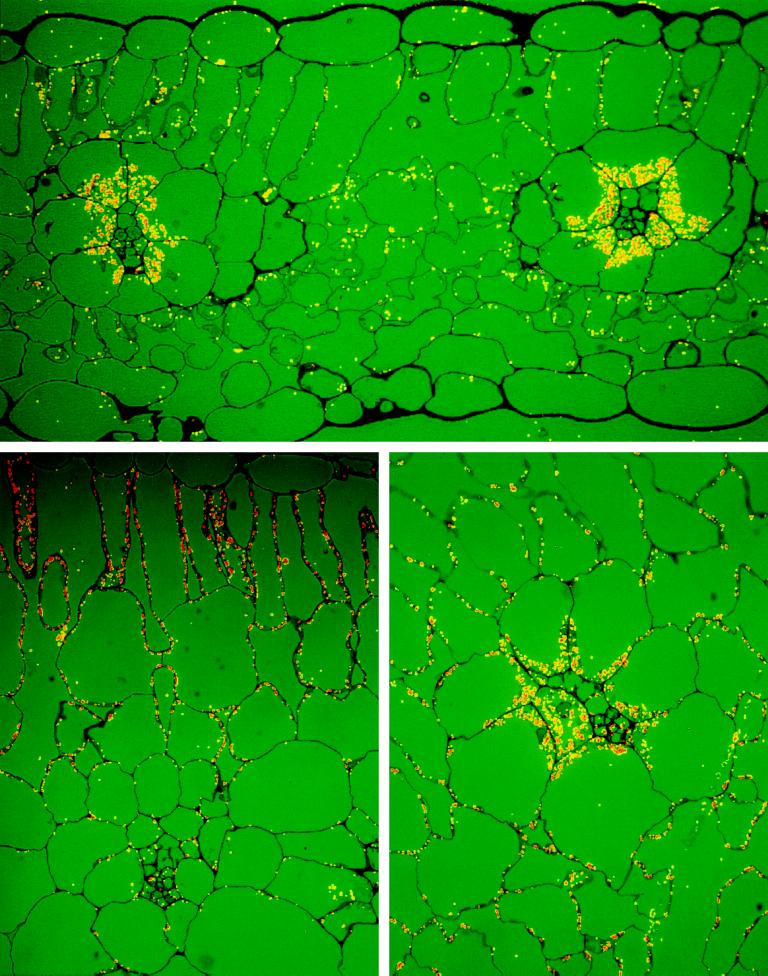
Light microscopy of in situ immunolocalization of NADP-ME in leaves of F. bidentis (C4, upper panel), F. robusta (C3, lower left panel), and F. ramosissima (C3-C4, lower right panel).
Figure 6
Figure 6
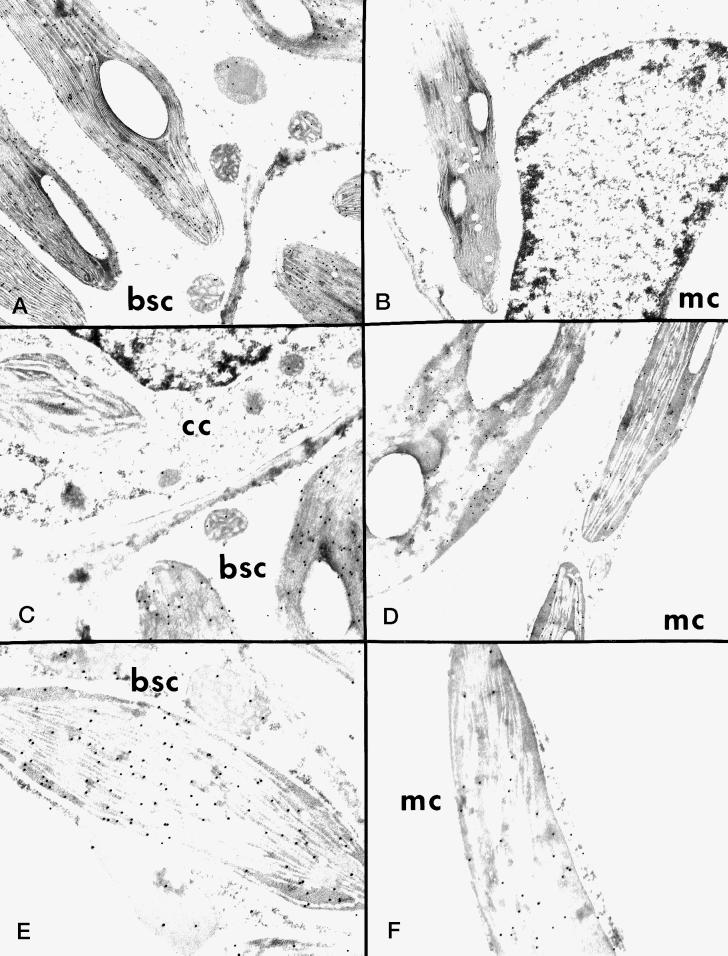
Electron microscopy of in situ immunolocalization of NADP-ME in leaves of Flaveria spp. A to C, F. bidentis (C4); D, F. robusta (C3); E and F, F. ramosissima (C3-C4). bsc, Bundle-sheath cell; mc, mesophyll cell; cc, companion cell.

References

    1. Borsch D, Westhoff P. Primary structure of NADP-dependent malic enzyme in the dicotyledonous Flaveria trinervia. FEBS Lett. 1990;273:111–115. - PubMed
    1. Burnette WN. “Western blotting”: electrophoretic transfer of proteins from sodium dodecyl sulfate-polyacrylamide gels to unmodified nitrocellulose and radiographic detection with antibody and radioiodinated protein A. Anal Biochem. 1981;112:195–203. - PubMed
    1. Cameron RG, Bassett CL. Inheritance of C4 enzymes associated with carbon fixation in Flaveria species. Plant Physiol. 1988;88:532–536. - PMC - PubMed
    1. Cameron RG, Bassett CL, Bouton JH, Brown RH. Transfer of C4 photosynthetic characters through hybridization of Flaveria species. Plant Physiol. 1989;90:1538–1545. - PMC - PubMed
    1. Casati P, Spampinato CP, Andreo CS. Characteristics and physiological function of NADP-malic enzyme from wheat. Plant Cell Physiol. 1997;38:928–934.

LinkOut - more resources