. 1998 Jul;117(3):841-9.
doi: 10.1104/pp.117.3.841.

The never ripe mutant provides evidence that tumor-induced ethylene controls the morphogenesis of agrobacterium tumefaciens-induced crown galls on tomato stems

The never ripe mutant provides evidence that tumor-induced ethylene controls the morphogenesis of agrobacterium tumefaciens-induced crown galls on tomato stems

R Aloni et al. Plant Physiol. 1998 Jul.

Abstract

We confirm the hypothesis that Agrobacterium tumefaciens-induced galls produce ethylene that controls vessel differentiation in the host stem of tomato (Lycopersicon esculentum Mill.). Using an ethylene-insensitive mutant, Never ripe (Nr), and its isogenic wild-type parent we show that infection by A. tumefaciens results in high rates of ethylene evolution from the developing crown galls. Ethylene evolution from isolated internodes carrying galls was up to 50-fold greater than from isolated internodes of control plants when measured 21 and 28 d after infection. Tumor-induced ethylene substantially decreased vessel diameter in the host tissues beside the tumor in wild-type stems but had a very limited effect in the Nr stems. Ethylene promoted the typical unorganized callus shape of the gall, which maximized the tumor surface in wild-type stems, whereas the galls on the Nr stems had a smooth surface. The combination of decreased vessel diameter in the host and increased tumor surface ensured water-supply priority to the growing gall over the host shoot. These results indicate that in addition to the well-defined roles of auxin and cytokinin, there is a critical role for ethylene in determining crown-gall morphogenesis.


Figures
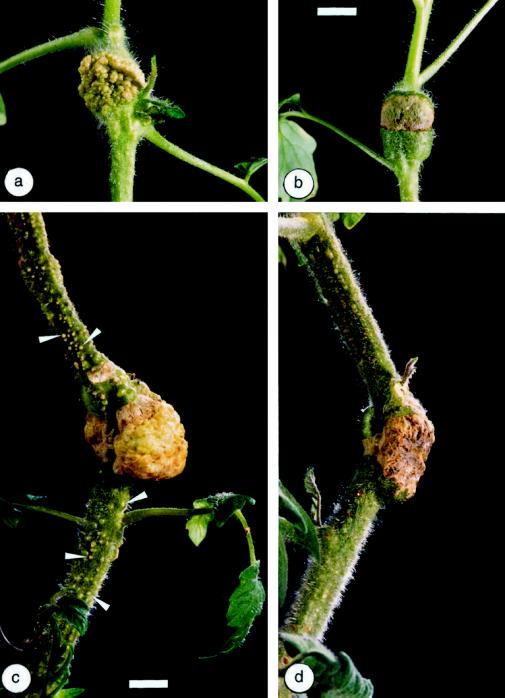
Figure 1
Figure 1
Comparison of A. tumefaciens-induced crown galls on wild-type tomato (a and c) and Nr mutant (b and d) stems. a, Front view of a 3-week-old tumor developed on a wild-type plant showing the typical unorganized callus shape of a young crown gall and the epinastic response of the leaves both above and below the tumor. b, Front view of a 3-week-old tumor developed on the Nr mutant, characterized by a smooth surface and leaves in the normal orientation. Note that the lower half of the gall is protected by epidermis. c, Side view of a 2-month-old tumor on a wild-type stem with numerous adventitious roots (white spots) developed both above and below the crown gall (indicated with arrowheads). d, Side view of a 2-month-old tumor on the Nr mutant showing a fibrous hard gall and a stem almost free of adventitious roots. All photographs are at the same magnification (bars = 10 mm).
Figure 2
Figure 2
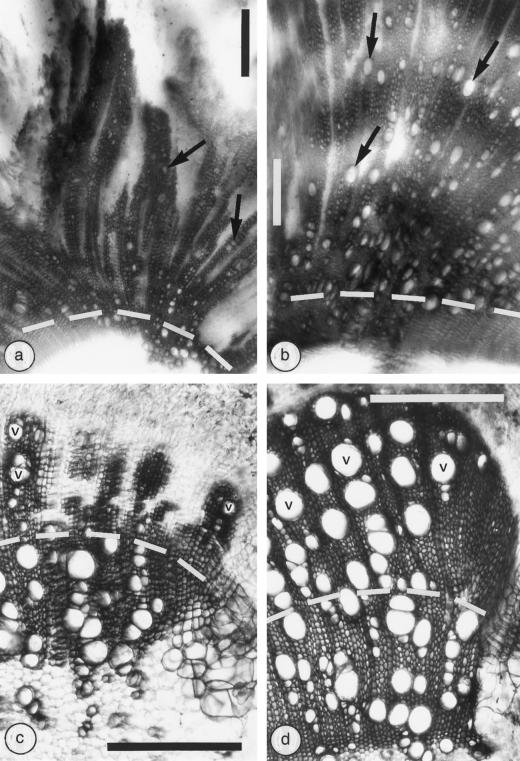
The effects of 6-week-old A. tumefaciens-induced crown galls on xylem differentiation in tomato host stems (a and b), and the effects of a 5-week application of 1% (w/w) ethrel on xylem differentiation in tomato stems (c and d), are shown in thick transverse sections cleared with lactic acid and stained with lacmoid. The crown galls were located above the micrographs (a and b), and the white region at the lower part of the photographs is the cleared pith. The border between the xylem formed after infection with A. tumefaciens or after ethrel application (upper part of each micrograph) and the intact xylem developed before the treatments (lower part) is delineated by a broken line. At the lower right of the ethrel-affected stems (c and d) there is a wound reaction resulting from a marking scratch done at the beginning of the experiment. a, Limited differentiation of pathologic xylem with very narrow vessels and wide rays (the clear regions in the upper part of the xylem) characterize the wild-type host. b, Massive xylem with wide vessels and almost normal rays occur in the Nr mutant. c, Limited differentiation of xylem with narrow vessels and wide rays (clear radial regions) characterize the ethrel-affected xylem. d, Wide vessels and normal lignified rays are typical of the new xylem formed in the Nr mutant after ethrel application. Arrows, Vessels affected by A. tumefaciens; v, vessels affected by ethrel. Bars = 500 μm.
Figure 3
Figure 3
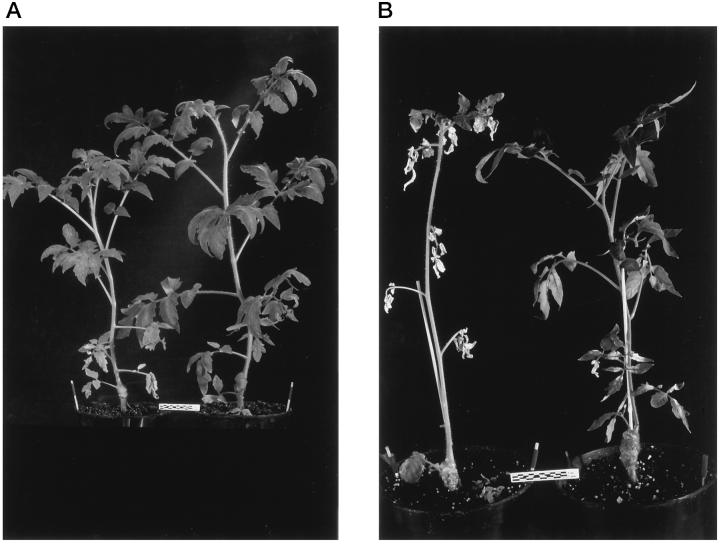
The effects of 4-week-old A. tumefaciens-induced crown galls located at the base of the stems on shoot development and leaf senescence in tomato plants. A, Retarded wild-type shoot (left) and a typically taller Nr shoot with large leaves (right). Note that the older leaves in the wild-type plant started to turn yellow and senesce. B, Moderate water stress caused leaf senescence in the wild-type shoot (left), whereas most of the leaves remained green and healthy on the Nr shoot (right).
Figure 4
Figure 4
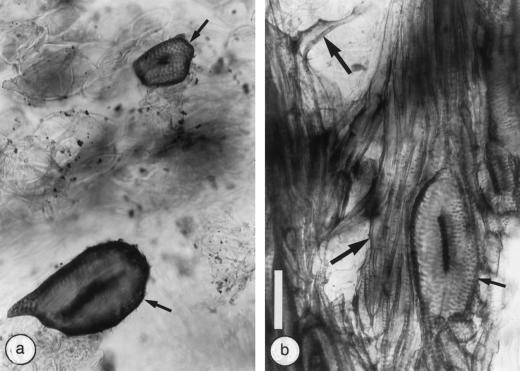
Typical patterns of vascular tissues in 6-week-old A. tumefaciens-induced crown galls on tomato stems observed in thick, longitudinal radial sections cleared with lactic acid and stained with lacmoid. a, Circular vessels surrounded by parenchyma cells in wild-type stems. b, Circular vessels surrounded by fibers in the Nr mutant. Small arrows, Circular vessels; large arrows, fibers. Both photographs are at the same magnification (bar = 100 μm).

References

    1. Abeles FB, Morgan PW, Saltveit ME., Jr . Ethylene in Plant Biology, Ed 2. San Diego, CA: Academic Press; 1992.
    1. Agrios GN (1988) Bacterial galls. In GN Agrios, ed, Plant Pathology. Academic Press, New York, pp 483–488
    1. Akiyoshi DE, Morris RO, Hinz R, Mischke BS, Kosuge T, Garfinkel DJ, Gordon MP, Nester EW. Cytokinin/auxin balance in crown gall tumors is regulated by specific loci in the T-DNA. Proc Natl Acad Sci USA. 1983;80:407–411. - PMC - PubMed
    1. Aloni R. Role of auxin and gibberellin in differentiation of primary phloem fibers. Plant Physiol. 1979;63:609–614. - PMC - PubMed
    1. Aloni R. Differentiation of vascular tissues. Annu Rev Plant Physiol. 1987;38:179–204.

LinkOut - more resources