. 1998 Jul;117(3):1059-69.
doi: 10.1104/pp.117.3.1059.

Potent inhibition of ribulose-bisphosphate carboxylase by an oxidized impurity in ribulose-1,5-bisphosphate

Potent inhibition of ribulose-bisphosphate carboxylase by an oxidized impurity in ribulose-1,5-bisphosphate

HJ Kane et al. Plant Physiol. 1998 Jul.

Abstract

Oxidation of D-ribulose-1,5-bisphosphate (ribulose-P2) during synthesis and/or storage produces D-glycero-2,3-pentodiulose-1, 5-bisphosphate (pentodiulose-P2), a potent slow, tight-binding inhibitor of spinach (Spinacia oleracea L.) ribulose-P2 carboxylase/oxygenase (Rubisco). Differing degrees of contamination with pentodiulose-P2 caused the decline in Rubisco activity seen during Rubisco assay time courses to vary between different preparations of ribulose-P2. With some ribulose-P2 preparations, this compound can be the dominant cause of the decline, far exceeding the significance of the catalytic by-product, D-xylulose-1, 5-bisphosphate. Unlike xylulose-1,5-bisphosphate, pentodiulose-P2 did not appear to be a significant by-product of catalysis by wild-type Rubisco at saturating CO2 concentration. It was produced slowly during frozen storage of ribulose-P2, even at low pH, more rapidly in Rubisco assay buffers at room temperature, and particularly rapidly on deliberate oxidation of ribulose-P2 with Cu2+. Its formation was prevented by the exclusion of transition metals and O2. Pentodiulose-P2 was unstable and decayed to a variety of other less-inhibitory compounds, particularly in the presence of some buffers. However, it formed a tight, stable complex with carbamylated spinach Rubisco, which could be isolated by gel filtration, presumably because its structure mimics that of the enediol intermediate of Rubisco catalysis. Rubisco catalyzes the cleavage of pentodiulose-P2 by H2O2, producing P-glycolate.


Figures
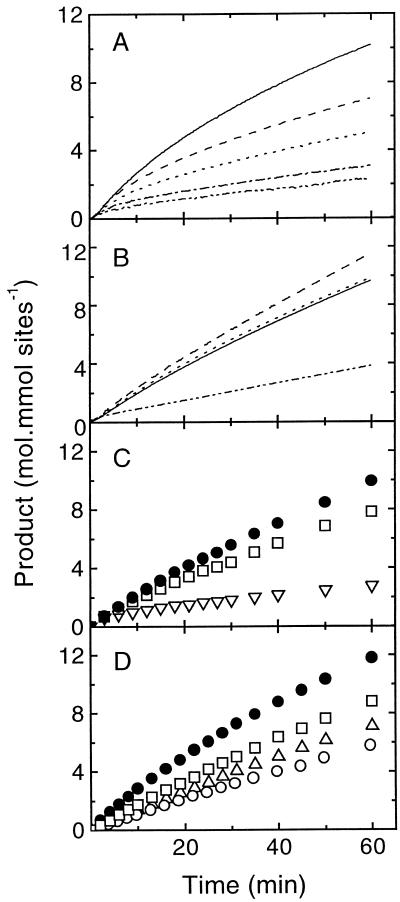
Figure 1
Figure 1
Effect of storage of ribulose-P2 and treatment with H2O2 on the time courses of Rubisco activity assays. Assays were conducted as described in Methods using either the spectrophotometric (A and B) or the radiometric (C and D) procedure. Ribulose-P2 was derived from a freshly thawed aliquot that had been stored in liquid N2 since synthesis. It was either used without further treatment or preincubated aseptically in 125 mm Hepps-NaOH buffer, pH 8.0, containing 25 mm MgCl2, at 22°C before use. A, Effect of increasing periods of preincubation: ——, 0 min; — — —, 130 min; - - -, 240 min; — - —, 480 min; and — - - —, 1445 min. B, Effect of exclusion of O2 during ribulose-P2 storage and/or Rubisco assay: ——, fresh ribulose-P2/aerobic assay; - - -, fresh ribulose-P2/anaerobic assay; — - - —, ribulose-P2 stored aerobically for 24 h/aerobic assay; and — — —, ribulose-P2 stored anaerobically for 27 h in Mg2+-free buffer in the presence of Chelex 100 resin (100–200 mesh, Na+ form, Bio-Rad)/anaerobic assay. C, Reversal of inhibition by exposure of the stored ribulose-P2 preparation to H2O2. Ribulose-P2 was used without storage (•), stored for 24 h (▿), or stored for 24 h followed by treatment with 1 m H2O2 for 30 min and removal of H2O2 with 500 units of bovine catalase (□). D, Effect of H2O2 when present during assay of Rubisco using fresh ribulose-P2: •, no H2O2; □, 2 mm H2O2; Δ, 4 mm H2O2; and ○, 6 mm H2O2.
Figure 2
Figure 2
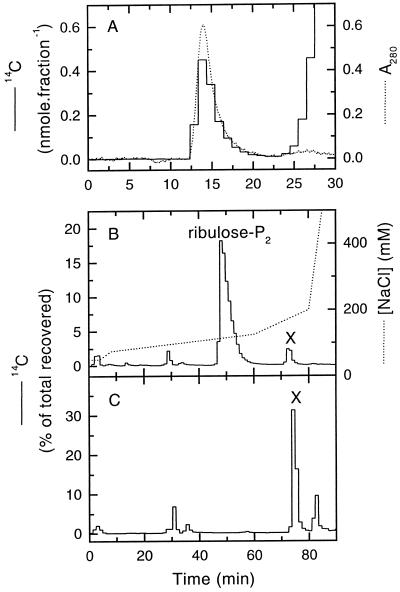
An impurity in a 14C-ribulose-P2 preparation that binds tightly to Rubisco. A, [1-14C]ribulose-P2 (freshly thawed after 4 years of storage at pH 2.8 and at −80°C, final concentration 30 μm, 82,000 cpm nmol−1) was mixed with preactivated spinach Rubisco (final concentration 17 μm) in 45 mm Hepps-NaOH buffer, pH 8.0, containing 13 mm MgCl2, 1 mm EDTA, and 9 mm NaHCO3. After 10 min at 22°C, 0.56 mL of this solution was applied to a 1- × 26-cm column of Sephadex G-50 (fine) equilibrated with the same buffer components at a flow rate of 0.63 mL min−1. The effluent was monitored for radioactivity and A280. B, Anion-exchange chromatography on a Mono-Q 5/5 column (see “Materials and Methods,” elution protocol A) of the [1-14C]ribulose-P2 preparation used in A. C, Fractions comprising the high-Mr peak shown in A were pooled and SDS was added to 1% (w/v). Protein was removed by ultrafiltration and an aliquot of the filtrate was chromatographed as in B, approximately 2 h after the addition of SDS.
Figure 3
Figure 3
Characterization of the tight-binding impurity in [1-14C]ribulose-P2. A, Twenty-six nanomoles of [1-14C]ribulose-P2 (82,000 cpm nmol−1) was chromatographed on a Mono-Q 5/5 column as described in Methods (elution protocol B). Fractions comprising the 52-min peak were pooled and divided into 500-μL aliquots, each of which was subjected to one of the following treatments and then rechromatographed. B, An aliquot was snap frozen, stored overnight in liquid N2, diluted to 1 mL with column-starting buffer, and rechromatographed. C, An aliquot was diluted to 1 mL with 50 mm Hepps-NaOH buffer, pH 8.0, supplemented with o-phenylenediamine to 100 mm, and rechromatographed after storage for 1 h in the dark at 22°C. D, To another aliquot, H2O2 was added to a final concentration of 1.1 m. After 1 h at room temperature, water was added to 2 mL and 2,600 units of bovine catalase was added. Thirty minutes later, the mixture was snap frozen and stored overnight in liquid N2 before rechromatography. The resulting chromatogram was aligned against a separate chromatogram of a 6:1 mixture of [3H]-P-glycolate and [3H]-P-glycerate generated from [1-3H]ribulose-P2 with R. rubrum Rubisco in a solution equilibrated with 500 μL L−1 CO2 in O2 as described by Kane et al. (1994) but omitting the phosphatase treatment. The larger peak of [3H]P-glycolate, eluting near 28 min and clearly resolved from the closely preceding [3H]P-glycerate peak, aligns precisely with the 28-min peak derived from the impurity. The peaks eluting near 4 min are presumably the products of phosphatase contamination of the enzyme preparations.
Scheme 1
Scheme 1
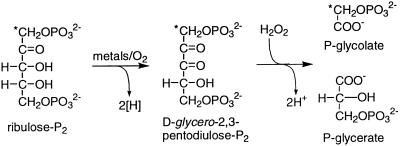
Transition-metal-catalyzed oxidation of ribulose-P2 and nonenzymatic cleavage of the resultant pentodiulose-P2 by high concentrations of H2O2. The asterisks indicate the fate of the C-1 carbon of ribulose-P2.
Figure 4
Figure 4
Inhibition of Rubisco caused by a product of ribulose-P2 oxidation. [1-3H]ribulose-P2 (280 cpm nmol−1) was mixed with an air-equilibrated solution containing 100 mm Hepps-NaOH, pH 8.0, and 2 mm CuSO4 and stored at room temperature for 3.5 h. A 1-mL sample was then applied to a 0.5-g column of Chelex 100 resin, and the column was washed with 0.4 mL of 10 mm Hepps-NaOH buffer, pH 8.0, containing 10 mm sodium borate. The eluant was applied to the Hema-IEC column and chromatographed as described in Methods. Fractions (1 min) were collected and 200 μL was removed for counting 3H (——). Fresh [1-3H]ribulose-P2, before Cu2+ treatment, was also chromatographed similarly (·······). Fractions in the vicinity of the 58-min, peak of the chromatogram of the Cu2+-treated sample were assayed within 10 min of collection for ability to inhibit Rubisco (○). A nonradioactive fraction eluting between ribulose-P2 and X was used as the control. Two-hundred microliters of each fraction was mixed with 200 μL of a solution of preactivated spinach Rubisco. After 5 min at 25°C, the reaction was initiated by a single addition of 75 μL of a mixture of ribulose-P2 and NaH14CO3. The final concentrations of components were: Rubisco, 2.3 μg mL−1; Hepps-NaOH buffer, pH 8.0, 90 mm; MgCl2, 17 mm; Na14HCO3 (4200 cpm nmol−1), 9.7 mm; NaCl, 75 mm; sodium borate, 4 mm; ribulose-P2, 525 μm. After 2 min, the reaction was stopped by addition of formic acid to 10% (v/v) and the mixtures were evaporated to dryness before addition of scintillant. 14C was determined by scintillation spectrometry using a window that discriminated completely against 3H. Inset, Plot of the extent of inhibition as a function of the concentration of inhibitor present in the assays, calculated from the 3H content. The dotted line shows the best fit of the data to a rectangular hyperbola. The solid line shows the best fit to the following equation, which models tight-binding inhibition (adapted from Berry et al. [1987]): formula image where Et and It are the total (bound plus free) concentrations of Rubisco active sites and the inhibitor, respectively, and Kd is the dissociation constant.
Scheme 2
Scheme 2
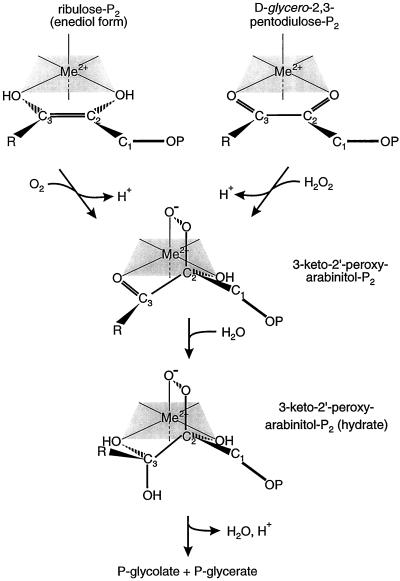
The structural analogy between the ribulose-P2 enediol and pentodiulose-P2 when bound within the active site of Rubisco, and the mechanistic analogy between Rubisco-catalyzed oxygenation of the enediol and Rubisco-catalyzed peroxidation of pentodiulose-P2 in the presence of low concentrations of H2O2. R = -CHOH-CH2OPO32−.

References

    1. Andrews TJ, Ballment B. Active site carbamate formation and reaction-intermediate-analog binding by ribulose bisphosphate carboxylase-oxygenase in the absence of its small subunits. Proc Natl Acad Sci USA. 1984;81:3660–3664. - PMC - PubMed
    1. Andrews TJ, Kane HJ. Pyruvate is a by-product of catalysis by ribulosebisphosphate carboxylase/oxygenase. J Biol Chem. 1991;266:9447–9452. - PubMed
    1. Andrews TJ, Lorimer GH (1987) Rubisco: structure, mechanisms, and prospects for improvement. In MD Hatch, NK Boardman, eds, The Biochemistry of Plants: A Comprehensive Treatise, Vol. 10, Photosynthesis. Academic Press, New York, pp 131–218
    1. Asada K. Production and action of active oxygen species in photosynthetic tissues. In: Foyer CH, Mullineaux PM, editors. Causes of Photooxidative Stress and Amelioration of Defense Systems in Plants. Boca Raton, FL: CRC Press; 1994. pp. 77–104.
    1. Badger MR, Andrews TJ, Canvin DT, Lorimer GH. Interaction of hydrogen peroxide with ribulose bisphosphate carboxylase-oxygenase. J Biol Chem. 1980;255:7870–7875. - PubMed

LinkOut - more resources