


Screening for problem drinking: comparison of CAGE and AUDIT. Ambulatory Care Quality Improvement Project (ACQUIP). Alcohol Use Disorders Identification Test
- PMID: 9669567
- PMCID: PMC1496970
- DOI: 10.1046/j.1525-1497.1998.00118.x
Screening for problem drinking: comparison of CAGE and AUDIT. Ambulatory Care Quality Improvement Project (ACQUIP). Alcohol Use Disorders Identification Test
Abstract
Objective: To compare self-administered versions of three questionnaires for detecting heavy and problem drinking: the CAGE, the Alcohol Use Disorders Identification Test (AUDIT), and an augmented version of the CAGE.
Design: Cross-sectional surveys.
Setting: Three Department of Veterans Affairs general medical clinics.
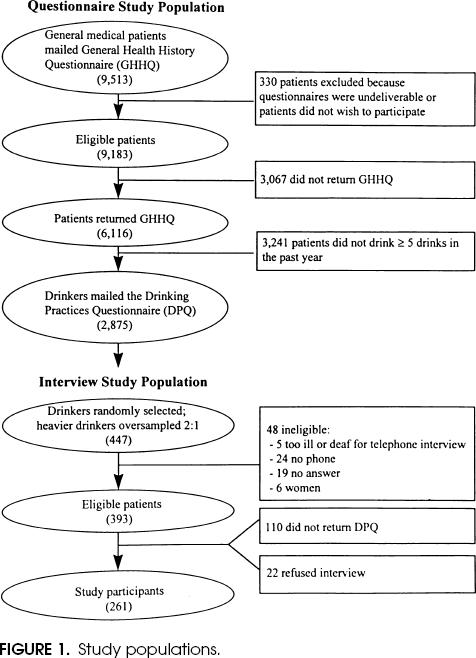
Patients: Random sample of consenting male outpatients who consumed at least 5 drinks over the past year ("drinkers"). Heavy drinkers were oversampled.
Measurements: An augmented version of the CAGE was included in a questionnaire mailed to all patients. The AUDIT was subsequently mailed to "drinkers." Comparison standards, based on the tri-level World Health Organization alcohol consumption interview and the Diagnostic Interview Schedule, included heavy drinking (> 14 drinks per week typically or > or = 5 drinks per day at least monthly) and active DSM-IIIR alcohol abuse or dependence (positive diagnosis and at least one alcohol-related symptom in the past year). Areas under receiver operating characteristic curves (AUROCs) were used to compare screening questionnaires.
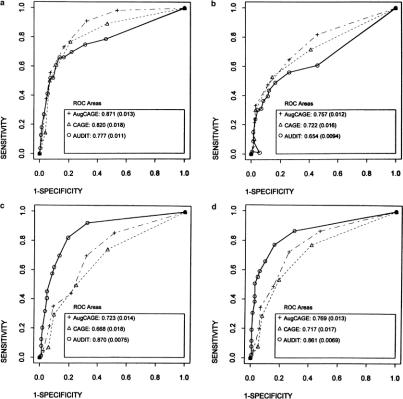
Main results: Of 393 eligible patients, 261 (66%) returned the AUDIT and completed interviews. For detection of active alcohol abuse or dependence, the CAGE augmented with three more questions (AUROC 0.871) performed better than either the CAGE alone or AUDIT (AUROCs 0.820 and 0.777, respectively). For identification of heavy-drinking patients, however, the AUDIT performed best (AUROC 0.870). To identify both heavy drinking and active alcohol abuse or dependence, the augmented CAGE and AUDIT both performed well, but the AUDIT was superior (AUROC 0.861).
Conclusions: For identification of patients with heavy drinking or active alcohol abuse or dependence, the self-administered AUDIT was superior to the CAGE in this population.
Figures
References
-
- Buchsbaum DG, Buchanan RG, Centor RM, Schnoll SH, Lawton MJ. Screening for alcohol abuse using CAGE scores and likelihood ratios. Ann Intern Med. 1991;115:774–7. - PubMed
-
- Connors GJ. Screening for alcohol problems. In: Allen JP, Columbus M, eds. Assessing Alcohol Problems: A Guide for Clinicians and Researchers. Bethesda, Md: National Institutes of Health; 1995;17–29. NIH publication 95-3745.
-
- Barry KL, Fleming MF. Computerized administration of alcoholism screening tests in a primary care setting. J Am Board Fam Pract. 1990;3:93–8. - PubMed
-
- Buchsbaum DG, Buchanan RG, Welsh J, Centor RM, Schnoll SH. Screening for drinking disorders in the elderly using the CAGE questionnaire. J Am Geriatr Soc. 1992;40:662–5. - PubMed
-
- Chan AK, Pristach EA, Welte JW. Detection by the CAGE of alcoholism or heavy drinking in primary care outpatients and the general population. J Subst Abuse. 1994;6(2):123–35. - PubMed
Publication types
MeSH terms
LinkOut - more resources
Full Text Sources
Medical
Miscellaneous