. 1998 Jul 21;95(15):8496-501.
doi: 10.1073/pnas.95.15.8496.

A C-terminal motif found in the beta2-adrenergic receptor, P2Y1 receptor and cystic fibrosis transmembrane conductance regulator determines binding to the Na+/H+ exchanger regulatory factor family of PDZ proteins

Affiliations

A C-terminal motif found in the beta2-adrenergic receptor, P2Y1 receptor and cystic fibrosis transmembrane conductance regulator determines binding to the Na+/H+ exchanger regulatory factor family of PDZ proteins

R A Hall et al. Proc Natl Acad Sci U S A. .

Abstract

The Na+/H+ exchanger regulatory factor (NHERF) binds to the tail of the beta2-adrenergic receptor and plays a role in adrenergic regulation of Na+/H+ exchange. NHERF contains two PDZ domains, the first of which is required for its interaction with the beta2 receptor. Mutagenesis studies of the beta2 receptor tail revealed that the optimal C-terminal motif for binding to the first PDZ domain of NHERF is D-S/T-x-L, a motif distinct from those recognized by other PDZ domains. The first PDZ domain of NHERF-2, a protein that is 52% identical to NHERF and also known as E3KARP, SIP-1, and TKA-1, exhibits binding preferences very similar to those of the first PDZ domain of NHERF. The delineation of the preferred binding motif for the first PDZ domain of the NHERF family of proteins allows for predictions for other proteins that may interact with NHERF or NHERF-2. For example, as would be predicted from the beta2 receptor tail mutagenesis studies, NHERF binds to the tail of the purinergic P2Y1 receptor, a seven-transmembrane receptor with an intracellular C-terminal tail ending in D-T-S-L. NHERF also binds to the tail of the cystic fibrosis transmembrane conductance regulator, which ends in D-T-R-L. Because the preferred binding motif of the first PDZ domain of the NHERF family of proteins is found at the C termini of a variety of intracellular proteins, NHERF and NHERF-2 may be multifunctional adaptor proteins involved in many previously unsuspected aspects of intracellular signaling.


Figures
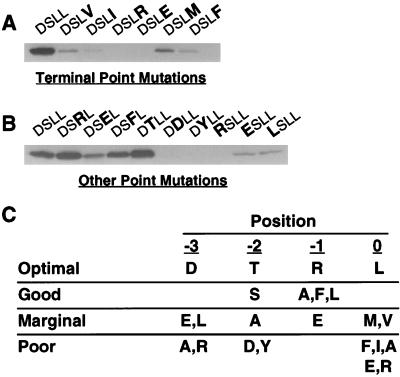
Figure 1
Figure 1
NHERF preferentially binds to the motif D-S/T-x-L at the end of target proteins. (A) Binding of the first PDZ domain of NHERF to the β2 receptor tail is inhibited by point mutations of the final residue of the tail. GST fusion proteins of the β2 receptor tail with mutations at the terminal position were expressed and purified. Equal amounts (≈25 μg) were loaded on SDS/PAGE gels, blotted, and overlaid with NHERF PDZ1 fusion protein (50 nM). The mutations of the β2 receptor tail (D-S-L-L) are indicated in bold at the top of the panel. (B) Point mutations at the −1, −2, and −3 positions of the β2 receptor tail differentially alter NHERF PDZ1 binding. Equal amounts of various β2 receptor tail point mutants were loaded on an SDS/PAGE gel, blotted, and probed for NHERF PDZ1 fusion protein binding. (C) Summary of NHERF PDZ1-binding preferences at the final four amino acid positions of target proteins based on single amino acid substitution studies of the β2 receptor tail. The optimal amino acid for each position is shown in the first line of the table. “Good” means that the given change causes less than a twofold loss in NHERF PDZ1 binding relative to the optimal amino acid at that position, whereas “marginal” means that the given change causes more than a twofold but less than a 10-fold decrease in binding. “Poor” means that the given change leads to a >10-fold decrease in NHERF PDZ1 binding. The results are representative of two to four independent determinations for binding to each mutant tail.
Figure 2
Figure 2
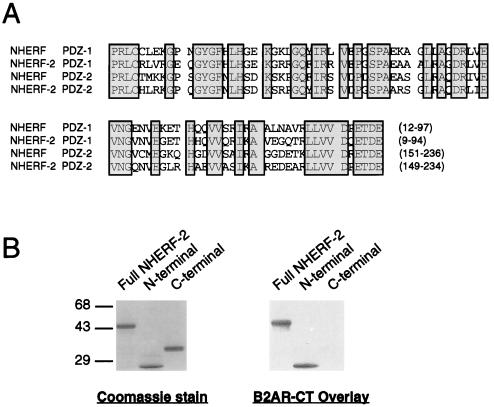
NHERF-2 exhibits structural and functional similarity to NHERF. (A) Alignment of NHERF and NHERF-2 PDZ domains. The first (“PDZ-1”) and second (“PDZ-2”) PDZ domains of both human NHERF and human NHERF-2 are aligned, with conserved residues boxed and shaded. The positions of the PDZ domains within the NHERF proteins are indicated by the numbers in parentheses at the end of each sequence. The two PDZ-1 sequences exhibit 73% identity, whereas the two PDZ-2 sequences exhibit 70% identity. The PDZ-1 and PDZ-2 domains of each protein are 60% identical to each other. (B) The β2 receptor tail binds to recombinant NHERF-2 fusion proteins on a blot overlay. The β2 receptor tail expressed as a GST fusion protein was overlaid onto three blotted samples: full-length NHERF-2 (“full”), the N-terminal 121 amino acids of NHERF-2, which contains the first PDZ domain (“N-term”), and the C-terminal 210 amino acids of NHERF-2, which contains the second PDZ domain (“C-term”). As shown by the Coomassie-stained SDS/PAGE gel (Left), equal amounts of the three fusion proteins were loaded. Overlays of the blotted samples with the β2 receptor tail-GST (Right) revealed that the receptor tail binds specifically to full-length NHERF-2 and to the N-terminal portion of NHERF-2 but not to the C-terminal portion. This experiment was performed three times with identical results.
Figure 3
Figure 3
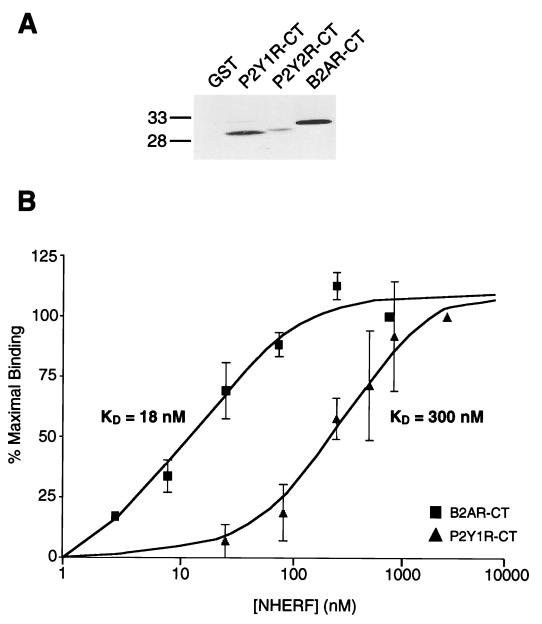
The P2Y1 receptor tail binds to the first PDZ domain of NHERF, though with lower affinity than the β2-adrenergic receptor tail. (A) The first PDZ domain of NHERF binds well to the β2 receptor tail, moderately to the P2Y1 receptor tail, and poorly to the P2Y2 receptor tail. Equal amounts of the three fusion proteins (25 μg), along with control GST (Left lane), were run on an SDS/PAGE gel, blotted, and overlaid with NHERF PDZ1 fusion protein (50 nM). This experiment was performed twice with identical results. (B) Determination of the binding affinity of NHERF for the β2 receptor and P2Y1 receptor tails. Equal amounts of β2 receptor tail GST fusion protein or P2Y1 receptor tail GST fusion protein (25 μg) were run on SDS/PAGE gels, blotted, and overlaid with six different concentrations of purified S-tagged NHERF fusion protein. The x-axis is plotted as a logarithmic scale of the concentration of NHERF PDZ1 fusion protein, and the y-axis represents the relative amount of NHERF PDZ1 binding expressed as a percentage of the binding observed at the highest NHERF PDZ1 concentration (1 μM in the case of the β2 receptor, 3 μM in the case of the P2Y1 receptor). The estimated KD for NHERF binding to the β2 receptor tail is 18 nM, whereas the estimate for NHERF binding to the P2Y1 receptor tail is 300 nM. Each point and error bar represents the mean ± SEM for three independent determinations.
Figure 4
Figure 4
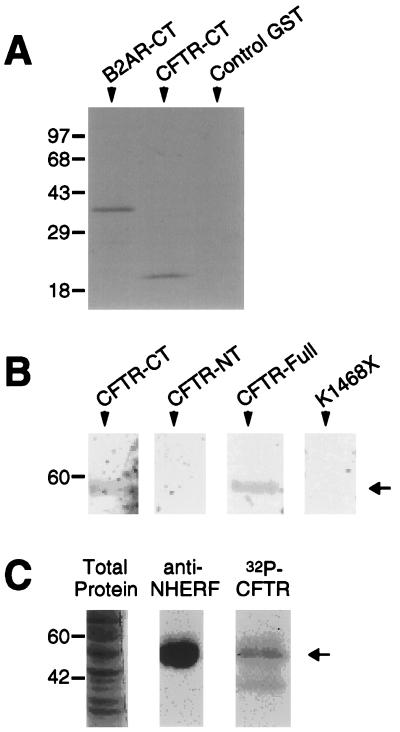
NHERF associates with CFTR tail and full-length CFTR. (A) NHERF PDZ1 binds equally well to the tails of the β2 receptor and CFTR expressed as fusion proteins but does not bind detectably to control GST. Approximately 25 μg of each protein was run on an SDS/PAGE gel, blotted, and then overlaid with 50 nM NHERF PDZ1 fusion protein. This experiment was performed twice with identical results. (B) Full-length CFTR binds to full-length NHERF. In vitro translated 35S-labeled probes of either CFTR C terminus (“CFTR-CT”), CFTR N terminus (“CFTR-NT”), full-length CFTR (“CFTR-Full), or a truncated CFTR (”K1468X“) were overlaid onto blot strips containing ≈10 μg of purified full-length NHERF fusion protein. Full-length CFTR and CFTR C terminus bound avidly to the NHERF but CFTR N terminus and CFTR K1468X did not detectably bind. (C) An airway epithelial protein consistent with the size of NHERF is recognized by the anti-NHERF antibody and by the C terminus of CFTR. Soluble fractions of differentiated airway cells were stained with Coomassie blue and probed with an anti-NHERF antibody or with a 32P-phosphorylated C-terminal fusion protein of CFTR. The antibody and the C-terminal probe both recognized a band of identical size in the soluble fraction of airway proteins consistent with the expected size of NHERF.

References

    1. Sheng M. Neuron. 1996;17:575–578. - PubMed
    1. Harrison S C. Cell. 1996;86:341–343. - PubMed
    1. Saras J, Heldin C-H. Trends Biochem Sci. 1996;21:455–458. - PubMed
    1. Kornau H C, Schenker L T, Kennedy M B, Seeburg P H. Science. 1995;269:1737–1740. - PubMed
    1. Songyang Z, Fanning A S, Fu C, Xu J, Marfatia S M, Chishti A H, Crompton A, Chan A C, Anderson J M, Cantley L C. Science. 1997;275:73–77. - PubMed

Publication types

MeSH terms

Substances

Associated data