. 1998 Jul 21;95(15):8733-8.
doi: 10.1073/pnas.95.15.8733.

Bloom's and Werner's syndrome genes suppress hyperrecombination in yeast sgs1 mutant: implication for genomic instability in human diseases

Affiliations

Bloom's and Werner's syndrome genes suppress hyperrecombination in yeast sgs1 mutant: implication for genomic instability in human diseases

K Yamagata et al. Proc Natl Acad Sci U S A. .

Abstract

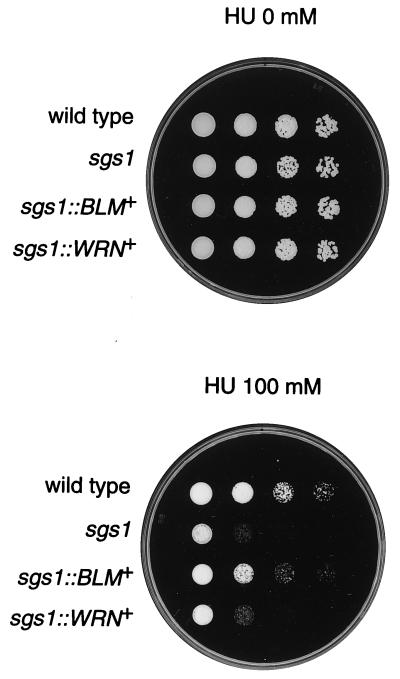
Bloom's syndrome (BS) and Werner's syndrome (WS) are genetic disorders in which an increased rate of chromosomal aberration is detected. The genes responsible for these diseases, BLM and WRN, have been found to be homologs of Escherichia coli recQ and Saccharomyces cerevisiae SGS1 genes. Here we show that yeast Sgs1 helicase acts as a suppressor of illegitimate recombination through homologous recombination and that human BLM and WRN helicases can suppress the increased homologous and illegitimate recombinations in the S. cerevisiae sgs1 mutant. The results imply a role of BLM and WRN helicases to control genomic stability in human cells. Similar to Sgs1 helicase, BLM helicase suppressed the cell growth in the top3 sgs1 mutation background and restored the increased sensitivity of the sgs1 mutant to hydroxyurea, but the WRN helicase did not. We discussed differential roles of BLM and WRN helicases in human cells. BLM- and WRN-bearing yeasts provide new useful models to investigate human BS and WS diseases.


Figures

Figure 1
Figure 1
Junction sequences of deleted plasmids derived from the sgs1 mutant. The top sequence represents the parental sequence corresponding to the left side of the junction, the middle sequence represents the sequence of the recombinant, and the bottom sequence represents the parental sequence corresponding to the right side of the junction. Homologous sequences around a junction are represented by a bold letter. The orientation of DNA is 5′ to 3′ from left to right. Numbers represent the map coordinates of the YCpL2 sequence.
Figure 2
Figure 2
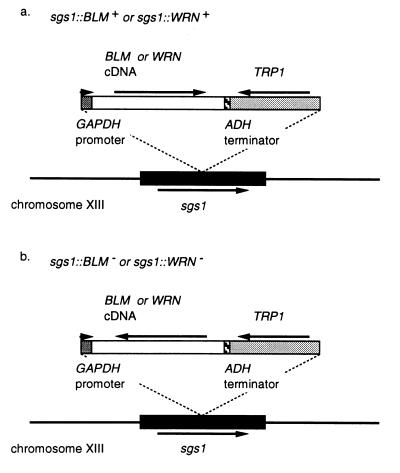
Construction of BLM- and WRN-bearing yeast strains. (a) Structures of the sgs1∷BLM+ and sgs1∷WRN+strains. To construct these strains, we inserted a GAPDH promoter-BLM cDNA (or WRN cDNA)-ADH terminator-TRP1 fragment into the SGS1 locus of S. cerevisiae DH6.61D by a one-step gene replacement method (25). The BLM cDNA (or WRN cDNA) was connected with the GAPDH promoter in the correct orientation. Arrows indicate the orientation of GAPDH promoter and other genes. (b) Structures of the sgs1∷BLM and sgs1WRN strains. The sgs1∷BLM and sgs1∷WRN strains are also constructed by insertion into the SGS1 locus as shown above, except that the BLM cDNA (or WRN cDNA) was connected with the GAPDH promoter in the opposite orientation.
Figure 3
Figure 3
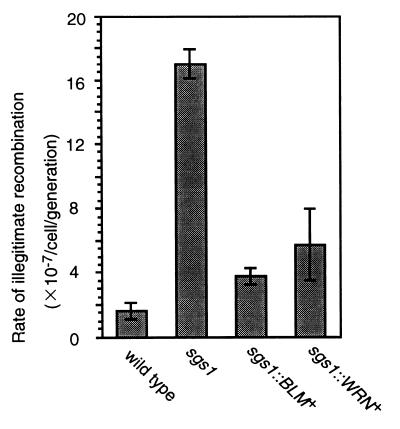
The rate of illegitimate recombination in the sgs1∷BLM+ and sgs1∷WRN+strains. The rates of illegitimate recombination in DH6.61D wild type, KY12 sgs1, KY21 sgs1∷BLM+, and KY23 sgs1∷WRN+ were determined by fluctuation analysis by using plasmid YCpL2 as described in Table 1. Vertical bars represent SEM.
Figure 4
Figure 4
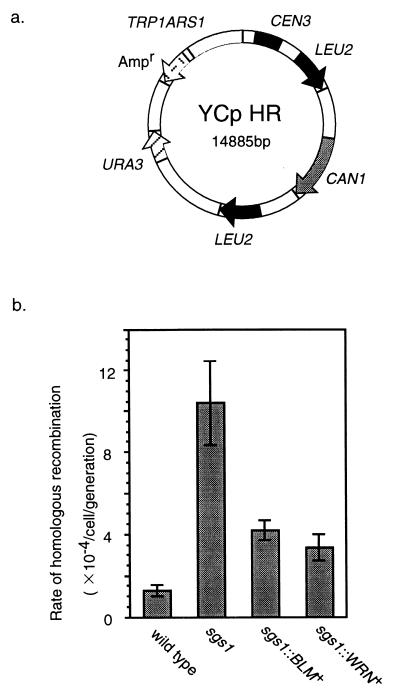
The rate of homologous recombination in the sgs1∷BLM+ and sgs1∷WRN+ strains. (a) Plasmid YCpHR carries the CAN1 gene between direct repeats of the LEU2 gene and is used to determine the rate of homologous recombination. (b) The rates of deletion between direct repeats in plasmid YCpHR. The rates of homologous recombination between direct repeats in DH6.61D wild type, KY12 sgs1, KY21 sgs1∷BLM+, and KY23 sgs1∷WRN+ were determined as described above. Vertical bars represent SEM.
Figure 5
Figure 5
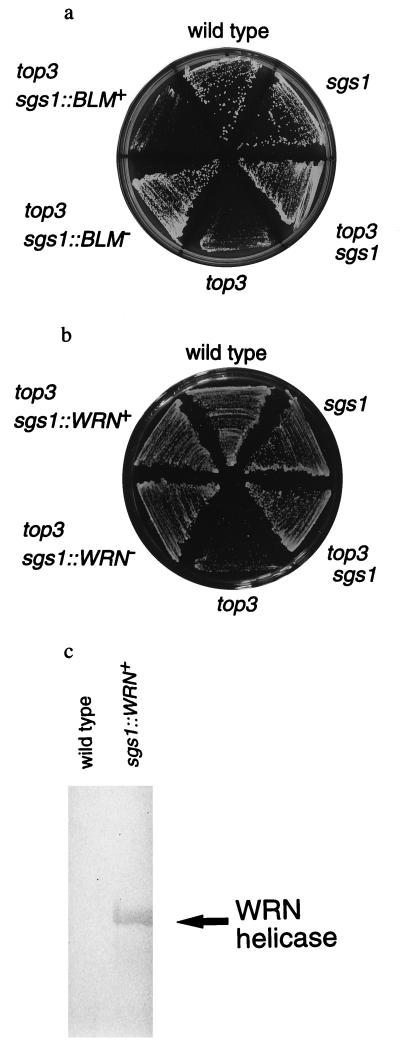
Functions of BLM and WRN genes in the top3 background. (a) Comparison of the growth rates in the top3 sgs1∷BLM+ and top3 sgs1∷BLM strains. We examined the growth rates of six strains: DH6.61D wild type, KY12 sgs1, KY15 top3 sgs1, KY16 top3, KY25 top3 sgs1∷BLM+, KY26 top3 sgs1∷BLM. (b) Comparison of growth rates of the top3 sgs1∷WRN+ and top3 sgs1∷WRN strains. We examined growth rates of six strains: DH6.61D wild type, KY12 sgs1, KY15 top3 sgs1, KY16 top3, KY27 top3 sgs1∷WRN+, and KY28 top3 sgs1∷WRN−. (c) Western blot analysis of DH6.61D wild type and KY23 sgs1∷WRN+. Western blot analysis of DH6.61D wild type and KY23 sgs1∷WRN+ was carried out as described in Materials and Methods.
Figure 6
Figure 6
Sensitivity of the sgs1∷BLM+ and sgs1∷WRN+ strains to hydroxyurea. Exponential cultures of DH6.61D wild type, KY12 sgs1, KY21 sgs1∷BLM+, and KY23 sgs1∷WRN+ were spotted onto synthetic complete plates with or without 100 mM hydroxyurea (HU). Numbers of cells per spot were 3 × 10⁴, 3 × 10³, 3 × 10², and 30 (from left to right).

References

    1. Langlois R G, Bigbee W L, Jensen R H, German J. Proc Natl Acad Sci USA. 1989;86:670–674. - PMC - PubMed
    1. Scappaticci S, Cerimele D, Fraccaro M. Hum Genet. 1982;62:16–24. - PubMed
    1. Fukuchi K, Martin G M, Monnat R J., Jr Proc Natl Acad Sci USA. 1989;86:5893–5897. - PMC - PubMed
    1. Monnat R J, Jr, Hackmann A F, Chiaverotti T A. Genomics. 1992;13:777–787. - PubMed
    1. Ellis N A, Groden J, Ye T-Z, Straughen J, Lennon D J, Ciocci S, Proytcheva M, German J. Cell. 1995;83:655–666. - PubMed

Publication types