


Growth hormone-releasing hormone antagonist MZ-5-156 inhibits growth of DU-145 human androgen-independent prostate carcinoma in nude mice and suppresses the levels and mRNA expression of insulin-like growth factor II in tumors
- PMID: 9671770
- PMCID: PMC21168
- DOI: 10.1073/pnas.95.15.8864
Growth hormone-releasing hormone antagonist MZ-5-156 inhibits growth of DU-145 human androgen-independent prostate carcinoma in nude mice and suppresses the levels and mRNA expression of insulin-like growth factor II in tumors
Abstract
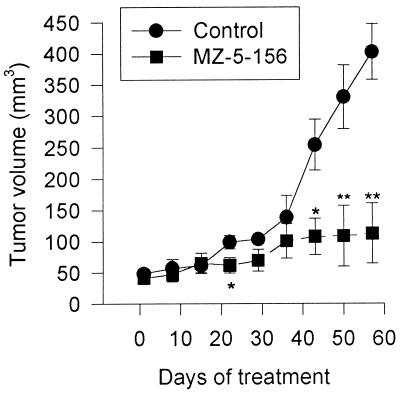
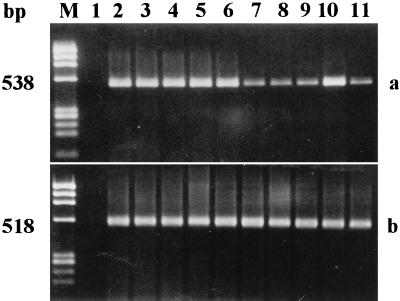
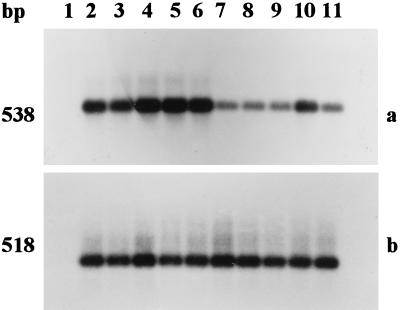
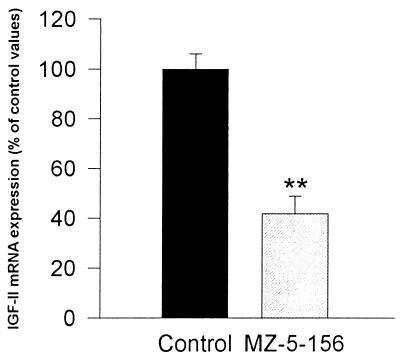
Insulin-like growth factors I and II (IGF-I and -II) are potent mitogens for various cancers, including carcinoma of the prostate. In several experimental cancers, treatment with antagonists of growth hormone-releasing hormone (GH-RH) produces a reduction in IGF-I and -II, concomitant to inhibition of tumor growth. To investigate the mechanisms involved, we treated male nude mice bearing xenografts of DU-145 human androgen-independent prostate cancer for 8 weeks with potent GH-RH antagonist MZ-5-156 at a dose of 20 microg/animal s.c. twice a day. Tumor growth, serum and tumor levels of IGF-I and -II, and the mRNA expression of IGF-I and -II in tumors were evaluated. After 8 weeks of therapy, final volume and weight of DU-145 tumors in mice treated with MZ-5-156 were significantly (P < 0.01) decreased compared with controls, and serum IGF-I showed a significant reduction. Treatment of nude mice bearing DU-145 xenografts with MZ-5-156 also significantly (P < 0.01) diminished by 77% the levels of IGF-II in tumor tissue compared with controls, but did not affect the concentration of IGF-I. Reverse transcription-PCR analyses revealed a high expression of IGF-II mRNA in DU-145 tumors. Treatment with GH-RH antagonist MZ-5-156 decreased the expression of IGF-II mRNA by 58% (P < 0.01) as compared with controls. Our work suggests that GH-RH antagonist MZ-5-156 may inhibit the growth of DU-145 human androgen-independent prostate cancers through a reduction in the production and mRNA expression of IGF-II by the tumor tissue. These findings extend our observations on the mechanism of action of GH-RH antagonists and may explain how GH-RH antagonists inhibit tumor growth.
Figures
References
-
- Parker S L, Tong T, Bolden S, Wingo P A. CA Cancer J Clin. 1996;46:5–27. - PubMed
-
- Schally A V, Comaru-Schally A M. In: Cancer Medicine. Holland J F, Frei E III, Bast D R Jr, Kufe D E, Morton D L, Weichselbaum R R, editors. Baltimore: Williams & Wilkins; 1997. pp. 1067–1085.
-
- Schally A V, Comaru-Schally A M, Gonzales-Barcena D. Biomed Pharmacother. 1990;46:465–471. - PubMed
-
- Reubi J C, Waser B, Schaer J C, Markwalder R. J Clin Endocrinol Metab. 1995;80:2806–2814. - PubMed
-
- Sekyi-Otu A, Bell R S, Ohashi C, Pollak M, Andrulis I L. Cancer Res. 1995;55:129–134. - PubMed
Publication types
MeSH terms
Substances
LinkOut - more resources
Full Text Sources
Other Literature Sources
Medical
