


CD1 presents antigens from a gram-negative bacterium, Haemophilus influenzae type B
- PMID: 9673229
- PMCID: PMC108382
- DOI: 10.1128/IAI.66.8.3523-3526.1998
CD1 presents antigens from a gram-negative bacterium, Haemophilus influenzae type B
Abstract
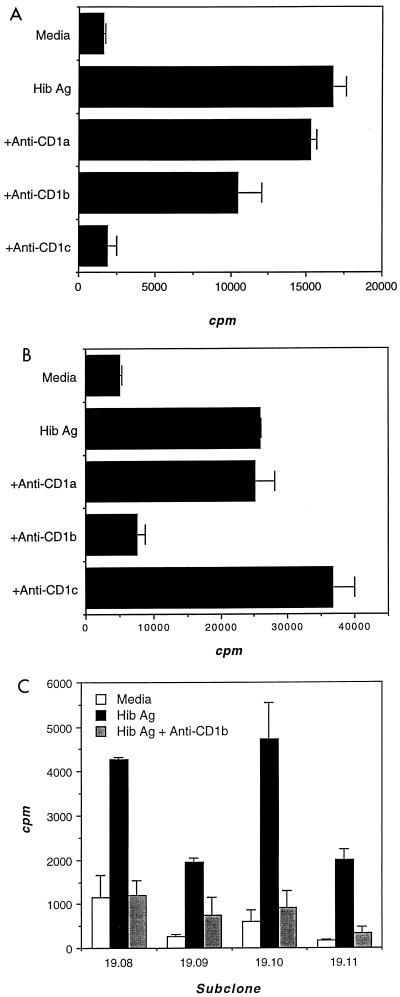
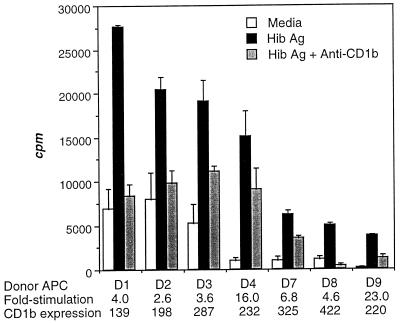
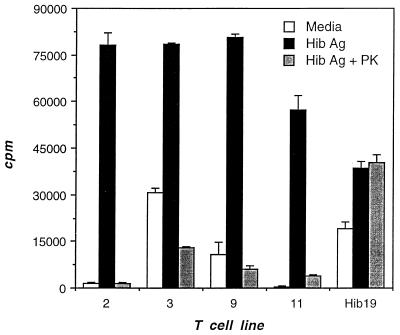
Human CD1 is a family of nonpolymorphic major histocompatibility complex class I-like molecules capable of presenting mycobacterial lipids, including lipoarabinomannan (LAM), to double-negative (DN; CD4(-) CD8(-)) as well as CD8(+) T cells. Structural similarities between LAM and the capsular polysaccharides of gram-negative bacteria led us to consider the latter as candidate CD1 ligands. We derived two CD1-restricted DN T-cell populations which proliferated to Haemophilus influenzae type b (Hib) antigen. One T-cell population also proliferated to proteinase K-treated Hib antigen, suggesting that it recognized a nonpeptide. Our work thus expands the universe of T cell antigens to include nonpeptides distinct from mycobacterial lipids and suggests a potential role for CD1-restricted T cells in immunity to Hib.
Figures
References
-
- Beckman E M, Porcelli S A, Morita C T, Behar S M, Furlong S T, Brenner M B. Recognition of a lipid antigen by CD1-restricted alpha beta+ T cells. Nature. 1994;372:691–694. - PubMed
-
- Beckman E M, Brenner M B. MHC class I-like, class II-like and CD1 molecules: distinct roles in immunity. Immunol Today. 1995;16:349–352. - PubMed
Publication types
MeSH terms
Substances
Grants and funding
LinkOut - more resources
Full Text Sources
Research Materials
