


doi: 10.1128/IAI.66.8.3981-3984.1998.
Binding of the Helicobacter pylori vacuolating cytotoxin to target cells
Affiliations
- PMID: 9673292
- PMCID: PMC108470
- DOI: 10.1128/IAI.66.8.3981-3984.1998
Item in Clipboard
Binding of the Helicobacter pylori vacuolating cytotoxin to target cells
Infect Immun.
1998 Aug.
Abstract
The vacuolating cytotoxin of Helicobacter pylori, VacA, enters the cytoplasm of target cells and causes vacuolar degeneration by interfering with late stages of endocytosis. By using indirect immunofluorescence and flow cytometry, we have demonstrated that VacA binds to specific high-affinity cell surface receptors and that this interaction is necessary for cell intoxication.
Figures
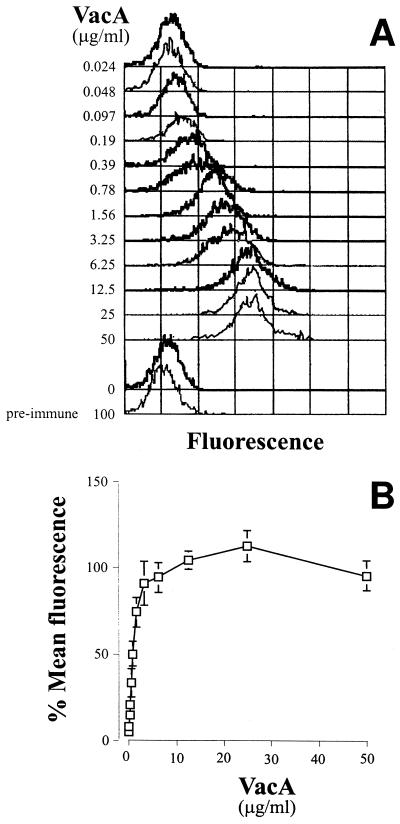
Indirect immunofluorescence and flow cytometry of VacA bound to HeLa cells. (A) Example of the curves obtained with HeLa cells incubated with increasing concentrations of VacA revealed with anti-VacA sera and fluorescein isothiocyanate-labelled anti-rabbit IgG. (B) Saturation curve of VacA binding to HeLa cells. The data are means of five independent experiments, and the bars show standard deviations. To normalize the data, each value was calculated as the percentage of the maximum MFI (average of the last three values) obtained in each respective experiment.
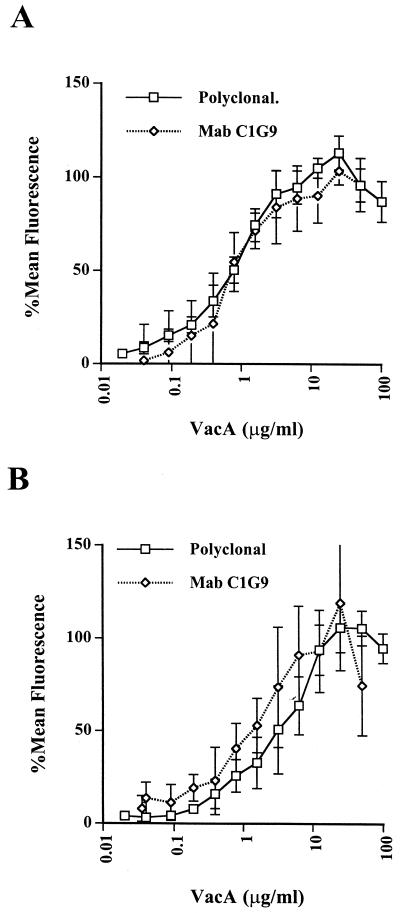
Saturation curves of native (A) or acid-treated (B) VacA binding to HeLa cells obtained by using rabbit polyclonal anti-VacA antibodies or anti-VacA MAb C1G9, as indicated. The data are from four or five independent experiments for each curve. Data were normalized as described in the legend to Fig. 1B.
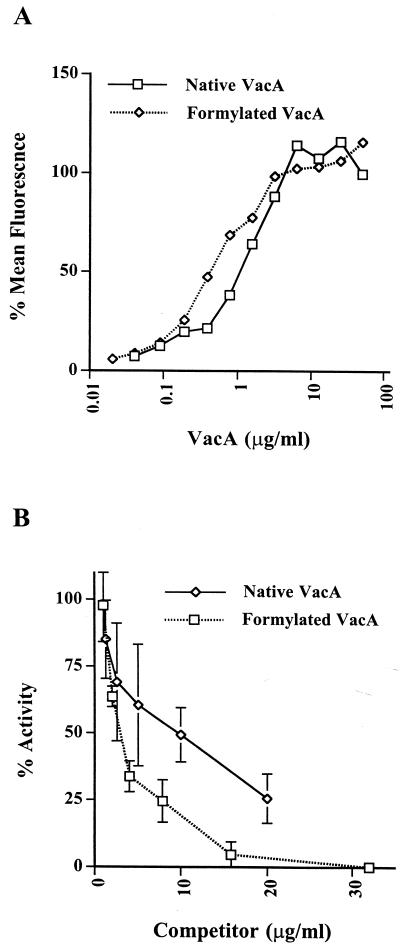
Inhibition of acid-activated VacA activity on HeLa cells by inactive VacA. (A) Curves of native and formaldehyde-inactivated VacA binding to HeLa cells. Data are normalized as described in the legend to Fig. 1B. (B) Inhibition of VacA activity by native or formaldehyde-inactivated VacA. The values are percent inhibition of acid-activated VacA in the HeLa cell vacuolation assay as measured by neutral red uptake.
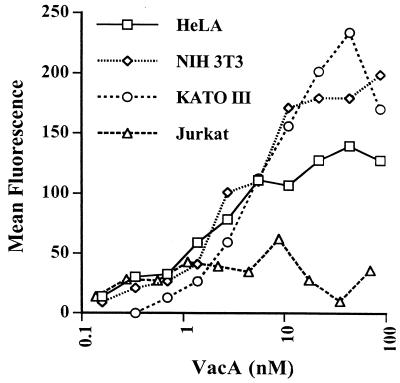
VacA binding to different cell types revealed by MAb C1G9. Binding and flow cytometry were carried out in a single session by using identical machine settings.
References
-
- Alouf J. Cholesterol binding toxins (Streptococcus, Bacillus, Clostridium, Listeria) In: Rappuoli R, Montecucco C, editors. Guide book to protein toxins and their use in cell biology. Oxford, England: Sambrook & Tooze; 1997. pp. 7–10.
-
- Balfanz J, Rautenberg P, Ullman U. Molecular mechanisms of action of bacterial exotoxins. J Med Microbiol. 1996;284:170–206. - PubMed
-
- De Bernard M, Arico B, Papini E, Rizzuto R, Grandi G, Rappuoli R, Montecucco C. Helicobacter pylori toxin VacA induces vacuole formation by acting in the cell cytosol. Mol Microbiol. 1997;26:665–674. - PubMed
-
- De Bernard M, Papini E, de Filippis V, Gottardi E, Telford J L, Manetti R, Fontana A, Rappuoli R, Montecucco C. Low pH activates the vacuolating toxin of Helicobacter pylori, which becomes acid and pepsin resistant. J Biol Chem. 1995;270:23937–23940. - PubMed
Publication types
MeSH terms
Substances
LinkOut - more resources
Full Text Sources
