Comparative Study
. 1998 Aug;180(15):3765-70.
doi: 10.1128/JB.180.15.3765-3770.1998.

Promoter recognition by Bacillus subtilis sigmaW: autoregulation and partial overlap with the sigmaX regulon

Affiliations
Comparative Study

Promoter recognition by Bacillus subtilis sigmaW: autoregulation and partial overlap with the sigmaX regulon

X Huang et al. J Bacteriol. 1998 Aug.

Abstract

The Bacillus subtilis genome encodes at least 17 distinct sigma factors, including seven members of the extracytoplasmic function (ECF) subfamily. We have investigated the expression and regulation of the ECF sigma factor encoded by the sigW gene. A sigmaW-dependent promoter (PW) precedes sigW, demonstrating that this transcription factor is positively autoregulated. Expression of sigW is regulated by both growth phase and medium composition. Maximal expression is attained in early-stationary-phase cells grown in rich medium. We previously reported that sigW mutants have elevated transcription of some sigmaX-controlled genes, and we now report that the converse is also true: in a sigX mutant, PW is derepressed during logarithmic growth. Thus, these two regulons are mutually antagonistic. Reconstituted sigmaW holoenzyme faithfully recognizes the PW preceding sigW but does not recognize the PX promoter preceding the sigX gene. Autoregulation of sigX is also highly specific: sigmaX holoenzyme initiates transcription from PX but recognizes PW poorly if at all. In contrast, several promoters that are at least partially under sigmaX control are active with both the sigmaX and sigmaW holoenzymes in vitro. This finding supports the suggestion that the sigmaW and sigmaX regulons overlap. Sequence comparisons suggest that promoters recognized by these two sigma factors have similar -35 elements but are distinguished by different base preferences at two key positions within the -10 element.


Figures
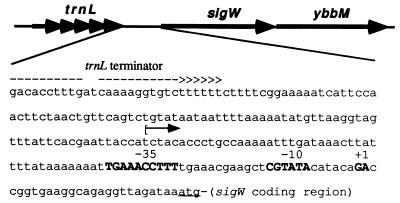
FIG. 1
FIG. 1
Diagram of the sigW-ybbM region (16.6°; 195 kb) of the B. subtilis chromosome. The sequence of the region between trnL and sigW is shown. The inverted repeat predicted to terminate transcription of the trnL operon is illustrated. The bracket and arrow indicate the upstream boundary of the PW-containing fragment used in construction of the PW-cat-lacZ reporter. The −35 and −10 regions of PW, and the two observed transcription start points, are shown in boldface.
FIG. 2
FIG. 2
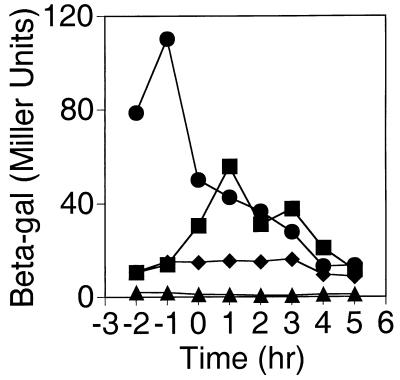
Expression of PW-cat-lacZ. Expression of β-galactosidase (Miller Units) is plotted as a function of growth phase for cells grown in 4×SG. Time zero is the end of logarithmic-phase growth. The strains used contain SPβ7063 (PW-cat-lacZ) reporter phage in either wild-type (■), sigW::erm (▴), sigX::spc (•), or rsiX::pVA29 (⧫) mutant background.
FIG. 3
FIG. 3
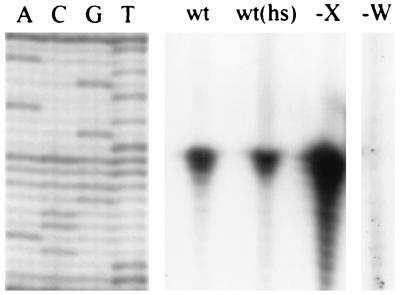
Primer extension analysis of PW activity. RNA samples were prepared from late-logarithmic-phase cells of the wild-type strain CU1065 grown at 37°C (wt) or 15 min after a shift to 50°C [wt(hs)] and analyzed by reverse transcription. Samples were also prepared from the sigX::spc (−X) and sigW::erm (−W) mutants. The sequencing ladder on the left was generated by using the same reverse primer (primer 181) and double-stranded pXH23 DNA. The two start sites are A and G residues as shown in Fig. 1.
FIG. 4
FIG. 4
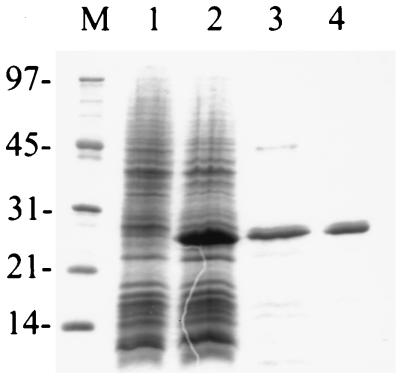
Sodium dodecyl sulfate-polyacrylamide gel electrophoresis analysis of fractions from the ςW purification. Lane M, molecular weight markers (sizes in kilodaltons are indicated on the left); lane 1, 100 μg of whole-cell lysate of HE7123 prior to induction with IPTG; lane 2, 100 μg of whole-cell lysate after 3 h of induction with IPTG; lane 3, 10 μg of peak fractions after heparin-Sepharose CL-6B chromatography; lane 4, 10 μg of peak fractions after FPLC Superdex-75 chromatography.
FIG. 5
FIG. 5
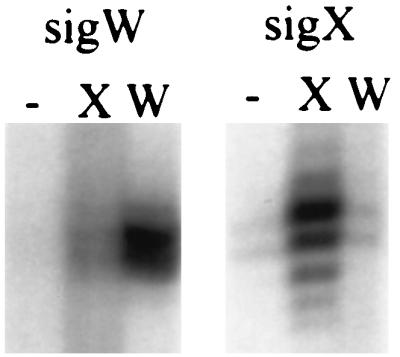
In vitro runoff transcription of PW and PX. PCR products containing either PW or PX were used as templates for runoff transcription reactions with core RNAP either alone (−) or after supplementation with either ςX (X) or ςW (W). Note that the core RNAP preparation has a low level of activity in the absence of added ς, suggesting that this preparation has some contaminating ςX as noted previously (15).
FIG. 6
FIG. 6
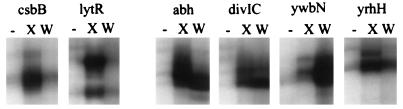
In vitro runoff transcription of EςX and EςW on six ςX-dependent promoters. PCR products containing the indicated promoter regions were amplified from the corresponding pJPM122 derivatives (16) and used as templates for runoff transcription reactions with core RNAP either alone (−) or after supplementation with either ςX (X) or ςW (W). Promoter sequences are shown in Table 2 together with the deduced transcription start sites. All runoff transcripts are between 110 and 180 nucleotides in length, allowing start sites to be assigned with an accuracy of ±2 nucleotides. The start sites for the in vitro EςX transcripts have been previously determined at nucleotide resolution by primer extension mapping (16). Some of the transcript heterogeneity (most notably in the lytR reaction) is apparently due to different 3′ ends resulting from variability in the PCR products since a single well-defined start point is observed in primer extension mapping experiments (data not shown and reference 16).

References

    1. Akbar S, Price C W. Isolation and characterization of csbB, a gene controlled by Bacillus subtilis general stress transcription factor ςB. Gene. 1996;177:123–128. - PubMed
    1. Braun V. Surface signaling: novel transcription initiation mechanism starting from the cell surface. Arch Microbiol. 1997;167:325–331. - PubMed
    1. Brutsche S, Braun V. SigX of Bacillus subtilis replaces the ECF sigma factor FecI of Escherichia coli and is inhibited by RsiX. Mol Gen Genet. 1997;256:416–425. - PubMed
    1. Bsat N, Chen L, Helmann J D. Mutation of the Bacillus subtilis alkyl hydroperoxide reductase (ahpCF) operon reveals compensatory interactions among hydrogen peroxide stress genes. J Bacteriol. 1996;178:6579–6586. - PMC - PubMed
    1. Burgess R R. Purification of overproduced Escherichia coli RNA polymerase ς factors by solubilizing inclusion bodies and refolding from Sarkosyl. Methods Enzymol. 1996;273:145–149. - PubMed

Publication types

MeSH terms

LinkOut - more resources