


doi: 10.1128/JB.180.15.4002-4006.1998.
Identification of OmpT as the protease that hydrolyzes the antimicrobial peptide protamine before it enters growing cells of Escherichia coli
Affiliations
- PMID: 9683502
- PMCID: PMC107389
- DOI: 10.1128/JB.180.15.4002-4006.1998
Item in Clipboard
Identification of OmpT as the protease that hydrolyzes the antimicrobial peptide protamine before it enters growing cells of Escherichia coli
J Bacteriol.
1998 Aug.
Abstract
The influence of extracytoplasmic proteases on the resistance of Escherichia coli to the antimicrobial peptide protamine was investigated by testing strains with deletions in the protease genes degP, ptr, and ompT. Only DeltaompT strains were hypersusceptible to protamine. This effect was abolished by plasmids carrying ompT. Both at low and at high Mg2+ concentrations, ompT+ strains cleared protamine from the medium within a few minutes. By contrast, at high Mg2+ concentrations, protamine remained present for at least 1 h in the medium of an ompT strain. These data indicate that OmpT is the protease that degrades protamine and that it exerts this function at the external face of the outer membrane.
Figures
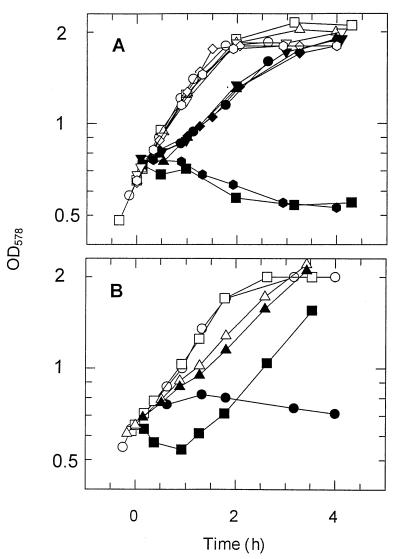
Effect of ompT and other extracytoplasmic protease genes on protamine susceptibility of E. coli cells. Protamine (100 mg/liter) was added at t = 0 to a suspension of growing cells. Closed symbols, protamine-treated cells; open symbols, control cells. (A) Circles, strain KS272; squares, strain SF110; triangles, strain SF103; diamonds, strain KS474; inverted triangles, strain SF115; and octagons, strain SF120; (B) circles, strain UT5600; triangles, strain UT5600(pML19); and squares, strain UT5600(pDS319). The last two strains grew in the presence of 100 mg of carbenicillin and 12.5 mg of tetracycline per liter, respectively.
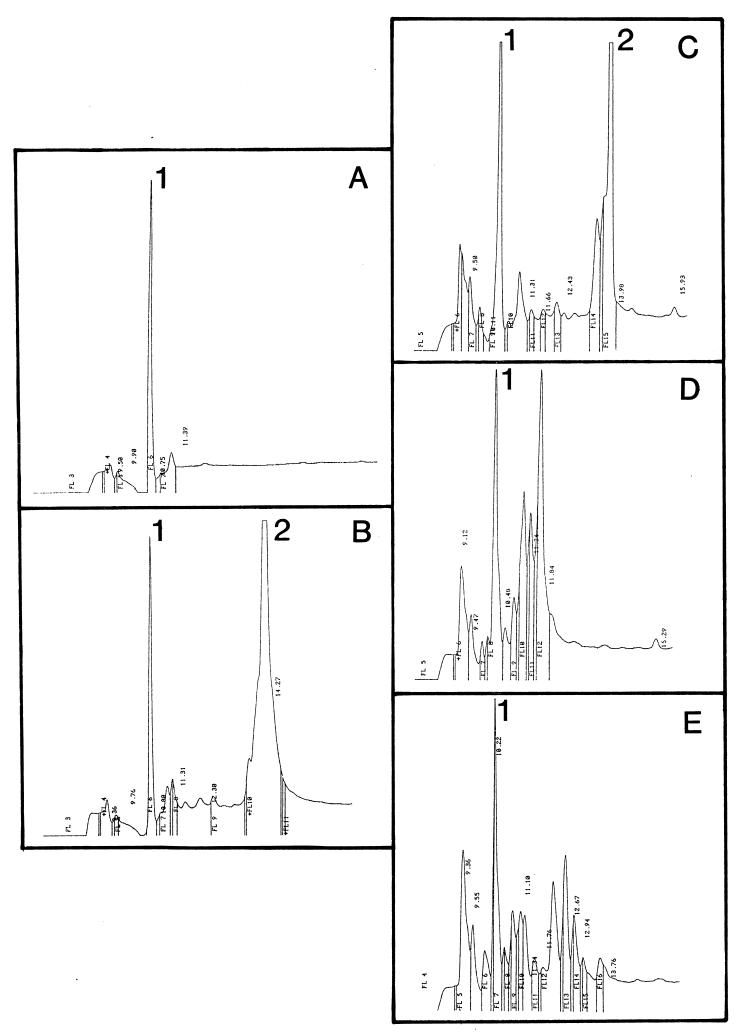
Protamine vanishes rapidly from the medium of growing cells of E. coli KS272. The peptide content of the supernatant from centrifuged cells was analyzed by reverse-phase HPLC. (A) Growth medium; (B) growth medium plus 100 mg of protamine per liter; (C to E) chromatograms of the supernatants taken at 75 s, 7 min and 30 s and 30 min, respectively, after addition of 100 mg of protamine per liter to the cell suspension at time zero. Peaks 1 and 2 represent thiamine and protamine, respectively.
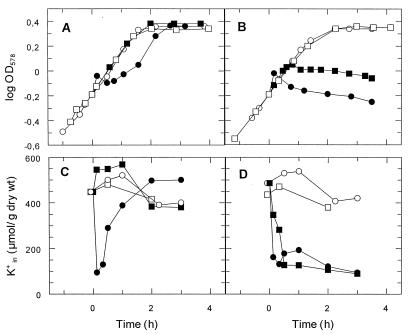
High concentration of Mg2+ protects ompT+ cells from toxic effects of protamine. Protamine (100 mg/liter) was added at time zero to growing cells of the wild-type strain KS272 (A and C) or the ompT strain SF110 (B and D). (A and B) Growth curves; (C and D) K+ contents. Closed symbols, protamine-treated cells; open symbols, control cells; circles, cells growing at 0.4 mM Mg2+; and squares, cells growing at 5 mM Mg2+.
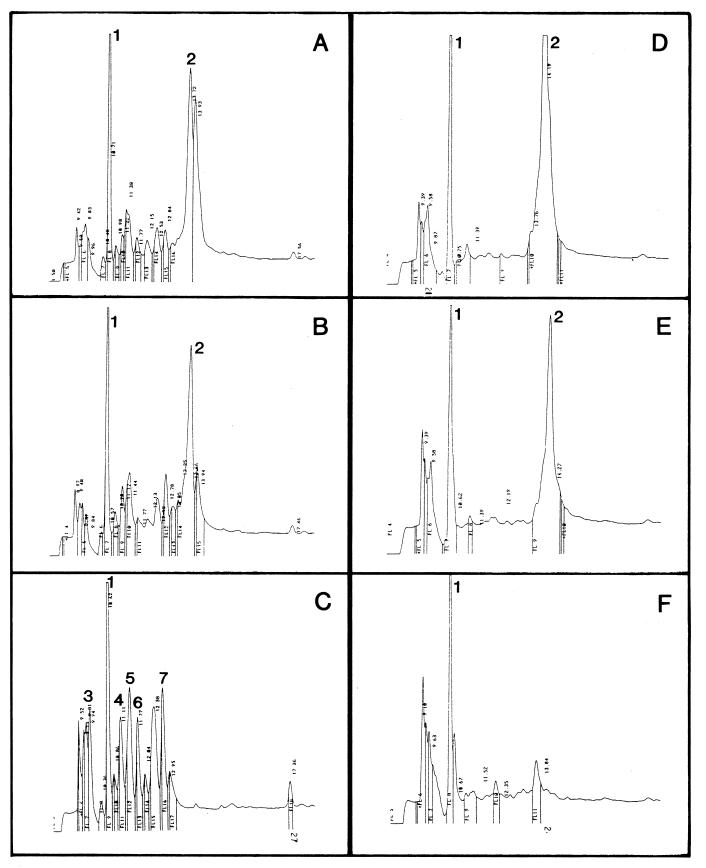
Fate of protamine in the high-Mg2+ medium of cells of strains KS272 and SF110. Protamine (100 mg/liter) was added at time zero to the suspension of cells growing at 5 mM Mg2+. (A to C) HPLC chromatograms of the supernatant of cells of strain KS272 centrifuged at 3 min, 7 min and 30 s, and 60 min, respectively, after addition of protamine to the suspension; (D to F) HPLC chromatograms of the supernatant of cells of strain SF110 centrifuged at 30, 60, and 180 min, respectively, after addition of protamine to the medium. Peaks 1 and 2 are the same as those described in the legend to Fig. 2. The N termini of peptides from peaks 3 to 7 in panel C were determined by Edman degradation (see the text for details).
References
-
- Ando T, Watanabe S. A new method for fractionation of protamines and the amino acid sequences of one compound of salmine and three compounds of iridine. Int J Protein Res. 1969;1:221–224. - PubMed
-
- Ando T, Yamasaki M, Suzuki S. Protamines; isolation, characterization and function. New York, N.Y: Springer Verlag; 1973. pp. 58–80. - PubMed
-
- Aspedon A, Groisman E A. The antibacterial action of protamine: evidence for disruption of cytoplasmic membrane energization in Salmonella typhimurium. Microbiology. 1996;142:3389–3397. - PubMed
-
- Elish M E, Pierce J R, Earhart C F. Biochemical analysis of spontaneous fepA mutants of Escherichia coli. J Gen Microbiol. 1988;134:1355–1364. - PubMed
-
- Foxman B, Zhang L, Palin K, Tallmann P, Marrs C F. Bacterial virulence characteristics of Escherichia coli isolates from first time urinary tract infection. J Infect Dis. 1995;171:1514–1521. - PubMed
Publication types
MeSH terms
Substances
LinkOut - more resources
Full Text Sources
Other Literature Sources
Molecular Biology Databases
