. 1998 Aug;42(8):1900-5.
doi: 10.1128/AAC.42.8.1900.

Effect of growth rate on resistance of Candida albicans biofilms to antifungal agents

Affiliations

Effect of growth rate on resistance of Candida albicans biofilms to antifungal agents

G S Baillie et al. Antimicrob Agents Chemother. 1998 Aug.

Abstract

A perfused biofilm fermentor, which allows growth-rate control of adherent microbial populations, was used to assess whether the susceptibility of Candida albicans biofilms to antifungal agents is dependent on growth rate. Biofilms were generated under conditions of glucose limitation and were perfused with drugs at a high concentration (20 times the MIC). Amphotericin B produced a greater reduction in the number of daughter cells in biofilm eluates than ketoconazole, fluconazole, or flucytosine. Similar decreases in daughter cell counts were observed when biofilms growing at three different rates were perfused with amphotericin B. In a separate series of experiments, intact biofilms, resuspended biofilm cells, and newly formed daughter cells were removed from the fermentor and were exposed to a lower concentration of amphotericin B for 1 h. The susceptibility profiles over a range of growth rates were then compared with those obtained for planktonic cells grown at the same rates under glucose limitation in a chemostat. Intact biofilms were resistant to amphotericin B at all growth rates tested, whereas planktonic cells were resistant only at low growth rates (</=0.13 h-1). Cells resuspended from biofilms were less resistant than intact biofilm populations but more resistant than daughter cells; the susceptibilities of both these cell types were largely independent of growth rate. Our findings indicate that the amphotericin B resistance of C. albicans biofilms is not simply due to a low growth rate but depends on some other feature of the biofilm mode of growth.


Figures
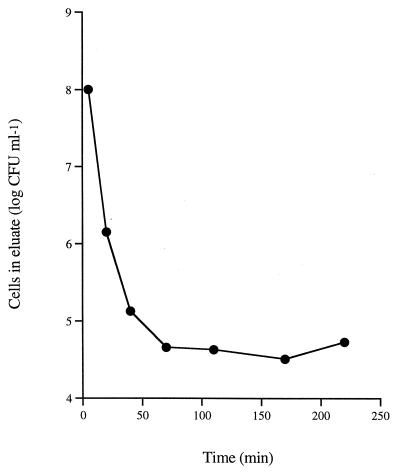
FIG. 1
FIG. 1
Elution of C. albicans from a cellulose acetate filter perfused with medium in the biofilm fermentor at a rate of 1.12 ml min−1. Organisms eluted during the initial 80 min correspond to loosely attached cells. Thereafter, newly formed daughter cells are eluted under steady-state conditions. The results are from a representative experiment repeated at least three times.
FIG. 2
FIG. 2
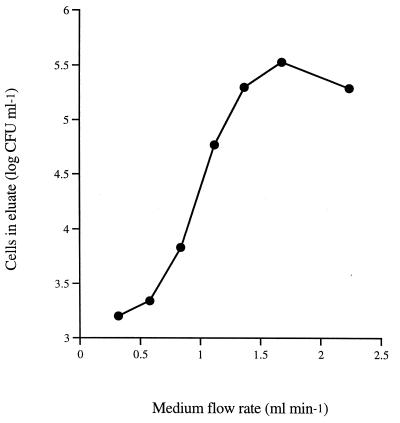
Determination of the critical medium flow rate for a C. albicans biofilm in the perfused biofilm fermentor. The number of daughter cells released from the biofilm increased with flow up to 1.7 ml min−1. This represents the critical medium flow rate at which the growth rate is maximum (μmax). The results are from a typical experiment repeated at least three times.
FIG. 3
FIG. 3
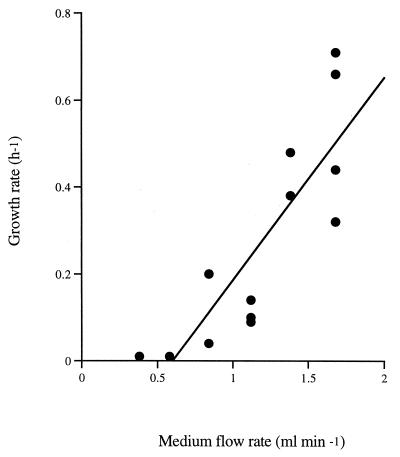
Relationship between flow rate and growth rate for a C. albicans biofilm in the perfused biofilm fermentor up to the critical medium flow rate (1.7 ml min−1).
FIG. 4
FIG. 4
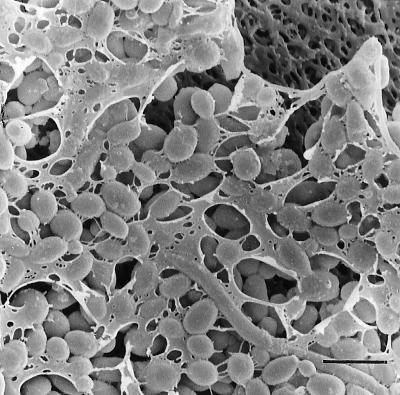
Scanning electron micrograph of a C. albicans biofilm grown on a cellulose acetate filter in a perfused biofilm fermentor. The growth rate was 0.2 h−1. Bar, 10 μm.
FIG. 5
FIG. 5
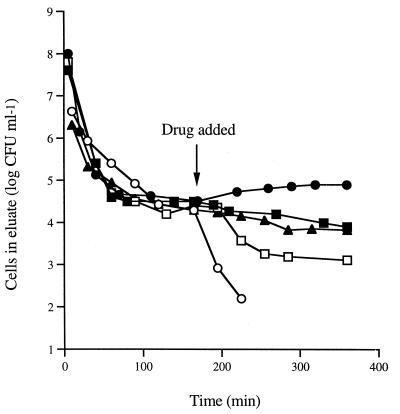
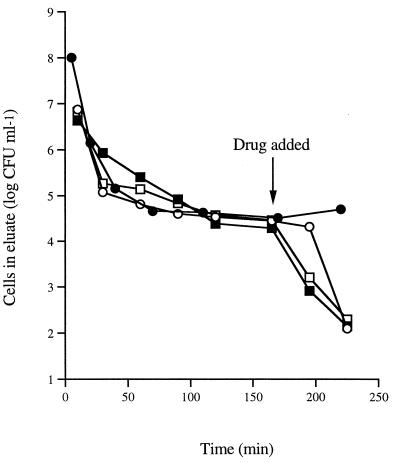
Perfusion of C. albicans biofilms with antifungal agents. Biofilms were maintained at a growth rate of 0.2 h−1 and were perfused with medium containing amphotericin B (○), flucytosine (■), ketoconazole (□), fluconazole (▴), or no antifungal agent (•). The antifungal agents were used at the following concentrations (20 times the MIC): amphotericin B, 26 μg ml−1; flucytosine, 4 μg ml−1; fluconazole, 8 μg ml−1; and ketoconazole, 0.5 μg ml−1. Results represent mean values from two independent experiments carried out with duplicate samples. SEs were less than 10% of the mean values. The viable counts of eluates from biofilms perfused with amphotericin B were zero after 225 min.
FIG. 6
FIG. 6
Perfusion of C. albicans biofilms grown at different rates with amphotericin B. Biofilms were maintained at a growth rate of 0.02 h−1 (○), 0.2 h−1 (■), or 0.4 h−1 (□). Control biofilms (•) were grown at a rate of 0.2 h−1 in medium without amphotericin B. Results represent mean values from two independent experiments carried out with duplicate samples. SEs were less than 10% of the mean values.
FIG. 7
FIG. 7
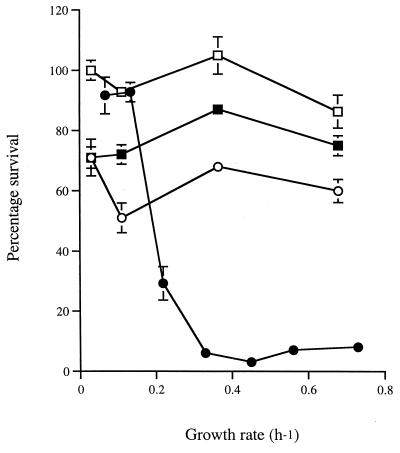
Survival of planktonic and biofilm cells of C. albicans grown at different rates after treatment with amphotericin B. Intact biofilms (□), resuspended biofilm cells (■), biofilm daughter cells (○), and planktonic cells (•) were exposed to amphotericin B for 1 h, and the percent survival was estimated by determining the viable counts. Results represent mean values (± standard error of the mean) from two independent experiments with viable counts determined in triplicate.

References

    1. Ashby M J, Neale J E, Critchley I A. Effect of antibiotics on non-growing planktonic cells and biofilms of Escherichia coli. J Antimicrob Chemother. 1994;33:443–452. - PubMed
    1. Bailey A, Wadsworth E, Calderone R A. Adherence of Candida albicans to human buccal epithelial cells: host-induced protein synthesis and signaling events. Infect Immun. 1995;63:569–572. - PMC - PubMed
    1. Brown M R W, Gilbert P. Sensitivity of biofilms to antimicrobial agents. J Appl Bacteriol Symp Suppl. 1993;74:87S–97S. - PubMed
    1. Brown M R W, Allison D G, Gilbert P. Resistance of bacterial biofilms to antibiotics: a growth-rate related effect? J Antimicrob Chemother. 1988;22:777–789. - PubMed
    1. Costerton J W, Cheng K J, Geesey G G, Ladd T I, Nickel J C, Dasgupta M, Marrie T J. Bacterial biofilms in nature and disease. Annu Rev Microbiol. 1987;41:435–464. - PubMed

Publication types

MeSH terms

LinkOut - more resources