


Characterization of the MexC-MexD-OprJ multidrug efflux system in DeltamexA-mexB-oprM mutants of Pseudomonas aeruginosa
- PMID: 9687387
- PMCID: PMC105713
- DOI: 10.1128/AAC.42.8.1938
Characterization of the MexC-MexD-OprJ multidrug efflux system in DeltamexA-mexB-oprM mutants of Pseudomonas aeruginosa
Abstract
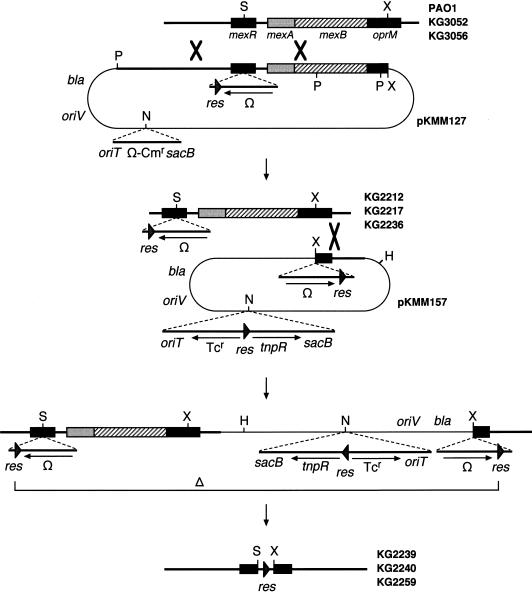
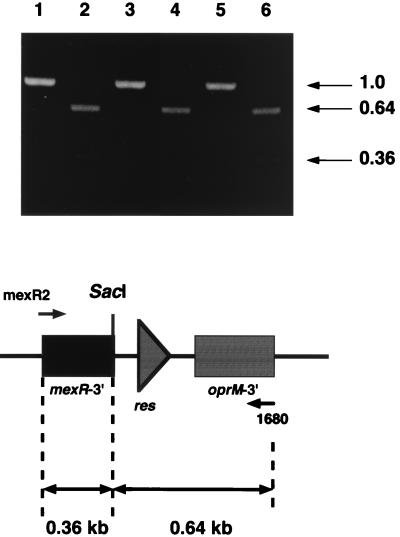
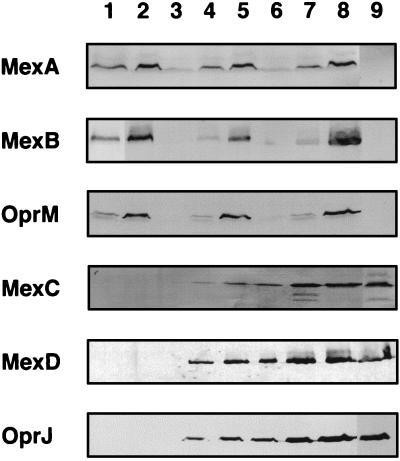
Expression of the multidrug efflux system MexC-MexD-OprJ in nfxB mutants of Pseudomonas aeruginosa contributes to resistance to fluoroquinolones and the "fourth-generation" cephems (cefpirome and cefozopran), but not to most beta-lactams, including the ordinary cephems (ceftazidime and cefoperazone). nfxB mutants also express a second multidrug efflux system, MexA-MexB-OprM, due to incomplete transcriptional repression of this operon by the mexR gene product. To characterize the contribution of the MexC-MexD-OprJ system to drug resistance in P. aeruginosa, a site-specific deletion method was employed to remove the mexA-mexB-oprM region from the chromosome of wild-type and nfxB strains of P. aeruginosa. Characterization of mutants lacking the mexA-mexB-oprM region clearly indicated that the MexC-MexD-OprJ efflux system is involved in resistance to the ordinary cephems as well as fluoroquinolones and the fourth-generation cephems but not to carbenicillin and aztreonam. Rabbit polyclonal antisera and murine monoclonal antibody against the components of the MexA-MexB-OprM system were prepared and used to demonstrate the reduced production of this efflux system in the nfxB mutants. Consistent with this, transcription of the mexA-mexB-oprM operon decreased in an nfxB mutant. This reduction appears to explain the hypersusceptibility of the nfxB mutant to beta-lactams, including ordinary cephems.
Figures
References
-
- Ausubel F M, Brent R, Kingston R E, Moore D D, Seidman J G, Smith J A, Struhl K, editors. Short protocols in molecular biology. 2nd ed. New York, N.Y: John Wiley and Sons; 1992.
-
- Gotoh N, Itoh N, Tsujimoto H, Yamagishi J, Oyamada Y, Nishino T. Isolation of OprM-deficient mutants of Pseudomonas aeruginosa by transposon insertion mutagenesis: evidence of involvement in multiple antibiotic resistance. FEMS Microbiol Lett. 1994;122:267–274. - PubMed
-
- Gotoh N, Nagino K, Wada K, Tsujimoto H, Nishino T. Burkholderia (formerly Pseudomonas) cepacia porin is an oligomer composed of two component protein. Microbiology. 1994;140:3285–3291. - PubMed
Publication types
MeSH terms
Substances
LinkOut - more resources
Full Text Sources
Other Literature Sources
Medical
