


Degradation of 1,3-dichloropropene by pseudomonas cichorii 170
- PMID: 9687453
- PMCID: PMC106795
- DOI: 10.1128/AEM.64.8.2931-2936.1998
Degradation of 1,3-dichloropropene by pseudomonas cichorii 170
Abstract
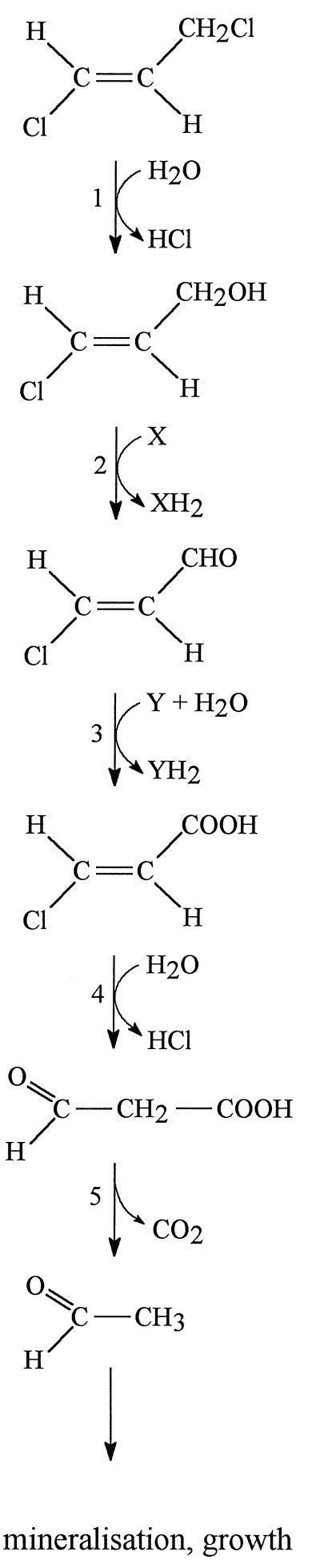
The gram-negative bacterium Pseudomonas cichorii 170, isolated from soil that was repeatedly treated with the nematocide 1, 3-dichloropropene, could utilize low concentrations of 1, 3-dichloropropene as a sole carbon and energy source. Strain 170 was also able to grow on 3-chloroallyl alcohol, 3-chloroacrylic acid, and several 1-halo-n-alkanes. This organism produced at least three different dehalogenases: a hydrolytic haloalkane dehalogenase specific for haloalkanes and two 3-chloroacrylic acid dehalogenases, one specific for cis-3-chloroacrylic acid and the other specific for trans-3-chloroacrylic acid. The haloalkane dehalogenase and the trans-3-chloroacrylic acid dehalogenase were expressed constitutively, whereas the cis-3-chloroacrylic acid dehalogenase was inducible. The presence of these enzymes indicates that 1, 3-dichloropropene is hydrolyzed to 3-chloroallyl alcohol, which is oxidized in two steps to 3-chloroacrylic acid. The latter compound is then dehalogenated, probably forming malonic acid semialdehyde. The haloalkane dehalogenase gene, which is involved in the conversion of 1,3-dichloropropene to 3-chloroallyl alcohol, was cloned and sequenced, and this gene turned out to be identical to the previously studied dhaA gene of the gram-positive bacterium Rhodococcus rhodochrous NCIMB13064. Mutants resistant to the suicide substrate 1,2-dibromoethane lacked haloalkane dehalogenase activity and therefore could not utilize haloalkanes for growth. PCR analysis showed that these mutants had lost at least part of the dhaA gene.
Figures
References
-
- Belser N O, Castro C E. Biodehalogenation—the metabolism of the nematocides cis- and trans-3-chloroallyl alcohol by a bacterium isolated from soil. J Agric Food Chem. 1971;19:23–26. - PubMed
-
- Bergman J G, Sanik J. Determination of trace amounts of chlorine in naphtha. Anal Chem. 1957;29:241–243.
-
- Castro C E, Belser N O. Hydrolysis of cis- and trans-1,3-dichloropropene in wet soil. J Agric Food Chem. 1966;14:69–70.
-
- Cohen D B, Gilmore D, Fischer B S, Bowes G W. Water quality and pesticides: 1,2-dichloropropane (1,2-D) and 1,3-dichloropropene (1,3-D). Sacramento: California State Water Resources Control Board; 1983.
-
- Curragh H, Flynn O, Larkin M J, Stafford T M, Hamilton J T G, Harper D B. Haloalkane degradation and assimilation by Rhodococcus rhodochrous NCIMB13064. Microbiology. 1994;140:1433–1442. - PubMed
Publication types
MeSH terms
Substances
LinkOut - more resources
Full Text Sources
Molecular Biology Databases
