. 1998 Aug 4;95(16):9238-43.
doi: 10.1073/pnas.95.16.9238.

Cocaine alters the accessibility of endogenous cysteines in putative extracellular and intracellular loops of the human dopamine transporter

Affiliations

Cocaine alters the accessibility of endogenous cysteines in putative extracellular and intracellular loops of the human dopamine transporter

J V Ferrer et al. Proc Natl Acad Sci U S A. .

Abstract

Cocaine and other psychostimulants act by blocking the dopamine transporter. Binding of the cocaine analog, [3H]2-beta-carbomethoxy-3-beta-(4-fluorophenyl) tropane (CFT) to the dopamine transporter is sensitive to polar sulfhydryl-specific derivatives of methanethiosulfonate (MTS). These reagents preferentially react with water-accessible, reduced cysteines. The human dopamine transporter has 13 cysteines. Their topology is not completely determined. We sought to identify those cysteine residues the modification of which affects CFT binding and to determine the topology of these reactive cysteines. We mutated each of the cysteines, one at a time and in various combinations, to residues that preserved binding and transport, and we tested the sensitivity of each of the mutant transporters to the reagents. One construct, X5C, had five mutated cysteines (C90A, C135A, C306A, C319F, and C342A). Using a membrane preparation in which both extracellular and intracellular cysteines could be accessible, we found that CFT binding in X5C, as compared with wild-type transporter, was two orders of magnitude less sensitive to MTS ethylammonium (MTSEA). The wild-type cysteines were substituted back into X5C, one at a time, and these constructs were tested in cells and in membranes. Cys-90 and Cys-306 appear to be extracellular, and Cys-135 and Cys-342 appear to be intracellular. Each of these residues is predicted to be in extramembranous loops. The binding of cocaine increases the rate of reaction of MTSEA and MTS ethyltrimethylammonium with the extracellular Cys-90 and therefore acts by inducing a conformational change. Cocaine decreases the rate of reaction of MTSEA with Cys-135 and Cys-342, acting either directly or indirectly on these intracellular residues.


Figures
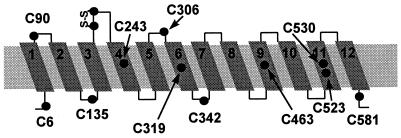
Figure 1
Figure 1
Predicted topology of DAT showing 12 putative membrane-spanning segments. The predicted positions of the 13 endogenous cysteines are shown. The cysteines in the second extracellular loop between M3 and M4 are thought to be disulfide bonded in the dopamine transporter and the serotonin transporter (see text).
Figure 2
Figure 2
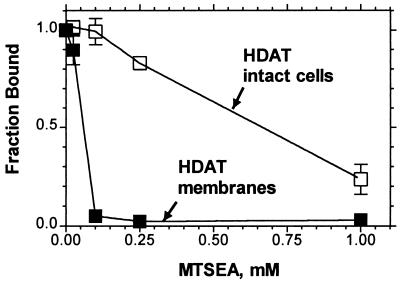
The inhibition of specific [3H]CFT binding (10 nM) to (□) intact dissociated HEK 293 cells stably transfected with wt DAT or (■) membranes prepared from these cells, resulting from a 2-min application of varying concentrations of MTSEA. The means and SEM of 3–6 independent experiments each performed with triplicate determinations are shown.
Figure 3
Figure 3
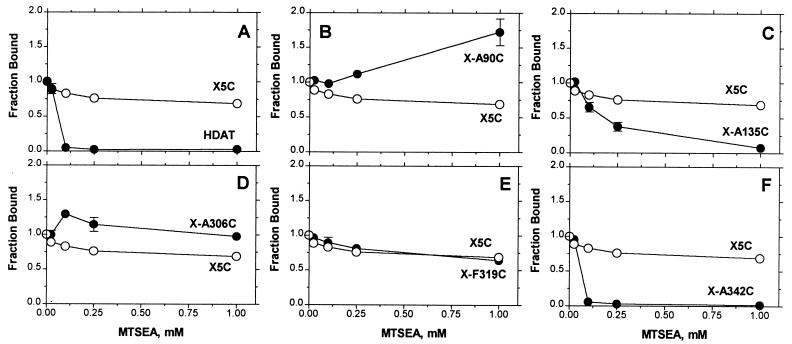
The inhibition of specific [3H]CFT binding (10nM) to membranes prepared from HEK 293 cells stably transfected with (•) wt (A), X-A90C (B), X-A135C (C), X-A306C (D), X-F319C (E), X-A342C (F), or with (○) X5C, resulting from a 2-min application of varying concentrations of MTSEA. The means and SEM of 3–6 independent experiments each performed with triplicate determinations are shown.
Figure 4
Figure 4
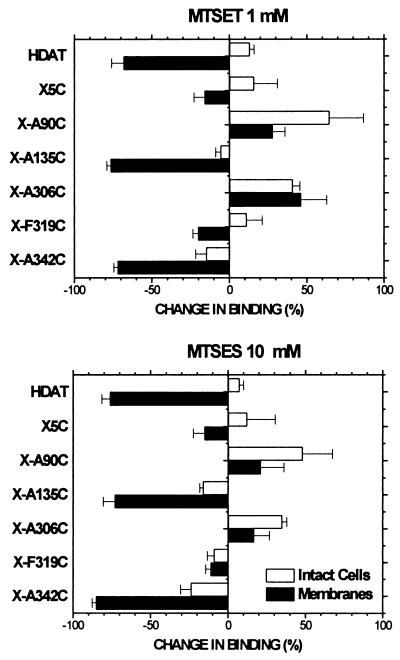
The percentage change of specific [3H]CFT binding (10 nM) to (filled bars) membranes prepared from or (open bars) intact dissociated HEK 293 cells stably transfected with the indicated DAT mutants resulting from a 2-min application of (Upper) 1 mM MTSET or (Lower) 10 mM MTSES. These concentrations were chosen to normalize for the different reactivities of the reagents with simple sulfhydryls in solution. The means and SEM of 5–11 independent experiments each performed with triplicate determinations are shown.
Figure 5
Figure 5
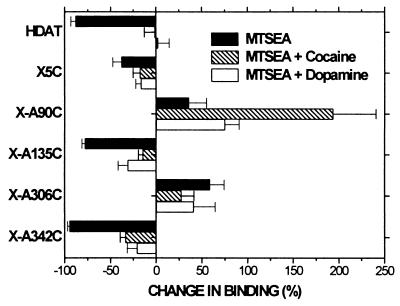
The effects of cocaine and dopamine on the reactivity of MTSEA with the endogenous cysteines individually restored into the X5C background. Membranes were incubated in PBS for 20 min at room temperature in the presence or absence of (hatched bars) 3 μM cocaine or (open bars) 1 mM dopamine. MTSEA was added, in the continued presence or absence of cocaine or dopamine, for 2 min at the following concentrations: 2.5 mM, X5C; 1 mM, X-A90C; 0.5 mM, X-A135C; 0.25 mM, HDAT; 0.1 mM, X-A306C; and 0.06 mM, X-A342C. To facilitate determination of a change in the rate of reaction, the concentrations of MTSEA were chosen to produce, in the absence of ligand, ≈70% of the maximal effect. Cells were washed with PBS by filtration through 96-well multiscreen plates containing GF/B filters (Millipore). [3H]CFT binding to the washed cells was performed in a final volume of 75 μl. The means and SEM of 4–6 independent experiments each performed with triplicate determinations are shown. Filled bars represent the effect of MTSEA alone.
Figure 6
Figure 6
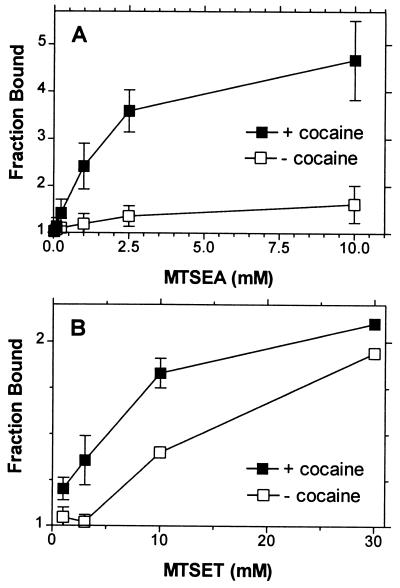
The potentiation of [3H]CFT (10 nM) binding to membranes prepared from HEK 293 cells stably transfected with X-A90C resulting from reaction of MTSEA (A) or MTSET (B) at varying concentrations in the (■) presence of 3 μM cocaine or (□) in its absence. The means and SEM of two independent experiments each performed with triplicate determinations are shown.

References

    1. Shimada S, Kitayama S, Lin C L, Patel A, Nanthakumar E, Gregor P, Kuhar M, Uhl G. Science. 1991;254:576–578. - PubMed
    1. Kilty J E, Lorang D, Amara S G. Science. 1991;254:578–579. - PubMed
    1. Vandenbergh D J, Persico A M, Uhl G R. Brain Res Mol Brain Res. 1992;15:161–166. - PubMed
    1. Giros B, el Mestikawy S, Godinot N, Zheng K, Han H, Yang-Feng T, Caron M G. Mol Pharmacol. 1992;42:383–390. - PubMed
    1. Usdin T B, Mezey E, Chen C, Brownstein M J, Hoffman B J. Proc Natl Acad Sci USA. 1991;88:11168–11171. - PMC - PubMed

Publication types

LinkOut - more resources