. 1998 Aug 4;95(16):9250-5.
doi: 10.1073/pnas.95.16.9250.

Isolation of a protein Z-dependent plasma protease inhibitor

Affiliations

Isolation of a protein Z-dependent plasma protease inhibitor

X Han et al. Proc Natl Acad Sci U S A. .

Abstract

Human protein Z (PZ) is a 62,000-Mr, vitamin K-dependent plasma protein whose structure is similar to coagulation factors VII, IX, X, protein C, and protein S, but whose function is not known. The procoagulant activity of factor Xa in a one-stage plasma coagulation assay is reduced when factor Xa is first incubated with PZ. This apparent inhibitory effect is time dependent, requires the presence of calcium ions and procoagulant phospholipids (rabbit brain cephalin), and appears predominantly related to the incubation period of PZ with cephalin. In serum the initial rate of inhibition of factor Xa with calcium ions and cephalin also is enhanced in the presence PZ. A PZ-dependent protease inhibitor (ZPI) has been isolated from plasma. ZPI is a 72,000-Mr single-chain protein with an N-terminal amino acid sequence of LAPSPQSPEXXA (X = indeterminate) and an estimated concentration in citrate-treated plasma of 1.0-1.6 microg/ml. In systems using purified components, the factor Xa inhibition produced by ZPI is rapid (>95% within 1 min by coagulation assay) and requires the presence of PZ, calcium ions, and cephalin. The inhibitory process appears to involve the formation of a factor Xa-PZ-ZPI complex at the phospholipid surface.


Figures
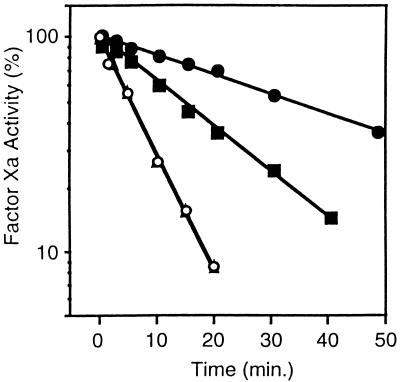
Figure 1
Figure 1
Effect of PZ on the inhibition of factor Xa by antithrombin III. Reaction mixtures containing factor Xa (5 nM), CaCl2 (4 mM), with or without PZ (40 nM), and with or without cephalin (15 μM) were incubated 5 min at 22°C before the addition of antithrombin III (3.4 μM). At the indicated times thereafter, samples were removed, diluted in HSA with 1 mM EDTA, and assayed for factor Xa activity by coagulation assay. (▴), Without cephalin, without PZ; (○), without cephalin, with PZ; (■), with cephalin, without PZ; (•), with cephalin, with PZ.
Figure 2
Figure 2
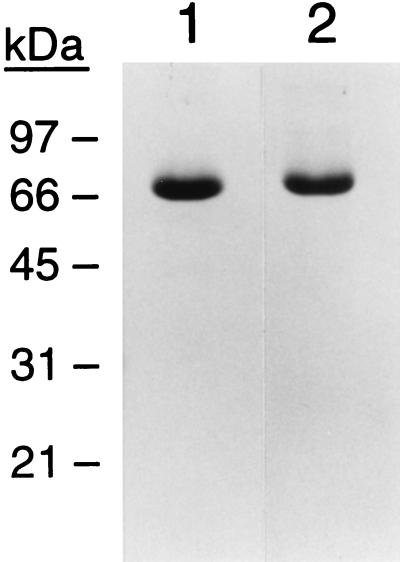
SDS/PAGE of purified ZPI. ZPI (5 μg) was analyzed with (lane 2) or without (lane 1) reduction with 5% 2-mercaptoethanol. Protein was stained with Coomassie brilliant blue. The position of molecular mass standards in kDa is shown on the left.
Figure 3
Figure 3
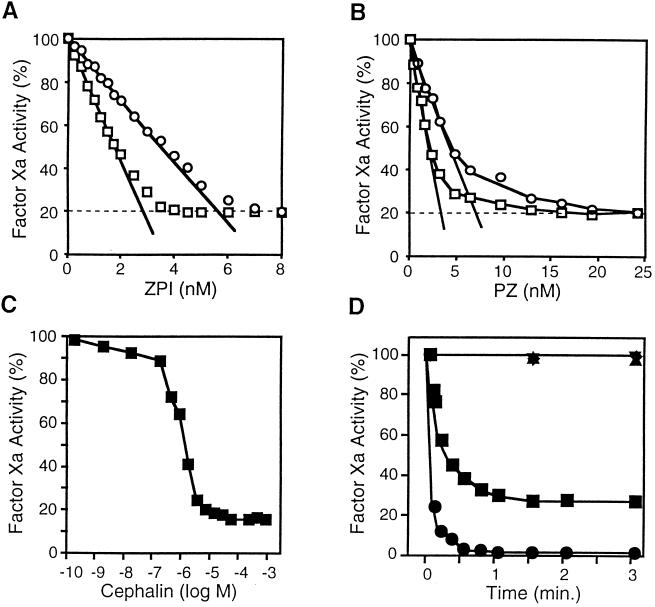
PZ-dependent inhibition of factor Xa by ZPI. (A) ZPI dose/response. Reaction mixtures containing factor Xa (2.5 or 5.0 nM), CaCl2 (4 mM), cephalin (15 μM), and PZ (40 nM) were incubated with increasing concentrations of ZPI for 15 min at 22°C before remaining factor Xa activity was determined by amidolytic assay. The molar concentration of ZPI was estimated assuming 1.0 mg/ml ZPI produces an A280 of 1.0. (□), Factor Xa, 2.5 nM; (○), factor Xa, 5.0 nM. (B) PZ dose/response. Reaction mixtures containing factor Xa (2.5 or 5.0 nM), CaCl2 (4 mM), cephalin (15 μM), and ZPI (10 nM) were incubated with increasing concentrations of PZ for 15 min at 22°C before remaining factor Xa activity was determined by amidolytic assay. (□), Factor Xa, 2.5 nM; (○), factor Xa, 5.0 nM. (C) Cephalin dose/response. Reaction mixtures containing factor Xa (2.5 nM), CaCl2 (4 mM), PZ (40 nM), and ZPI (10 nM) were incubated with increasing concentrations of cephalin for 15 min at 22°C before remaining factor Xa activity was determined by amidolytic assay. (D) Time course of factor Xa inhibition by PZ/ZPI. Reaction mixtures containing factor Xa (5.0 nM), with or without CaCl2 (4 mM), with or without cephalin (15 μM), and with or without PZ (40 nM) were incubated 5 min at 22°C before the addition of ZPI (10 nM). At the specified times thereafter remaining factor Xa activity was determined by coagulation assay or amidolytic assay. Coagulation assay: (•), with all reactants. Amidolytic assay: (■), with all reactants; (▾), without CaCl2; (▴), without cephalin; (⧫), without PZ.
Figure 4
Figure 4
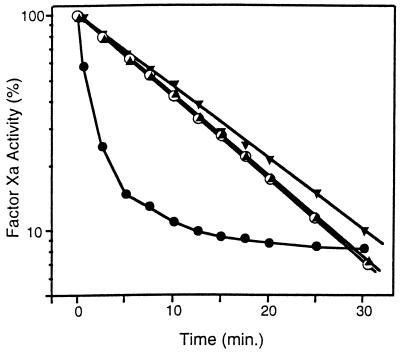
Effect of PZ and anti-ZPI antibodies on factor Xa inhibition in serum. Factor Xa (5 nM), CaCl2 (4 mM), and cephalin (15 μM) with or without PZ (40 nM) were incubated 5 min at 22°C before the addition of barium-adsorbed serum (25%, vol/vol), which had been treated previously for 30 min with rabbit preimmune or immune anti-ZPI IgG (300 μg/ml). At the specified times thereafter, samples of the reaction mixtures were diluted in HSA with 1 mM EDTA and assayed for factor Xa activity by coagulation assay. (•), With PZ and preimmune IgG; (▾), with PZ and anti-ZPI IgG; (○), without PZ and with preimmune IgG; (▴), without PZ and with anti-ZPI IgG.
Figure 5
Figure 5
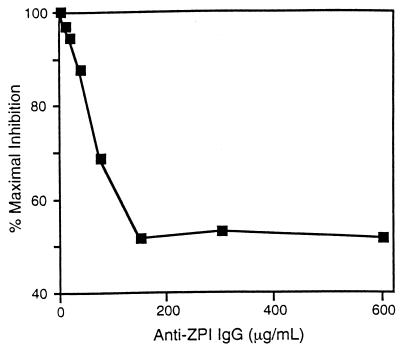
Effect of anti-ZPI antibodies on factor Xa-induced coagulation of plasma. Reaction mixtures (200 μl) containing factor Xa (0.125 nM), CaCl2 (5 mM), and cephalin (18.75 μM), with or without PZ (50 nM), were incubated in the sample cup of a fibrometer. After 2 min at 37°C, 50 μl of factor X-deficient plasma that had been treated with rabbit preimmune IgG (600 μg/ml) or various concentrations of immune anti-ZPI IgG for 30 min was added and the clotting time was measured. Apparent factor Xa inhibition (76%) produced by the inclusion of PZ during the preincubation period and using plasma treated with preimmune IgG is listed as maximal PZ-dependent inhibition (100% on the ordinate). The concentration of anti-ZPI IgG used to treat the plasma is listed on the abscissa. Note that the range of “% Maximal Inhibition” listed on the ordinate is plotted from 40 to 100.

References

    1. Stenflo J, Fernlund P, Egan W, Roepstorff P. Proc Natl Acad Sci USA. 1974;71:2730–2733. - PMC - PubMed
    1. Nelsestuen G L, Zytkovicz T H, Howard J B. J Biol Chem. 1974;249:6347–6350. - PubMed
    1. Esmon C T, Suttie J W, Jackson C M. J Biol Chem. 1975;250:4094–4099. - PubMed
    1. Prowse C V, Esnouf M P. Biochem Soc Trans. 1977;5:255–256. - PubMed
    1. Mattock P, Esnouf M P. Nat New Biol. 1973;242:90–92. - PubMed

Publication types

MeSH terms

LinkOut - more resources