


Absence of neurofilaments reduces the selective vulnerability of motor neurons and slows disease caused by a familial amyotrophic lateral sclerosis-linked superoxide dismutase 1 mutant
- PMID: 9689132
- PMCID: PMC21390
- DOI: 10.1073/pnas.95.16.9631
Absence of neurofilaments reduces the selective vulnerability of motor neurons and slows disease caused by a familial amyotrophic lateral sclerosis-linked superoxide dismutase 1 mutant
Abstract
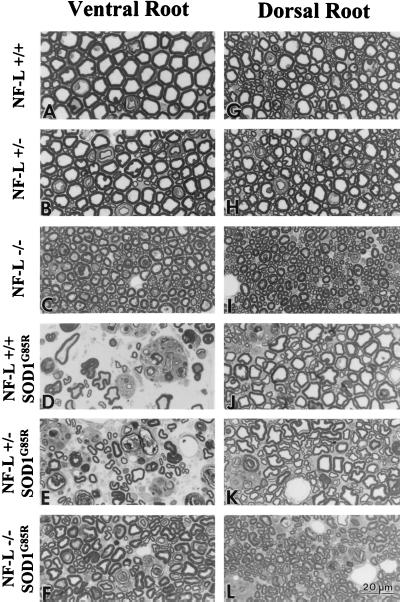
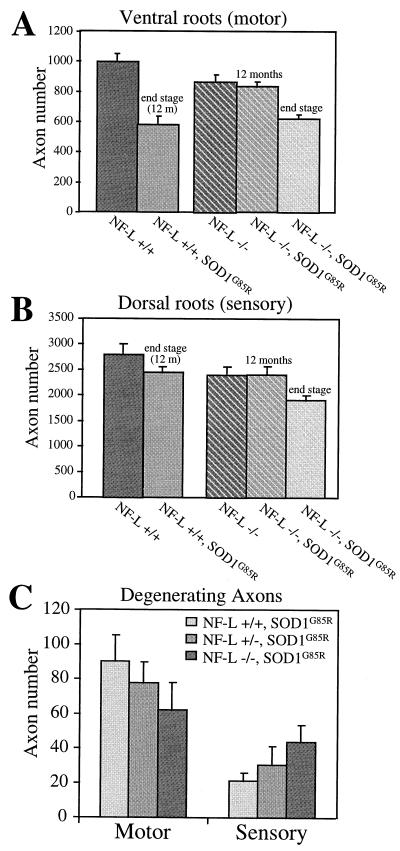
Mutations in superoxide dismutase 1 (SOD1), the only proven cause of amyotrophic lateral sclerosis (ALS), provoke disease through an unidentified toxic property. Neurofilament aggregates are pathologic hallmarks of both sporadic and SOD1-mediated familial ALS. By deleting NF-L, the major neurofilament subunit required for filament assembly, onset and progression of disease caused by familial ALS-linked SOD1 mutant G85R are significantly slowed, while selectivity of mutant-mediated toxicity for motor neurons is reduced. In NF-L-deleted animals, levels of the two remaining neurofilament subunits, NF-M and NF-H, are markedly reduced in axons but are elevated in motor neuron cell bodies. Thus, while neither perikaryal nor axonal neurofilaments are essential for SOD1-mediated disease, the absence of assembled neurofilaments both diminishes selective vulnerability and slows SOD1(G85R) mutant-mediated toxicity to motor neurons.
Figures




References
-
- Rosen D R, Siddique T, Patterson D, Figlewicz D A, Sapp P, Hentati A, Donaldson D, Goto J, O’Regan J P, Deng H X, et al. Nature (London) 1993;362:59–62. - PubMed
-
- Deng H-X, Hentati A, Tainer J A, Iqbal Z, Cayabyab A, Hung W-Y, Getzoff E D, Hu P, Herzfeldt B, Roos R P, et al. Science. 1993;261:1047–1051. - PubMed
-
- Siddique, T. & Deng, H. X. (1996) Hum. Mol. Genet. 5, Suppl. 1465–1470. - PubMed
-
- Fridovich I. Annu Rev Biochem. 1995;64:97–112. - PubMed
Publication types
MeSH terms
Substances
Grants and funding
LinkOut - more resources
Full Text Sources
Other Literature Sources
Medical
Molecular Biology Databases
Miscellaneous
