


Desoxyepothilone B: an efficacious microtubule-targeted antitumor agent with a promising in vivo profile relative to epothilone B
- PMID: 9689134
- PMCID: PMC21392
- DOI: 10.1073/pnas.95.16.9642
Desoxyepothilone B: an efficacious microtubule-targeted antitumor agent with a promising in vivo profile relative to epothilone B
Abstract
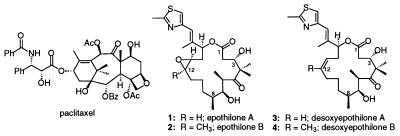
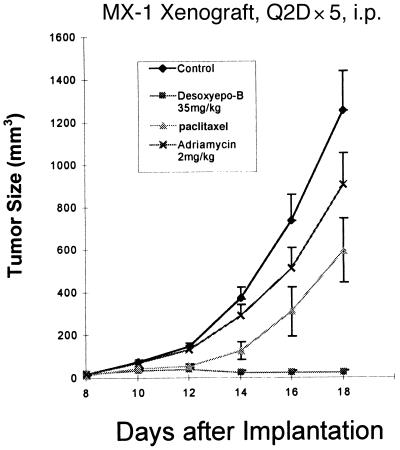
A new class of 16-membered macrolides, the epothilones (Epos), has been synthesized and evaluated for antitumor potential in vitro and in vivo. Recent studies in these and other laboratories showed that epothilones and paclitaxel (paclitaxel) share similar mechanisms of action in stabilizing microtubule arrays as indicated by binding-displacement studies, substitution for paclitaxel in paclitaxel-dependent cell growth, and electron microscopic examinations. The present study examined cell growth-inhibitory effects in two rodent and three human tumor cell lines and their drug-resistant sublines. Although paclitaxel showed as much as 1, 970-fold cross-resistance to the sublines resistant to paclitaxel, adriamycin, vinblastine, or actinomycin D, most epothilones exhibit little or no cross-resistance. In multidrug-resistant CCRF-CEM/VBL100 cells, IC50 values for EpoA (1), EpoB (2), desoxyEpoA (3) (dEpoA), desoxyEpoB (4) (dEpoB), and paclitaxel were 0.02, 0.002, 0.012, 0.017, and 4.14 microM, respectively. In vivo studies, using i.p. administration, indicated that the parent, EpoB, was highly toxic to mice and showed little therapeutic effect when compared with a lead compound, dEpoB. More significantly, dEpoB (25-40 mg/kg, Q2Dx5, i.p.) showed far superior therapeutic effects and lower toxicity than paclitaxel, doxorubicin, camptothecin, or vinblastine (at maximal tolerated doses) in parallel experiments. For mammary adenocarcinoma xenografts resistant to adriamycin, MCF-7/Adr, superior therapeutic effects were obtained with dEpoB compared with paclitaxel when i.p. regimens were used. For ovarian adenocarcinoma xenografts, SK-OV-3, dEpoB (i.p.), and paclitaxel (i. v.) gave similar therapeutic effects. In nude mice bearing a human mammary carcinoma xenograft (MX-1), marked tumor regression and cures were obtained with dEpoB.
Figures
References
-
- Höfle G, Bedorf N, Steinmetz H, Schumburg D, Gerth K, Reichenbach H. Angew Chem Int Ed Engl. 1996;35:1567–1569.
-
- Gerth K, Bedorf N, Höfle G, Irschik H, Reichenbach H. J Antibiot. 1996;49:560–563. - PubMed
-
- Bollag D M, McQuency P A, Zhu J, Hensens O, Koupal L, Liesch J, Goetz M, Lazarides E, Woods C M. Cancer Res. 1995;55:2325–2333. - PubMed
-
- Balog A, Meng D, Kamenecka T, Bertinato P, Su D-S, Sorensen E J, Danishefsky S J. Angew Chem Int Ed Engl. 1996;35:2801–2803.
-
- Su D-S, Balog A, Meng D, Bertinato P, Danishefsky S J, Zheng Y-H, Chou T-C, He L, Horwitz S B. Angew Chem Int Ed Engl. 1997;36:2093–2096.
Publication types
MeSH terms
Substances
Grants and funding
LinkOut - more resources
Full Text Sources
Other Literature Sources
Research Materials
