


Defective proximal tubular fluid reabsorption in transgenic aquaporin-1 null mice
- PMID: 9689137
- PMCID: PMC21395
- DOI: 10.1073/pnas.95.16.9660
Defective proximal tubular fluid reabsorption in transgenic aquaporin-1 null mice
Abstract
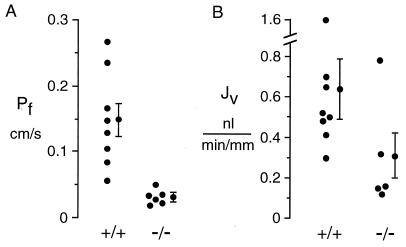
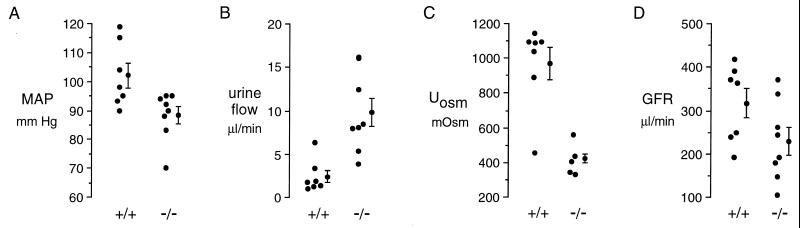
To investigate the role of aquaporin-1 (AQP1) water channels in proximal tubule function, in vitro proximal tubule microperfusion and in vivo micropuncture measurements were done on AQP1 knockout mice. The knockout mice were generated by targeted gene disruption and found previously to be unable to concentrate their urine in response to water deprivation. Unanesthetized knockout mice consumed 2.8-fold more fluid than wild-type mice and had lower urine osmolality (505 +/- 40 vs. 1081 +/- 68 milliosmolar). Transepithelial osmotic water permeability (Pf) in isolated microperfused S2 segments of proximal tubule from AQP1 knockout [-/-] mice was 0.033 +/- 0.005 cm/s (SE, n = 6 mice, 37 degreesC), much lower than that of 0.15 +/- 0.03 cm/s (n = 8) in tubules from wild-type [+/+] mice (P < 0.01). In the presence of isosmolar luminal perfusate and bath solutions, spontaneous fluid absorption rates (nl/min/mm tubule length) were 0.31 +/- 0.12 (-/-, n = 5) and 0.64 +/- 0.15 (+/+, n = 8). As determined by free-flow micropuncture, the ratios of tubular fluid-to-plasma concentrations of an impermeant marker TF/P in end proximal tubule fluid were 1.36 +/- 0. 05 (-/-, n = 8 mice [53 tubules]) and 1.95 +/- 0.09 (+/+, n = 7 mice [40 tubules]) (P < 0.001), corresponding to 26 +/- 3% [-/-] and 48 +/- 2% [+/+] absorption of the filtered fluid load. In collections of distal tubule fluid, TF/P were 2.8 +/- 0.3 [-/-] and 4.4 +/- 0.5 [+/+], corresponding to 62 +/- 4% [-/-] and 76 +/- 3% [+/+] absorption (P < 0.02). These data indicate that AQP1 deletion in mice results in decreased transepithelial proximal tubule water permeability and defective fluid absorption. Thus, the high water permeability in proximal tubule of wild-type mice is primarily transcellular, mediated by AQP1 water channels, and required for efficient near-isosmolar fluid absorption.
Figures

Comment in
-
Aquaporin null phenotypes: the importance of classical physiology.Proc Natl Acad Sci U S A. 1998 Aug 4;95(16):9061-3. doi: 10.1073/pnas.95.16.9061. Proc Natl Acad Sci U S A. 1998. PMID: 9689031 Free PMC article. No abstract available.
References
-
- Sabolic I, Valenti J, Verbavatz J M, Van Hoek A N, Verkman A S, Ausiello D A, Brown D. Am J Physiol. 1992;263:C1225–C1233. - PubMed
-
- Carpi-Medina P, Whittembury G. Pflügers Arch. 1988;412:66–74. - PubMed
-
- Ishibashi K, Kuwahara M, Gu Y, Kageyama Y, Tohsaka M, Marumo F, Sasaki S. J Biol Chem. 1997;272:20782–20786. - PubMed
Publication types
MeSH terms
Substances
Grants and funding
LinkOut - more resources
Full Text Sources
Molecular Biology Databases
Research Materials
Miscellaneous
