. 1998 Aug;9(8):2107-23.
doi: 10.1091/mbc.9.8.2107.

Mutational effect of fission yeast polalpha on cell cycle events

Affiliations
Free PMC article

Mutational effect of fission yeast polalpha on cell cycle events

D Bhaumik et al. Mol Biol Cell. 1998 Aug.
Free PMC article

Abstract

Polalpha is the principal DNA polymerase for initiation of DNA replication and also functions in postinitiation DNA synthesis. In this study, we investigated the cell cycle responses induced by mutations in polalpha+. Germinating spores carrying either a deletion of polalpha+ (polalphaDelta) or a structurally intact but catalytically dead polalpha mutation proceed to inappropriate mitosis with no DNA synthesis. This suggests that the catalytic function, and not the physical presence of Polalpha, is required to generate the signal that prevents the cells from entering mitosis prematurely. Cells with a polalphats allele arrest the cell cycle near the hydroxyurea arrest point, but, surprisingly, polalphats in cdc20 (polepsilon mutant) background arrested with a cdc phenoytpe, not a polalphats-like phenotype. At 25 degrees C, replication perturbation caused by polalphats alleles induces Cds1 kinase activity and requires the checkpoint Rads, Cds1, and Rqh1, but not Chk1, to maintain cell viability. At 36 degrees C, replication disruption caused by polalphats alleles induces the phosphorylation of Chk1; however, mutant cells arrest with heterogeneous cell sizes with a population of the cells entering aberrant mitosis. Together, our results indicate that the initiation DNA structure synthesized by Polalpha is required to bring about the S phase to mitosis checkpoint, whereas replication defects of different severity caused by polalphats mutations induce differential downstream kinase responses.


Figures
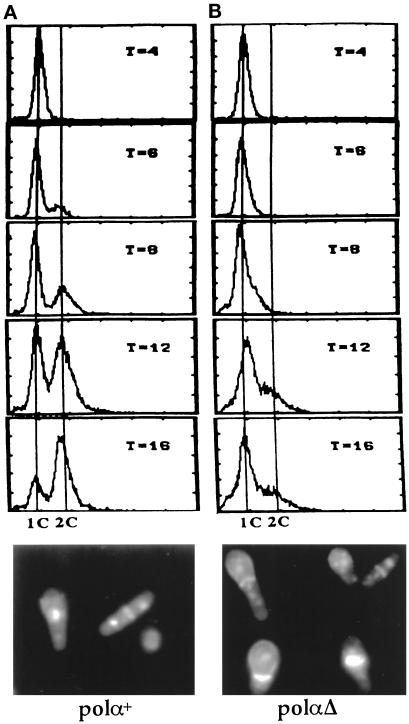
Figure 1
Figure 1
polαΔ germinating spores undergo mitosis with 1C DNA content. FACS profile and phenotype of polα+ (A) and polαΔ (B) germinating spores at 30°C. Shown here are germinating spores 12 h after inoculation into selective medium.
Figure 2
Figure 2
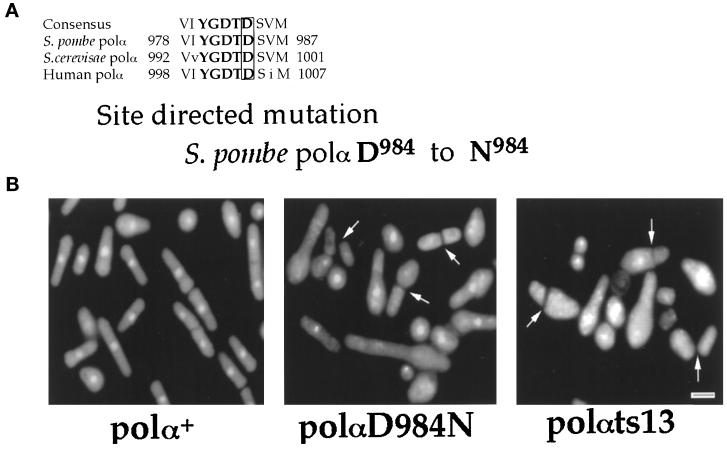
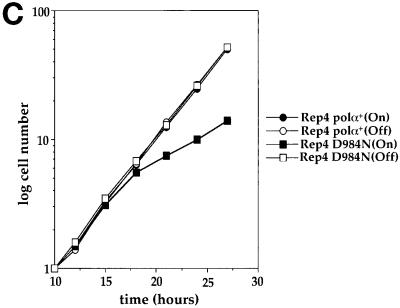
Germinating spores lacking Polα catalytic activity undergo inappropriate mitosis. (A) Primary sequence conservation of the region I of α-like DNA polymerases (Delarue et al., 1990; Ito and Braithwaite, 1991; Wang, 1991, 1996). Asp984 of S.pombe DNA polymerase α was mutagenized to Asn. (B) Phenotype of germinating spores containing a chromosomal polαΔ and plasmids pDblet(leu)polα+, pDblet(leu)polα(D984N), and pDblet(leu)polαts13. Diploid DB23 with one copy of the chromosomal polα+ deleted was transformed with pDblet(leu)polα+ or pDblet(leu)polα(D984N) and inoculated into selective media for germination of spores containing polαΔ/pDblet(leu)polα+ and polαΔ/pDblet(leu)polα+ at 30°C. The phenotype of the cells shown here is 14 h after inoculation. Diploid DB23 cells transformed with pDblet(leu)polαts13 were inoculated into selective media for germination of spores containing polαΔ/pDblet(leu)polαts13 at 36°C, and the phenotype shown is 10 h after inoculation. Bar, 4 μm. (C) Dominant negative effect of overexpressing Polα(D984N) mutant. Cell number increase after induction by removal of thiamine or repression by addition of thiamine was measured by counting cells starting from 10 h using a hemocytometer. After 16-h removal of thiamine from the media (Maundrell, 1993), the overexpression of catalytically dead Polα(D984N) caused a significant slowdown of cell growth.
Figure 2
Figure 2
Germinating spores lacking Polα catalytic activity undergo inappropriate mitosis. (A) Primary sequence conservation of the region I of α-like DNA polymerases (Delarue et al., 1990; Ito and Braithwaite, 1991; Wang, 1991, 1996). Asp984 of S.pombe DNA polymerase α was mutagenized to Asn. (B) Phenotype of germinating spores containing a chromosomal polαΔ and plasmids pDblet(leu)polα+, pDblet(leu)polα(D984N), and pDblet(leu)polαts13. Diploid DB23 with one copy of the chromosomal polα+ deleted was transformed with pDblet(leu)polα+ or pDblet(leu)polα(D984N) and inoculated into selective media for germination of spores containing polαΔ/pDblet(leu)polα+ and polαΔ/pDblet(leu)polα+ at 30°C. The phenotype of the cells shown here is 14 h after inoculation. Diploid DB23 cells transformed with pDblet(leu)polαts13 were inoculated into selective media for germination of spores containing polαΔ/pDblet(leu)polαts13 at 36°C, and the phenotype shown is 10 h after inoculation. Bar, 4 μm. (C) Dominant negative effect of overexpressing Polα(D984N) mutant. Cell number increase after induction by removal of thiamine or repression by addition of thiamine was measured by counting cells starting from 10 h using a hemocytometer. After 16-h removal of thiamine from the media (Maundrell, 1993), the overexpression of catalytically dead Polα(D984N) caused a significant slowdown of cell growth.
Figure 3
Figure 3
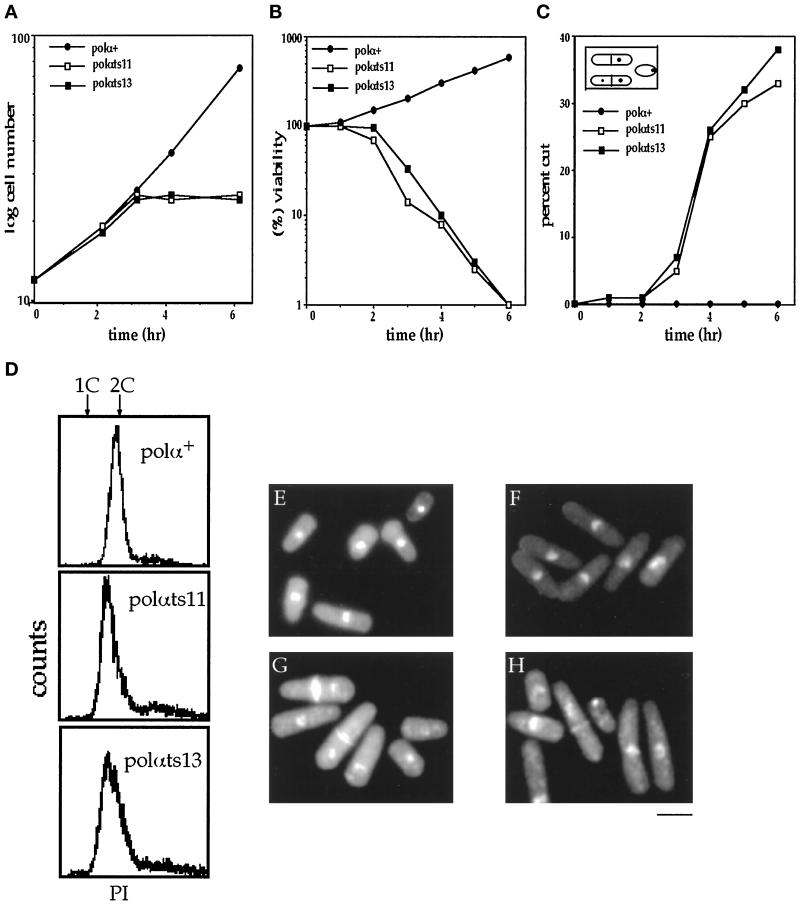
Characterization of temperature-sensitive mutants of polα+. Cell number increase and viability were determined as described in MATERIALS AND METHODS. (A) Cell number increase of wild-type DB10 (polα+) and mutants upon shift to 36°C. DBts11 (polαts11) and DBts13 (polαts13) arrested at 36°C after one cell division. (B) Viability of wild type and thermosensitive mutants. (C) Percentage of cells displaying aberrant nuclear phenotype. Aberrant phenotype described as cut was scored by microscopic examination of DAPI- and calcofluor-stained cells. The inset shows the three types of aberrant phenotypes observed. (D) Flow cytometry analysis of DB10 (polα+), DBts11 (polαts11), and DBts13 (polαts13) 4 h after shift to the restrictive temperature. 1C and 2C standards are arrested cdc10 cells and exponentially growing haploid wild-type cells, respectively. (E–H). Photomicrographs of DB10 (polα+) at 36°C; DBts13 (polαts13) 4 and 6 h after shift to 36°C. Bar, 5.8 μm.
Figure 4
Figure 4
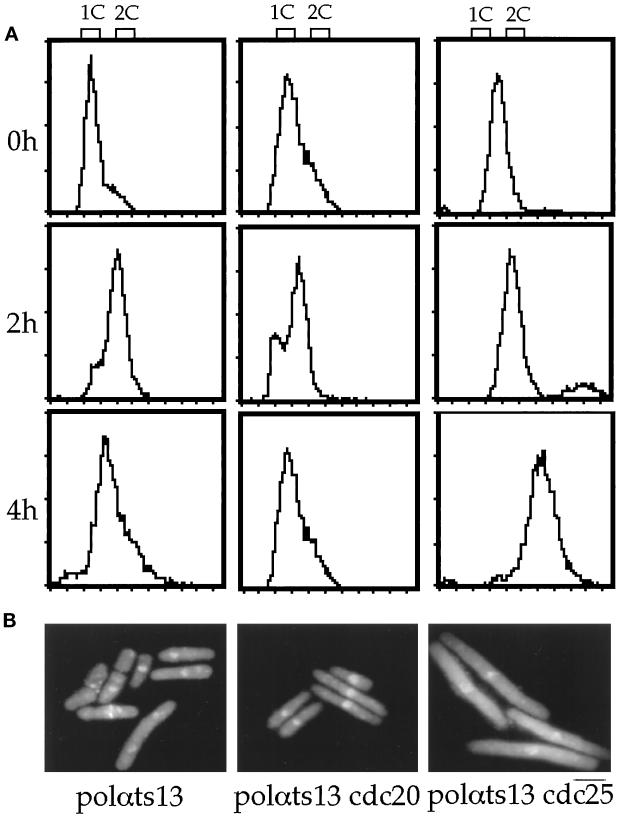
polαts13 cdc20 double mutant arrested with cdc phenotype. (A) FACS analysis of single mutant DBts13 (polαts13) and double mutants polαts13 cdc20 and polαts13 cdc25 in a hydroxyurea reciprocal shift experiment at 0, 2, and 4 h after shift to the restrictive temperature. The hydroxyurea reciprocal shift experiments were performed as described in MATERIALS AND METHODS. Double mutant polαts13 cdc25 at 25°C is moderately elongated, resulting in a >1C profile at 0 h. (B) Phenotypes of single and double mutants of polαts13 strains. Cells were stained with DAPI and calcofluor after shift to the restrictive temperature for 4 h. Bar, 5.8 μm.
Figure 5
Figure 5
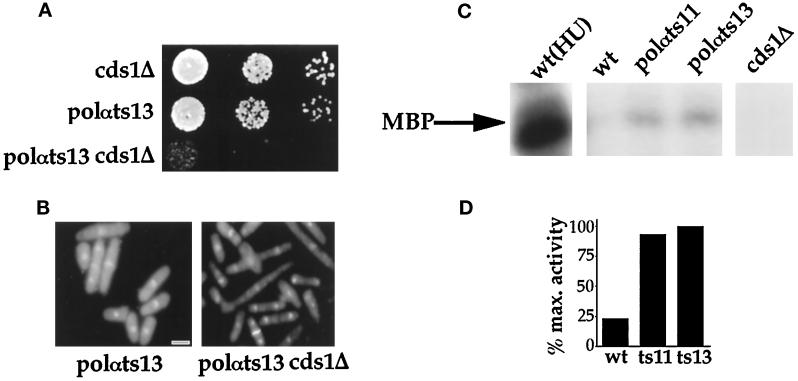
At 25°C, Cds1 is required to maintain normal growth of polαts13 mutant and is activated. (A) Double mutant polαts13 cds1Δ has reduced growth rate at 25°C compared with the respective single mutant cds1Δ and polαts13. Serial dilutions of exponentially growing cells at 25°C by 10-fold were spotted on YES plates. Plates were incubated at 25°C for 3 d. (B) Double mutant polαts13 cds1Δ displays an elongated phenotype compared with the respective single mutant. Shown are phenotypes of single mutant polαts13 and double mutant polαts13 cds1Δ at 25°C. Bar, 3.5 μm. (C) Cds1 kinase is activated in polαts mutants at 25°C. Cds1 protein was immunoprecipitated from logarithmically growing wild-type cells, (wt), wild-type cells treated with 20 mM hydroxyurea [wt(HU)], polαts11 and polαts13, and cds1Δ cells. The immunoprecipitated Cds1 proteins were used to assay for kinase activity using MBP as the substrate as described in MATERIALS AND METHODS. Shown here is the phosphorylation of MBP by Cds1 kinase derived from different strains. (D) The histogram shows that Cds1 kinase activity is fourfold higher in polαts11 and polαts13 as compared with the wild-type polα+ integrant DB10 cells. In DB10 cells treated with hydroxyurea, the Cds1 kinase activity is 25-fold higher than in untreated cells. The Cds1 kinase activity from polαts13 is defined as the 100% maximum activity.
Figure 6
Figure 6
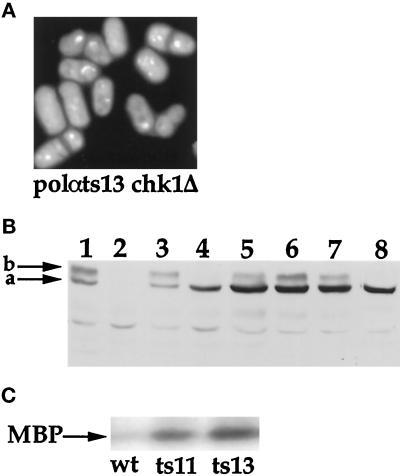
Cds1 and Chk1 are both activated in polαts mutants at 36°C. (A) Phenotype of double mutant DB242 (polαts13 chk1Δ) at the restrictive temperature. Midlog phase double mutant DB242 (polαts13 chk1Δ) grown at 25°C was shifted to 36°C for 6 h. Cells were stained with DAPI and calcofluor. (B) Activation of p56chk1:ep in DB232. Thirty micrograms of protein from cell lysates of DB232 carrying polαts13 and epitope-tagged chk1+, DBts13 (polαts13), and NW222 containing epitope-tagged chk1+ were fractionated on 8% SDS-polyacrylamide gels, transferred to polyvinylidene difluoride membranes, and probed with the 12CA5 antibody, and p56chk1:ep was detected using the ECL system (Amersham, Arlington Heights, IL). The unphosphorylated p56chk1:ep is marked by arrow a, and the phosphorylated p56chk1:ep is marked by arrow b. Lanes 1 and 3, Strains NW222 and DB232 (polαts13 p56chk1:ep) treated with MMS; lane 2, DBts13 (polαts13) containing no epitope-tagged chk1+ as a control; lanes 4–7, lysates from DB232 (polαts13 p56chk1:ep) after 0, 2, 4, and 6 h at 36°C; lane 8, phosphatase-treated lysates from DB232 (polαts13 p56chk1:ep) grown at 36°C for 6 h. (C) Activation of Cds1 kinase activity at 36°C. Cells were grown to midlog phase at 25°C and then shifted to 36°C for 3 h. Cds1 kinase activity was measured in wild-type cells, (wt), polαts11, and polαts13 as described in MATERIALS AND METHODS.
Figure 7
Figure 7
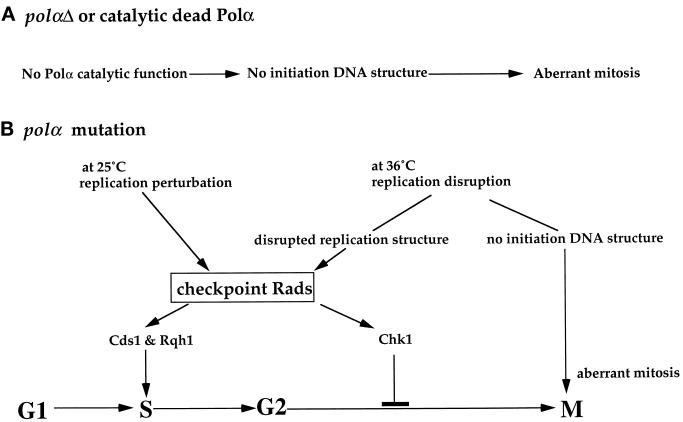
Mutational effects of polα+ on cell cycle events. A summary of the mutational effects of polα+ on cell cycle surveillance responses is depicted, and details are described in the text (see DISCUSSION).

References

    1. Al-Khodairy F, Carr AM. DNA repair mutants defining G2 checkpoint pathways in Schizosaccharomyces pombe. EMBO J. 1992;11:1343–1350. - PMC - PubMed
    1. Al-Khodairy F, Fotou E, Sheldrick KS, Griffiths DJ, Lehmann AR, Carr AM. Identification and characterization of new elements involved in checkpoint and feedback controls in fission yeast. Mol Biol Cell. 1994;5:147–160. - PMC - PubMed
    1. Aparicio OM, Weinstein DM, Bell SP. Components and dynamics of DNA replication complexes in S. cerevisiae: redistribution of MCM proteins and Cdc45p during S phase. Cell. 1997;91:59–69. - PubMed
    1. Boeke JD, Trueheart J, Natsoulis G, Fink GR. 5-Fluoroorotic acid a selective agent in yeast molecular genetics. Methods Enzymol. 1987;154:164–175. - PubMed
    1. Brun C, Dubey DD, Huberman JA. pDblet, a stable autonomously replicating shuttle vector for Schizosaccharomyces pombe. Gene. 1995;164:173–177. - PubMed

Publication types

LinkOut - more resources