


The second-site mutation in the herpes simplex virus recombinants lacking the gamma134.5 genes precludes shutoff of protein synthesis by blocking the phosphorylation of eIF-2alpha
- PMID: 9696792
- PMCID: PMC109920
- DOI: 10.1128/JVI.72.9.7005-7011.1998
The second-site mutation in the herpes simplex virus recombinants lacking the gamma134.5 genes precludes shutoff of protein synthesis by blocking the phosphorylation of eIF-2alpha
Abstract
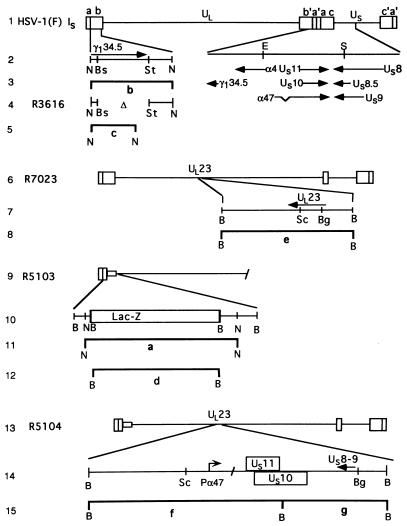
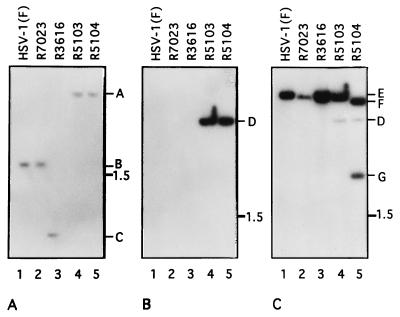
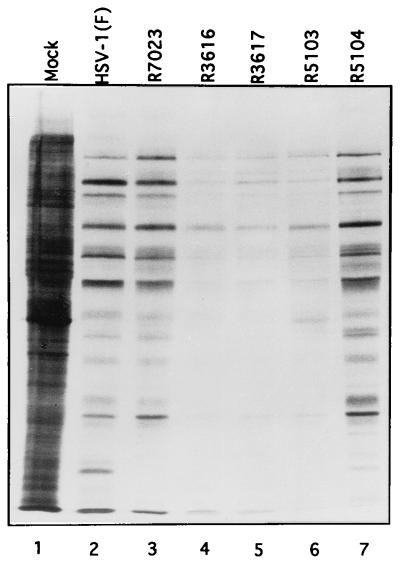
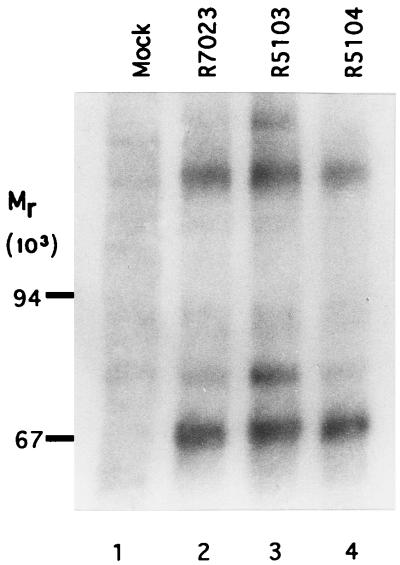
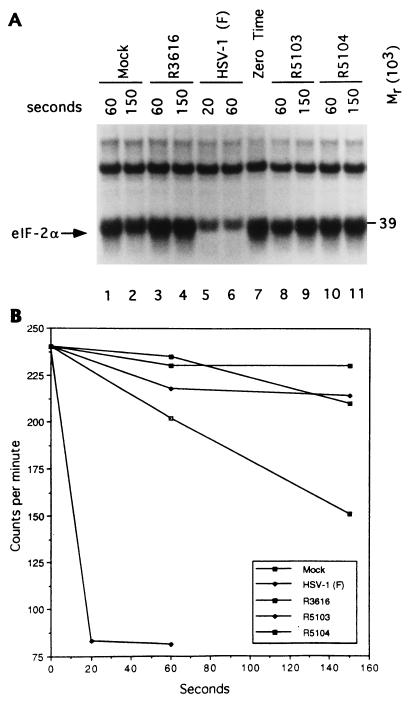
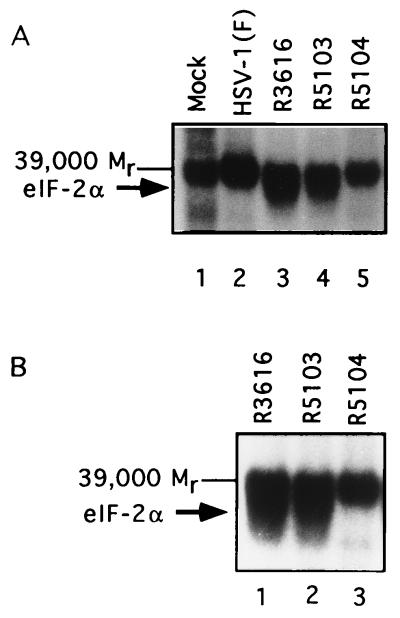
In cells infected with the herpes simplex virus 1 (HSV-1) recombinant R3616 lacking both copies of the gamma134.5 gene, the double-stranded protein kinase R (PKR) is activated, eIF-2alpha is phosphorylated, and protein synthesis is shut off. Although PKR is also activated in cells infected with the wild-type virus, the product of the gamma134.5 gene, infected-cell protein 34.5 (ICP34.5), binds protein phosphatase 1alpha and redirects it to dephosphorylate eIF-2alpha, thus enabling sustained protein synthesis. Serial passage in human cells of a mutant lacking the gamma134.5 gene yields second-site, compensatory mutants lacking various domains of the alpha47 gene situated next to the US11 gene (I. Mohr and Y. Gluzman, EMBO J. 15:4759-4766, 1996). We report the construction of two recombinant viruses: R5103, lacking the gamma134. 5, US8, -9, -10, and -11, and alpha47 (US12) genes; and R5104, derived from R5103 and carrying a chimeric DNA fragment containing the US10 gene and the promoter of the alpha47 gene fused to the coding domain of the US11 gene. R5104 exhibited a protein synthesis profile similar to that of wild-type virus, whereas protein synthesis was shut off in cells infected with R5103 virus. Studies on the wild-type parent and mutant viruses showed the following: (i) PKR was activated in cells infected with parent or mutant virus but not in mock-infected cells, consistent with earlier studies; (ii) lysates of R3616, R5103, and R5104 virus-infected cells lacked the phosphatase activity specific for eIF-2alpha characteristic of wild-type virus-infected cells; and (iii) lysates of R3616 and R5103, which lacked the second-site compensatory mutation, contained an activity which phosphorylated eIF-2alpha in vitro, whereas lysates of mock-infected cells or cells infected with HSV-1(F) or R5104 did not phosphorylate eIF-2alpha. We conclude that in contrast to wild-type virus-infected cells, which preclude the shutoff of protein synthesis by causing rapid dephosphorylation of eIF-2alpha, in cells infected with gamma134.5(-) virus carrying the compensatory mutation, eIF-2alpha is not phosphorylated. The activity made apparent by the second-site mutation may represent a more ancient mechanism evolved to preclude the shutoff of protein synthesis.
Figures
References
-
- Carroll K, Elroy-Stein O, Moss B, Jagus R. Recombinant vaccinia virus K3L gene product prevents activation of double-stranded RNA-dependent, initiation factor 2α-specific protein kinase. J Biol Chem. 1993;268:12837–12842. - PubMed
-
- Cassady, K., and B. Roizman. Unpublished results.
-
- Chou J, Kern E R, Whitley R J, Roizman B. Mapping of herpes simplex virus-1 neurovirulence to γ134.5, a gene nonessential for growth in cell culture. Science. 1990;250:1262–1266. - PubMed
Publication types
MeSH terms
Substances
Grants and funding
LinkOut - more resources
Full Text Sources
Other Literature Sources
