. 1998 Sep;72(9):7387-96.
doi: 10.1128/JVI.72.9.7387-7396.1998.

Rotavirus RNA replication requires a single-stranded 3' end for efficient minus-strand synthesis

Affiliations

Rotavirus RNA replication requires a single-stranded 3' end for efficient minus-strand synthesis

D Chen et al. J Virol. 1998 Sep.

Abstract

The segmented double-stranded (ds) RNA genome of the rotaviruses is replicated asymmetrically, with viral mRNA serving as the template for the synthesis of minus-strand RNA. Previous studies with cell-free replication systems have shown that the highly conserved termini of rotavirus gene 8 and 9 mRNAs contain cis-acting signals that promote the synthesis of dsRNA. Based on the location of the cis-acting signals and computer modeling of their secondary structure, the ends of the gene 8 or 9 mRNAs are proposed to interact in cis to form a modified panhandle structure that promotes the synthesis of dsRNA. In this structure, the last 11 to 12 nucleotides of the RNA, including the cis-acting signal that is essential for RNA replication, extend as a single-stranded tail from the panhandled region, and the 5' untranslated region folds to form a stem-loop motif. To understand the importance of the predicted secondary structure in minus-strand synthesis, mutations were introduced into viral RNAs which affected the 3' tail and the 5' stem-loop. Analysis of the RNAs with a cell-free replication system showed that, in contrast to mutations which altered the structure of the 5' stem-loop, mutations which caused complete or near-complete complementarity between the 5' end and the 3' tail significantly inhibited (>/=10-fold) minus-strand synthesis. Likewise, incubation of wild-type RNAs with oligonucleotides which were complementary to the 3' tail inhibited replication. Despite their replication-defective phenotype, mutant RNAs with complementary 5' and 3' termini were shown to competitively interfere with the replication of wild-type mRNA and to bind the viral RNA polymerase VP1 as efficiently as wild-type RNA. These results indicate that the single-strand nature of the 3' end of rotavirus mRNA is essential for efficient dsRNA synthesis and that the specific binding of the RNA polymerase to the mRNA template is required but not sufficient for the synthesis of minus-strand RNA.


Figures
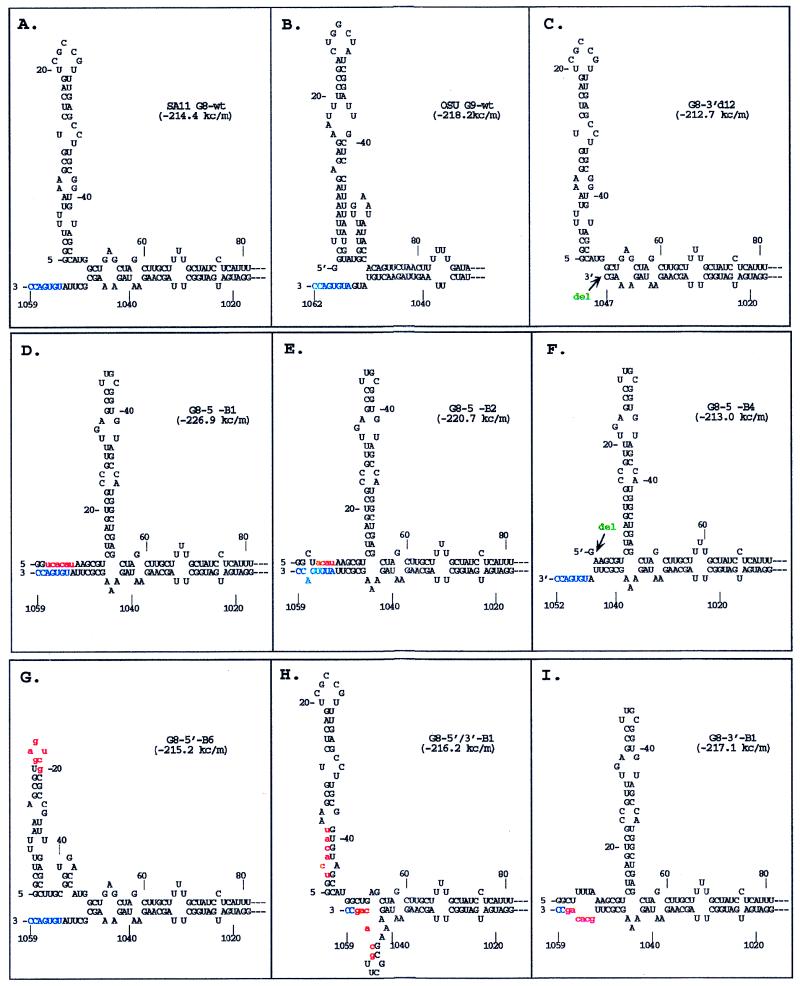
FIG. 1
FIG. 1
The optimal secondary structures of wild-type and mutant SA11 gene 8 RNAs and wild-type OSU gene 9 RNA were predicted based on free-energy minimization with the mfold program. Shown are the portions of the secondary structures illustrating the computed interaction between the 5′ and 3′ ends of the RNA. Mutations in the sequences are presented in red, lowercase letters. The conserved residues that are part of the 3′ essential cis-acting replication signal are shown in blue, and the location of deletions is shown in green. kc/m, kcal/mol.
FIG. 2
FIG. 2
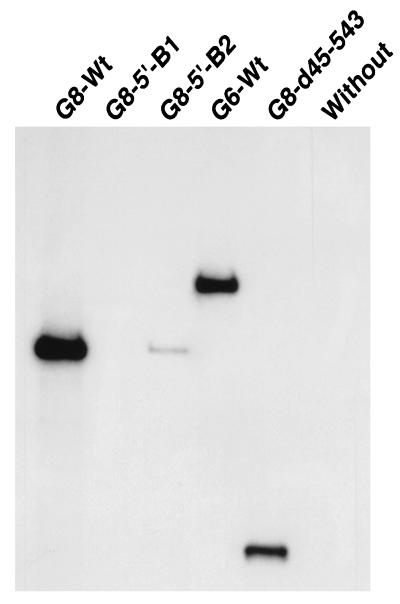
Synthesis of dsRNAs from wild-type and mutant template RNAs by the cell-free replication system. Reaction mixtures contained micrococcal nuclease-treated open cores, [32P]UTP, and either 0.1 μg of the indicated template RNA or no RNA (Without). The 32P-labeled dsRNA products were resolved by electrophoresis on a 12.5% polyacrylamide gel and detected by autoradiography.
FIG. 3
FIG. 3
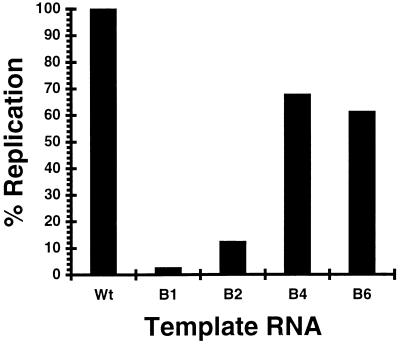
Effect of mutagenesis at the 5′ end of the gene 8 mRNA on synthesis of dsRNA in vitro. Wild-type RNA (Wt) and the mutant gene 8 mRNAs G8-5′-B1, -B2, -B4, and -B6 were used as templates in the cell-free replication system. The dsRNA products of the reaction mixtures were resolved by gel electrophoresis and quantified with a PhosphorImager. The relative values of dsRNA are shown with the value for the wild type normalized to 100%.
FIG. 4
FIG. 4
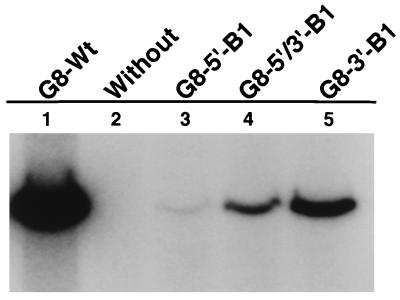
Partial rescue of the defective template activity of the G8-5′-B1 RNA by introduction of compensatory mutations in the 3′ terminus. The 32P-labeled dsRNA products made in reaction mixtures containing wild-type or mutant gene 8 template RNA or no template RNA (Without) were resolved on a 12.5% polyacrylamide gel and detected by autoradiography. Band intensities were determined by phosphorimaging.
FIG. 5
FIG. 5
Effect of complementary oligonucleotides on the replication of the gene 8 RNA in vitro. Wild-type gene 8 template RNA (0.1 μg) was replicated either alone (lane 3) or in the presence of the indicated concentrations of the oligonucleotides Wt-5′, B1-5′, or G8-507 (lanes 4 to 12). The 32P-labeled dsRNA products were resolved on a 12.5% polyacrylamide gel and quantified by phosphorimaging. The amount of dsRNA synthesized in the absence of oligonucleotide (lane 3) was considered to be 100%. Lane 1, 32P-labeled genomic dsRNA of SA11-4F; lane 2, no template RNA was added to the reaction mixture.
FIG. 6
FIG. 6
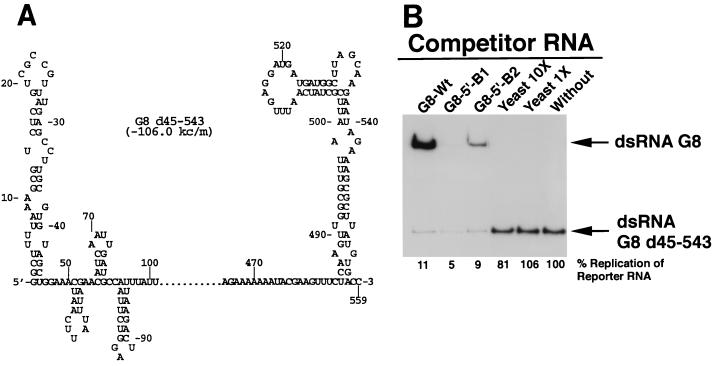
Inhibition of the replication of the G8d45-543 RNA by wild-type and mutant RNAs. (A) The optimal secondary structure for the 5′ and 3′ ends of the G8d45-543 RNA is shown. Note that the 5′ end of the RNA forms the same stem-loop structure as predicted for SA11 wild-type gene 8 mRNA but that the 5′ and 3′ ends of the RNA do not interact due to the deletion of residues 45 to 543 (Fig. 1A). (B) Replicase assays contained 0.1 μg of the internal deletion mutant RNA, G8d45-543 and no competitor RNA (Without), 0.1 μg of competitor RNA (G8-Wt, G8-5′-B1, G8-5′-B2, or Yeast 1X), or 1.0 μg of competitor RNA (Yeast 10X). The 32P-labeled dsRNA products were resolved on a 12.5% polyacrylamide gel and quantified with a PhosphorImager. The amount of G8d45-543 dsRNA synthesized in the absence of competitor RNA was considered to be 100%, and the relative amount of G8d45-543 dsRNA synthesized in the presence of the competitor RNAs is given (percentage of replication of reporter RNA).
FIG. 7
FIG. 7
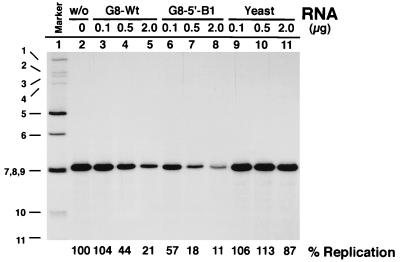
Inhibition of gene 8 RNA replication by competitor RNAs. 32P-labeled wild-type gene 8 RNA (0.1 μg) was replicated alone (lane 2) or in the presence of the indicated amount (in micrograms) of cold competitor RNA. The 32P-labeled dsRNA products were resolved by gel electrophoresis and detected by autoradiography. The intensities of the 32P-labeled bands were determined with a PhosphorImager. The amount of gene 8 dsRNA made in the absence of competitor RNA was considered to be 100%. Lane 1, 32P-labeled genomic dsRNA of SA11-4F.
FIG. 8
FIG. 8
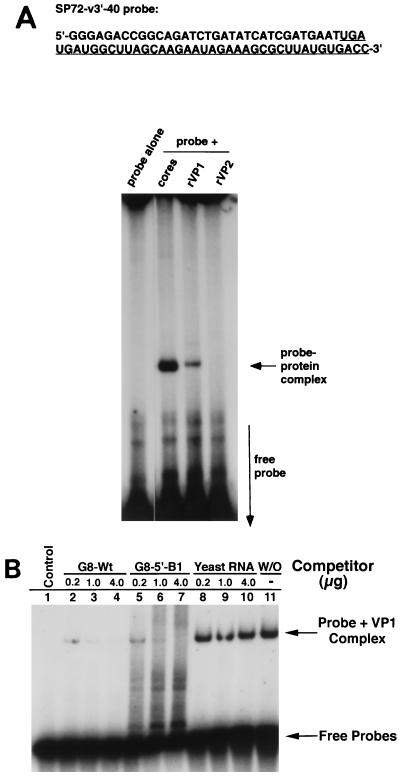
The replication-defective RNA, G8-5′-B1, competitively interferes with the formation of VP1-probe complexes. (A) The sequence of the 73-nucleotide SP72-v3′-40 probe is given, and the portion of the probe that corresponds to the last 40 residues of the gene 8 RNA is underlined. 32P-labeled SP72-v3′-40 probe (10 pmol) and 2.5 μg of rabbit liver tRNA were incubated alone, with open cores or with purified recombinant VP1 (60 ng) or VP2 (400 ng) (30). (B) 32P-labeled SP72-v3′-40 probe (27 ng; 1.2 pmol) was incubated alone (lane 1) or with open cores and no competitor RNA (lane 11), or with 0.2 μg (0.6 pmol), 1.0 μg (2.8 pmol), or 4.0 μg (11.4 pmol) of G8-wt, G8-5′-B1 RNAs, or yeast RNA. The molar ratios of competitor RNA to probe in assays containing 0.2, 1.0, and 4.0 μg of G8-wt and G8-5′-B1 RNA were 0.5, 2.3, and 9.5, respectively. VP1-probe complexes were detected in reaction mixtures by electrophoresis on nondenaturing 8% polyacrylamide gels and by autoradiography.

References

    1. Anzola J V, Xu Z, Asamizu T, Nuss D L. Segment-specific inverted repeats found adjacent to conserved terminal sequences in wound tumor virus genome and defective interfering RNAs. Proc Natl Acad Sci USA. 1987;84:8301–8305. - PMC - PubMed
    1. Beekwilder M J, Nieuwenhuizen R, van Duin J. Secondary structure model for the last two domains of single-stranded RNA phage Q beta. J Mol Biol. 1995;247:903. - PubMed
    1. Bican P, Cohen J, Charpilienne A, Scherrer R. Purification and characterization of bovine rotavirus cores. J Virol. 1982;43:1113–1117. - PMC - PubMed
    1. Chappell J, Goral M I, Rodgers S E, dePamphilis C W, Dermody T S. Sequence diversity within the reovirus S2 gene: reovirus genes reassort in nature, and their termini are predicted to form a panhandle motif. J Virol. 1994;68:750–756. - PMC - PubMed
    1. Chen D Y, Zeng C Q-Y, Wentz M J, Gorziglia M, Estes M K, Ramig R F. Template-dependent, in vitro replication of rotavirus RNA. J Virol. 1994;68:7030–7039. - PMC - PubMed

LinkOut - more resources