


doi: 10.1128/JVI.72.9.7577-7582.1998.
Epstein-Barr virus recombinant lacking expression of glycoprotein gp150 infects B cells normally but is enhanced for infection of epithelial cells
Affiliations
- PMID: 9696856
- PMCID: PMC110006
- DOI: 10.1128/JVI.72.9.7577-7582.1998
Item in Clipboard
Epstein-Barr virus recombinant lacking expression of glycoprotein gp150 infects B cells normally but is enhanced for infection of epithelial cells
J Virol.
1998 Sep.
Abstract
Glycoprotein gp150 is a highly glycosylated protein encoded by the BDLF3 open reading frame of Epstein-Barr virus (EBV). It does not have a homolog in the alpha- and betaherpesviruses, and its function is not known. To determine whether the protein is essential for replication of EBV in vitro, a recombinant virus which lacked its expression was made. The recombinant virus had no defects in assembly, egress, binding, or infectivity for B cells or epithelial cells. Infection of epithelial cells was, however, enhanced. The glycoprotein was sensitive to digestion with a glycoprotease that digests sialomucins, but no adhesion to cells that express selectins that bind to sialomucin ligands could be detected.
Figures
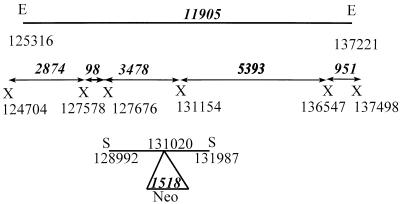
Diagram of the positions of the XhoI (X) restriction sites, numbered according to the B95-8 sequence, that surround the SacII (S) fragment shown at the bottom of the figure that was used for homologous recombination. The neomycin resistance cassette (Neo) was inserted in the BDLF3 ORF at position 131020 in the SacII fragment. Numbers in italics refer to the predicted sizes of the fragments resulting from digestion of wild-type virus DNA. The 11.9-kb EcoRI (E) fragment at the top of the figure was used as a probe of DNA digested with XhoI to determine whether homologous recombination had occurred and increased the size of the 3.5-kb XhoI fragment to 5.0 kb.
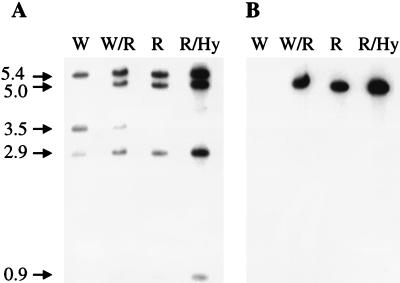
Southern blot analysis of DNA extracted from Akata cells harboring wild-type episomes (W), a parental clone of Akata harboring a mixture of wild-type and recombinant episomes (W/R), and two clones harboring pure recombinant episomes, derived either by infection of EBV-negative Akata cells (clone 2) (R) or by treatment of the parental clone with hydroxyurea (clone 26) (R/Hy). DNA was digested with XhoI, and the two identical halves of the membrane were cut apart and probed with either the EcoRI fragment (bp 125316 to 137221) of EBV (A) or the XmnI-HincII fragment containing the neomycin resistance gene (B). Sizes (in kilobases) are indicated by the arrows.
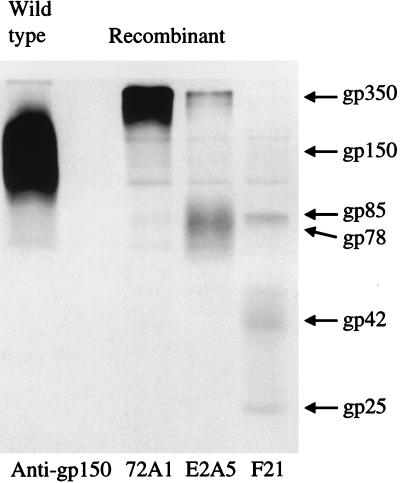
Electrophoretic analysis of proteins immunoprecipitated from Akata cells harboring wild-type or recombinant episomes by MAb 72A1 to gp350, MAb F-2-1 to gp42 and the associated proteins gp85 and gp25, MAb E2A5 to gp78, and rabbit antibody to gp150. The cells were induced with anti-human immunoglobulin and labeled with [3H]glucosamine. The numbers and arrows at the right indicate the masses of the immunoprecipitated proteins in kilodaltons.
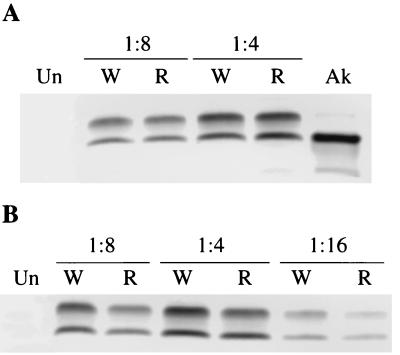
Induction of EBNA1 in EBV-negative Akata cells. Cells were mock infected (Un) or infected with wild-type virus (W) or with one of two different clones (one in panel A and the other in panel B) of recombinant virus (R) at the dilutions shown above the gels, and 5 days later they were harvested for Western blotting with human serum containing antibodies to EBNA1. The starting stocks of the viruses were adjusted so that they contained equal amounts of virus DNA. A sample of uninduced Akata cells (Ak) was included in panel A to demonstrate the mobility of EBNA1 in this strain.
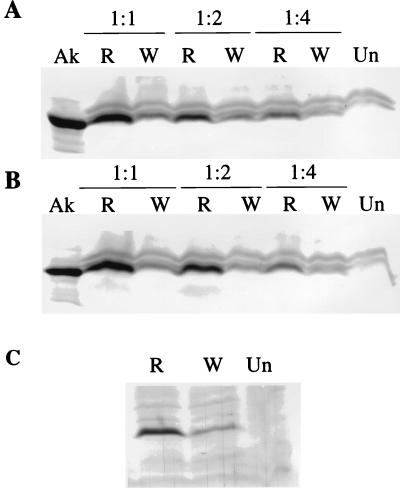
Induction of EBNA1 in SVKCR2 cells and the AGS gastric carcinoma cell line. (A and B) SVKCR2 cells were mock infected (Un) or infected with either wild-type virus (W) or one of two different clones (one in panel A and the other in panel B) of recombinant virus lacking gp150 (R) at the dilutions shown above the gels. The starting stocks of the viruses were adjusted so that they contained equal amounts of virus DNA. Samples of uninduced Akata cells (Ak) were included to demonstrate the mobility of EBNA1 in this strain. (C) AGS cells were mock infected (Un) or infected with equal amounts of recombinant virus (R) or wild-type virus (W). In all cases, 5 days after infection, cells were harvested for Western blotting with human serum containing antibodies to EBNA1.
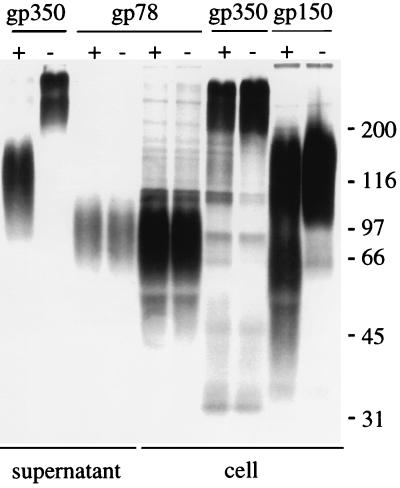
Electrophoretic analysis of proteins immunoprecipitated from Akata cells induced with anti-human immunoglobulin, radiolabeled with [3H]glucosamine, and treated with glycoprotease (+) or buffer alone (−). Cells were separated from the supernatant medium by centrifugation, and samples of supernatant and lysed cells were immunoprecipitated with antibodies to gp350, gp78, or gp150 as indicated. Sizes are indicated in kilodaltons.
References
-
- Baer R, Bankier A T, Biggin M D, Deininger P L, Farrell P J, Gibson T J, Hatfull G, Hudson G S, Satchwell S C, Seguin C, Tuffnell P S, Barrell B G. DNA sequence and expression of the B95-8 Epstein-Barr virus genome. Nature. 1984;310:207–211. - PubMed
-
- Catalfamo J L, Dodds W J. Isolation of platelets from laboratory animals. Methods Enzymol. 1989;169:27–33. - PubMed
-
- Chodosh J, Holder V P, Gan Y J, Belgaumi A, Sample J, Sixbey J W. Eradication of latent Epstein-Barr virus by hydroxyurea alters the growth-transformed cell phenotype. J Infect Dis. 1998;177:1194–1201. - PubMed
-
- Desgranges C, Wolf H, de The G, Shanmugaratnam K, Cammoun N, Ellouz R, Klein G, Lennert K, Munoz N, zur Hausen H. Nasopharyngeal carcinoma. X. Presence of Epstein-Barr virus genomes in separated epithelial cells of tumors in patients from Singapore, Tunisia and Kenya. Int J Cancer. 1975;16:7–15. - PubMed
Publication types
MeSH terms
Substances
Grants and funding
LinkOut - more resources
Full Text Sources
Other Literature Sources
