. 1998 Aug;117(4):1195-203.
doi: 10.1104/pp.117.4.1195.

Gibberellin dose-response regulation of GA4 gene transcript levels in Arabidopsis

Affiliations

Gibberellin dose-response regulation of GA4 gene transcript levels in Arabidopsis

R J Cowling et al. Plant Physiol. 1998 Aug.

Abstract

The gibberellins (GAs) are a complex family of diterpenoid compounds, some of which are potent endogenous regulators of plant growth. As part of a feedback control of endogenous GA levels, active GAs negatively regulate the abundance of mRNA transcripts encoding GA biosynthesis enzymes. For example, Arabidopsis GA4 gene transcripts encode GA 3beta-hydroxylase, an enzyme that catalyzes the conversion of inactive to active GAs. Here we show that active GAs regulate GA4 transcript abundance in a dose-dependent manner, and that down-regulation of GA4 transcript abundance is effected by GA4 (the product of 3beta-hydroxylation) but not by its immediate precursor GA9 (the substrate). Comparison of several different GA structures showed that GAs active in promoting hypocotyl elongation were also active in regulating GA4 transcript abundance, suggesting that similar GA:receptor and subsequent signal transduction processes control these two responses. It is interesting that these activities were not restricted to 3beta-hydroxylated GAs, being also exhibited by structures that were not 3beta-hydroxylated but that had another electronegative group at C-3. We also show that GA-mediated control of GA4 transcript abundance is disrupted in the GA-response mutants gai and spy-5. These observations define a sensitive homeostatic mechanism whereby plants may regulate their endogenous GA levels.


Figures
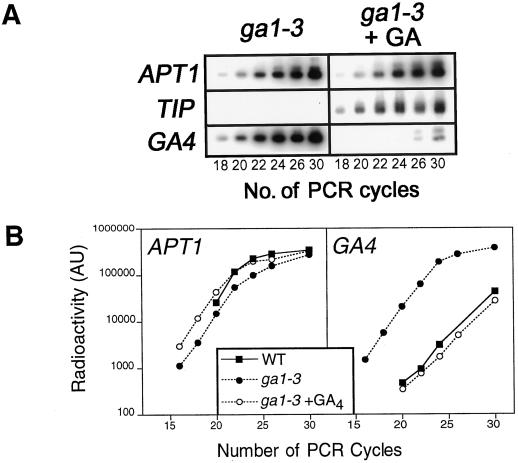
Figure 1
Figure 1
A, QRT-PCR analysis of GA4 and γ-TIP (TIP) transcripts relative to those of the APT1 control gene in GA4-treated (10−7 m; ga1–3 + GA) and untreated ga1–3 (ga1–3). The relevant primer pairs (see Methods) were used on poly-T-primed cDNA samples in separate reactions. Aliquots taken after the stated number of cycles were separated on a 1.2% agarose gel, blotted, hybridized to radioactively labeled probes of a known sequence, and visualized by phosphor imaging. B, Kinetics of RT-PCR reactions shown in A compared with others using wild-type samples. Radioactivity of hybridized filters was measured using ImageQuant software (see Methods) and plotted on a log10 scale (y axis) (AU, arbitrary units) against the number of PCR cycles (x axis). In the GA4-treated sample, the GA4-derived primers amplified two products, the smaller of which was of the correct size to be the GA4 sequence and the signal intensity of which was measured. Gradients over the linear portions (exponential phases) of the curves range from 2.2 to 2.8. RT-PCR product levels were compared before saturation occured (cycle 24). WT, wild type.
Figure 2
Figure 2
ga1–3 seedlings were assayed for relative GA4 mRNA levels and hypocotyl length 2 weeks after germination on medium containing the stated concentration of GA4. QRT-PCR results (GA4:APT1 ratios, calculated after 22 cycles, when the reaction had yet to saturate) were normalized with respect to ga1–3 grown on germination medium only (=1). Results from untreated wild-type seedlings are shown for a comparison (open symbols). Error bars represent se hypocotyl length (sometimes smaller than symbol width). •, ga1–3 hypocotyl elongation; ○, wild-type hypocotyl elongation; ▪, GA4/APT1 transcript ratios in ga1–3; □, GA4/APT1 transcript ratios in the wild type.
Figure 3
Figure 3
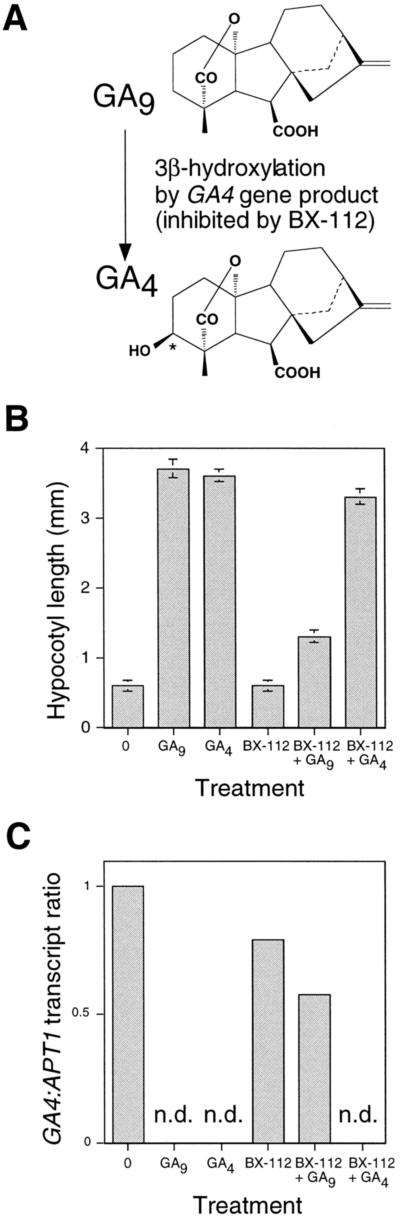
GA4 transcript levels are regulated by GA4 but not by GA9. A, GA9 is converted to GA4 by the addition of a 3β-OH group on C-3 (*). This reaction is catalyzed by the GA4 gene product and inhibited by BX-112. B, ga1–3 seedlings were grown for 2 weeks on germination medium supplemented with 10−4 m BX-112, 10−7 m GA9, and 10−7 m GA4 as stated. Hypocotyl lengths were measured as described in Figure 2, error bars represent se. C, ga1–3 seedlings treated as in B were assayed for GA4 transcript levels as in Figure 2. RT-PCR products were compared after 22 cycles. Results are presented as GA4:APT1 product ratios, normalized with respect to ga1–3 grown on germination medium only (=1). n.d., GA4 transcript not detected (see Methods).
Figure 4
Figure 4
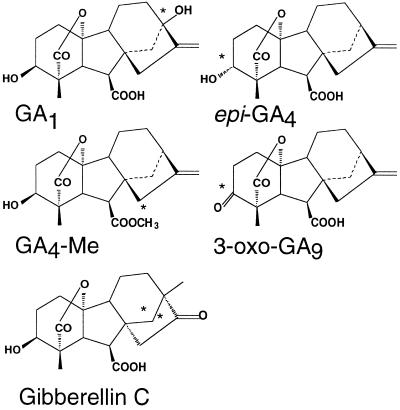
Structures of the GAs and GA analogs tested for biological activity. Significant differences in structure from GA4 (see Fig. 3A) are highlighted (*). epi-GA4 is 3α-hydroxylated rather than 3β-hydroxylated; GA1 is 13-hydroxylated; GA4-methyl ester (GA4-Me) is esterified on the carboxyl group at carbon-7; 3-oxo-GA9 has a ketone group at C-3 instead of a 3β-hydroxyl group; and GA C, a derivative of GA1, has a rearrangement of the C and D rings.
Figure 5
Figure 5
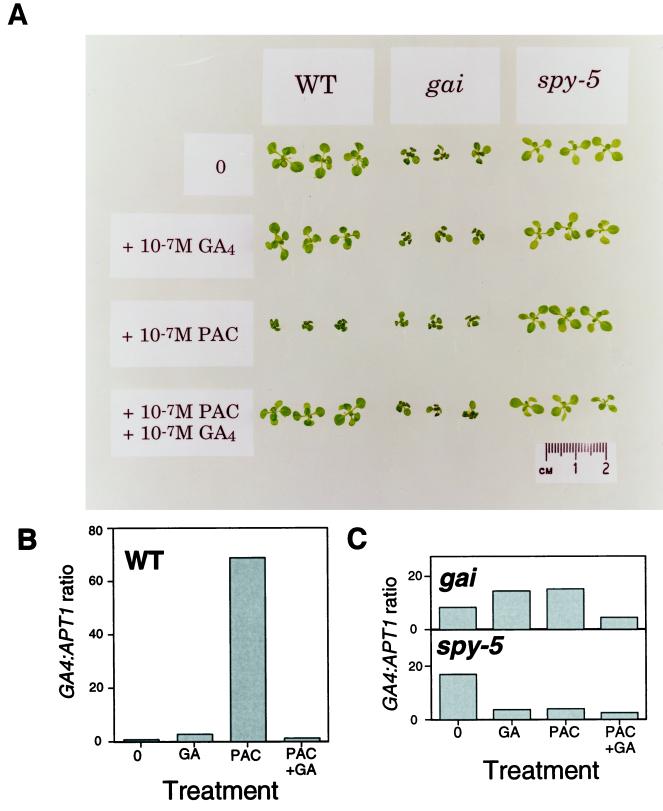
Effects of GA4 or PAC on wild-type (WT), gai, and spy-5 seedlings. A, Seedlings grown on germination medium containing 10−7 m GA4 and/or 10−7 m PAC for 2 weeks. B, Effects of exogenous GA4 (GA) and PAC (same concentrations as in A) on GA4 mRNA levels in the wild type. QRT-PCR results were converted to ratios by normalizing samples to the wild-type sample grown on germination medium only. All samples were prepared at the same time and compared after 22 cycles. C, Effects of exogenous GA4 (GA) and PAC (same concentrations as in A on GA4 mRNA levels in gai and spy mutants). Samples were prepared at the same time and data were normalized as in B and compared after 22 cycles.

References

    1. Aldridge DC, Hanson JR, Mulholland TPC (1965) Gibberellic acid. Part XXVIII. Some derivatives of gibberellins A4 and A7. J Chem Soc 3539–3549 - PubMed
    1. Brian PW, Grove JF, Mulholland TPC. Relationships between structure and growth-promoting activity of the gibberellins and some allied compounds, in four test systems. Phytochemistry. 1967;6:1475–1499.
    1. Chelly J, Kaplan J-C, Maire P, Gautrin S, Kahn A. Transcription of the dystrophin gene in human muscle and non-muscle tissues. Nature. 1988;333:858–860. - PubMed
    1. Chiang H-H, Hwang I, Goodman HM. Isolation of the Arabidopsis GA4 locus. Plant Cell. 1995;7:195–201. - PMC - PubMed
    1. Chiang H-H, Hwang I, Goodman HM. Isolation of the Arabidopsis GA4 locus. Correction. Plant Cell. 1997;9:979–980. - PMC - PubMed

Publication types