. 1998 Aug;117(4):1281-91.
doi: 10.1104/pp.117.4.1281.

Induction of a carbon-starvation-related proteolysis in whole maize plants submitted to Light/Dark cycles and to extended darkness

Affiliations

Induction of a carbon-starvation-related proteolysis in whole maize plants submitted to Light/Dark cycles and to extended darkness

R Brouquisse et al. Plant Physiol. 1998 Aug.

Abstract

Three-week-old maize (Zea mays L.) plants were submitted to light/dark cycles and to prolonged darkness to investigate the occurrence of sugar-limitation effects in different parts of the whole plant. Soluble sugars fluctuated with light/dark cycles and dropped sharply during extended darkness. Significant decreases in protein level were observed after prolonged darkness in mature roots, root tips, and young leaves. Glutamine and asparagine (Asn) changed in opposite ways, with Asn increasing in the dark. After prolonged darkness the increase in Asn accounted for most of the nitrogen released by protein breakdown. Using polyclonal antibodies against a vacuolar root protease previously described (F. James, R. Brouquisse, C. Suire, A. Pradet, P. Raymond [1996] Biochem J 320: 283-292) or the 20S proteasome, we showed that the increase in proteolytic activities was related to an enrichment of roots in the vacuolar protease, with no change in the amount of 20S proteasome in either roots or leaves. Our results show that no significant net proteolysis is induced in any part of the plant during normal light/dark cycles, although changes in metabolism and growth appear soon after the beginning of the dark period, and starvation-related proteolysis probably appears in prolonged darkness earlier in sink than in mature tissues.


Figures
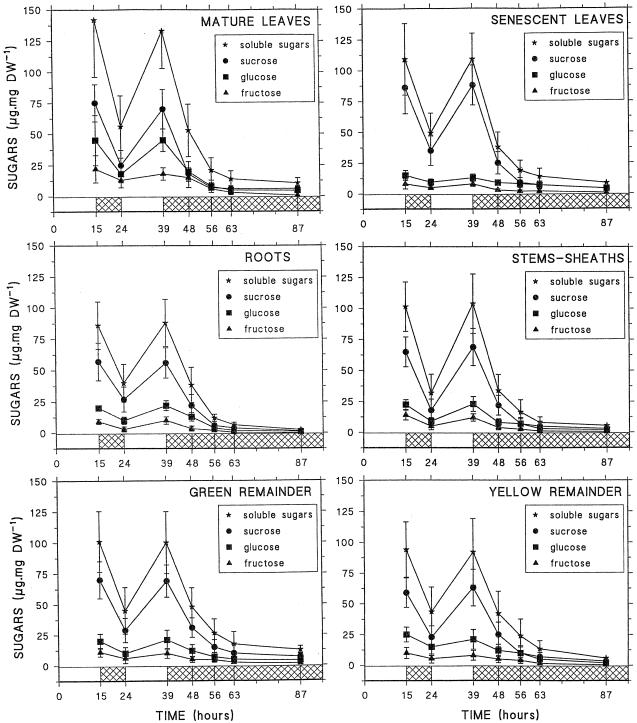
Figure 1
Figure 1
Changes in soluble sugars, Suc, Glc, and Fru, in different maize plant parts (whole roots, mature leaves, senescent leaves, stems and sheaths, green remainder, and yellow remainder) during light/dark cycles and 48 h of darkness. Each point represents the mean (±sd) of four independent experiments. DW, Dry weight.
Figure 2
Figure 2
Changes in protein content in different maize plant tissues (root tips, mature roots, senescent leaves, mature leaves, youngest leaves, stems and sheaths, green remainder, and yellow remainder) during light/dark cycles and 48 h of extended darkness. Each point represents the mean (±sd) of five different experiments. DW, Dry weight.
Figure 3
Figure 3
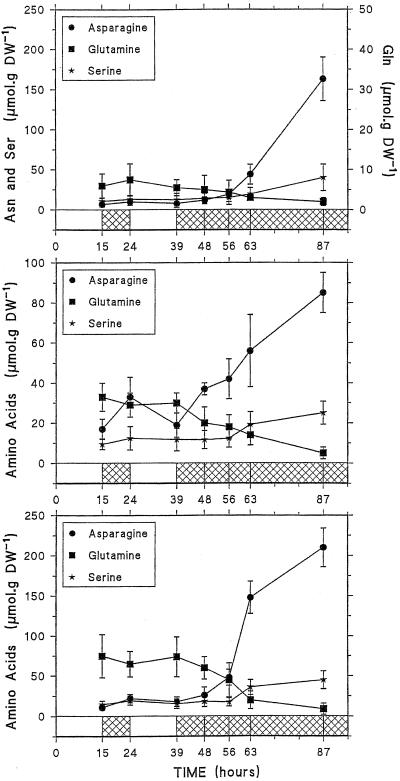
Changes in free amino acids, Asn, Gln, and Ser, in youngest leaves (top), mature roots (middle), and root tips (bottom) of maize plants submitted to light/dark cycles and to 48 h of darkness. Each point represents the mean (±sd) of three (youngest leaves), four (root tips), or five (mature roots) independent experiments. DW, Dry weight.
Figure 4
Figure 4
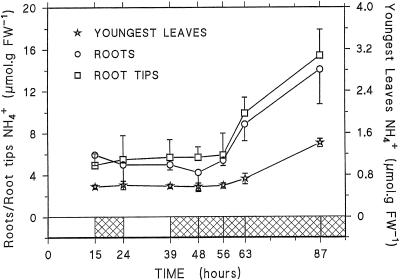
Changes in NH4+ content in youngest leaves, mature roots, and root tips of maize plants submitted to the light/dark cycle and to 48 h of darkness. Each point represents the mean of three independent experiments. For clarity, only one side of the sd is indicated for root-tip and mature root data. FW, Fresh weight.
Figure 5
Figure 5
Changes in total endopeptidase (EP) activity and immunodetection by western-blot analysis of RSIP (SDS-PAGE) and 20S proteasome (native-PAGE) in mature roots (Root) and youngest leaves (Y.L.) of maize plants submitted to light/dark cycles and 48 h of darkness. A, Azocasein was used as a substrate. Each point represents the mean (±sd) of three (youngest leaves) or six (mature roots) independent experiments. B, The equivalent to 0.5 mg dry weight of mature roots (bottom, 100–70 μg of protein) and youngest leaves (top, 90–60 μg of protein) was loaded onto each lane. FW, Fresh weight.
Figure 6
Figure 6
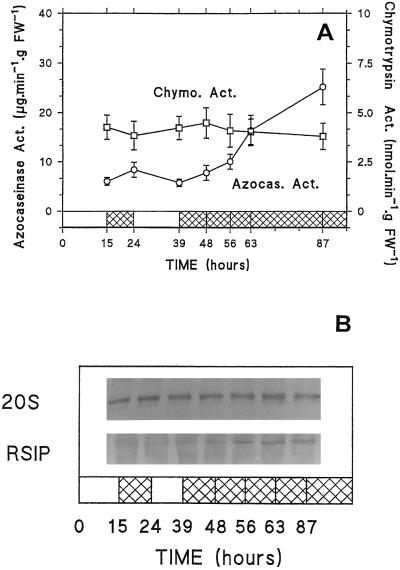
Changes in total endopeptidase and chymotrypsin-like activities and immunodetection by western-blot analysis of RSIP (SDS-PAGE) and 20S proteasome (native-PAGE) in root tips of maize plants submitted to light/dark cycles and 48 h of darkness. A, Azocasein was used as a substrate for total endopeptidase activity measurement, and Succ-Leu-Leu-Val-Tyr-MCA was used for chymotrypsin-like activity measurement. Each point represents the mean (±sd) of four (azocasein) or two (chymotrypsin-like) independent experiments. B, The equivalent to 0.25 mg dry weight of root tips (100–75 μg of protein) was loaded onto each lane. FW, Fresh weight; Chymo. Act., chymotrypisin activity; Azoca. Act., azocaseinase activity.
Figure 7
Figure 7
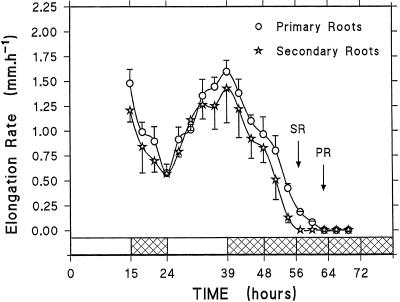
Changes in the elongation rate of primary and secondary roots of maize plants during light/dark cycles and extended darkness. These data are from a representative experiment that has been repeated two times. The first and second points of each curve represent the mean growth rates over the last 3 h of the light period and the first 3 h of the dark period, respectively. Each point represents the mean (±sd) of two (primary roots) or four (secondary roots) measurements. For clarity, only one side of the sd was indicated. Arrows indicate the moment when secondary (SR) or primary (PR) roots stopped growing.

References

    1. Amthor JS, McCree KJ (1990) Carbon balance of stressed plants: a conceptual model for integrating research results. In RG Alscher, JC Cumming, eds, Stress Responses in Plants: Adaptation and Acclimation Mechanisms. Wiley-Liss & Sons, Inc., New York, pp 1–15
    1. Aubert S, Gout E, Bligny R, Marty-Mazars D, Barrieu F, Alabouvette J, Marty F, Douce R. Ultrastructural and biochemical characterization of autophagy in higher plant cells subjected to carbon deprivation: control by the supply of mitochondria with respiratory substrates. J Cell Biol. 1996;133:1251–1263. - PMC - PubMed
    1. Baba M, Takeshige K, Baba N, Ohsumi Y. Ultrastructural analysis of the autophagic process in yeast: detection of autophagosomes and their characterization. J Cell Biol. 1994;124:903–913. - PMC - PubMed
    1. Baysdorfer C, Warmbrodt RD, Van Der Woude WJ. Mechanisms of starvation tolerance in pearl millet. Plant Physiol. 1988;88:1381–1387. - PMC - PubMed
    1. Bingham IJ, Stevenson EA. Control of root growth: effects of carbohydrates on the extension, branching and rate of respiration of different fractions of wheat roots. Physiol Plant. 1994;88:149–158.

LinkOut - more resources