. 1998 Aug;117(4):1333-9.
doi: 10.1104/pp.117.4.1333.

A benzothiadiazole primes parsley cells for augmented elicitation of defense responses

Affiliations

A benzothiadiazole primes parsley cells for augmented elicitation of defense responses

VA Katz et al. Plant Physiol. 1998 Aug.

Abstract

Systemic acquired resistance is an important component of the disease-resistance arsenal of plants, and is associated with an enhanced potency for activating local defense responses upon pathogen attack. Here we demonstrate that pretreatment with benzothiadiazole (BTH), a synthetic activator of acquired resistance in plants, augmented the sensitivity for low-dose elicitation of coumarin phytoalexin secretion by cultured parsley (Petroselinum crispum L.) cells. Enhanced coumarin secretion was associated with potentiated activation of genes encoding Phe ammonia-lyase (PAL). The augmentation of PAL gene induction was proportional to the length of pretreatment with BTH, indicating time-dependent priming of the cells. In contrast to the PAL genes, those for anionic peroxidase were directly induced by BTH in the absence of elicitor, thus confirming a dual role for BTH in the activation of plant defenses. Strikingly, the ability of various chemicals to enhance plant disease resistance correlated with their capability to potentiate parsley PAL gene elicitation, emphasizing an important role for defense response potentiation in acquired plant disease resistance.


Figures

Figure 1
Figure 1
Potentiation of elicitor-induced PAL gene activation (A) and coumarin secretion (B) upon pretreatment with BTH. Cultured parsley cells were pretreated for 24 h with the indicated concentrations of BTH and then incubated in the absence or presence of a low dose of elicitor (4 μg mL−1). Three hours after elicitor application, total RNA was extracted from an aliquot of cells and assayed for accumulation of PAL mRNA by northern analysis (A). The remainder of the cell suspension was agitated for another 21 h before extraction and quantification of coumarins from the suspension medium (B). To assess the extent of potentiation, the cell's response to a saturating dose of elicitor (40 μg mL−1) was also monitored.
Figure 4
Figure 4
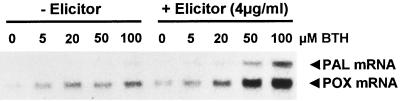
Pretreatment with BTH has different effects on the accumulation of POX and PAL mRNAs. Upon pretreatment for 24 h at various BTH concentrations, cultured parsley cells were incubated for another 3 h in the absence (−) or presence (+) of Pmg elicitor (4 μg mL−1). Cells were analyzed for accumulation of PAL and POX mRNAs by northern analysis simultaneously using parsley PAL- and POX-specific cDNA probes for hybridization. The band obtained with each of the two probes corresponds to the size of the respective mRNAs.
Figure 2
Figure 2
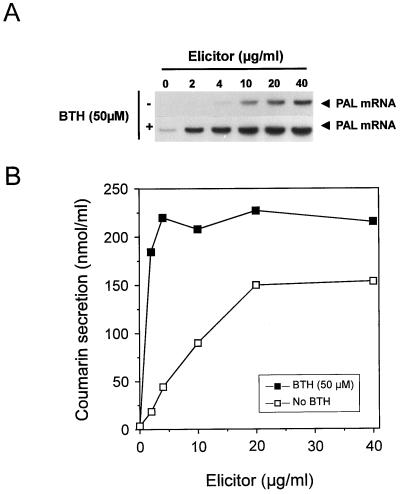
PAL gene activation (A) and coumarin secretion (B) by various elicitor concentrations upon pretreatment of cultured parsley cells in the absence or presence of BTH. Cell suspensions were pretreated for 24 h in the absence or presence of BTH (50 μm) and then supplied with the indicated concentrations of Pmg elicitor. Three hours later, an aliquot of cells was monitored for accumulation of PAL mRNA (A). Coumarins were extracted from the culture medium of the remainder of the cell suspension and quantified 24 h after elicitation.
Figure 3
Figure 3
Length of BTH preincubation determines the extent of potentiation of PAL gene activation (A) and coumarin secretion (B). A parsley cell culture was pretreated in the absence or presence of BTH (50 μm) for the indicated time periods prior to addition of elicitor (4 μg mL−1) or water (no elicitor) on the 4th d after subculturing (time zero). A, Cells were analyzed for accumulation of PAL gene transcripts by northern analysis 3 h after elicitation. B, Coumarins were extracted from the culture medium 24 h after elicitor application.
Figure 5
Figure 5
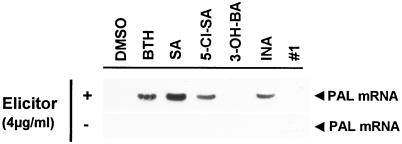
Potentiation of elicited PAL gene activation upon pretreatment of cultured parsley cells with various chemicals. Cells were preincubated for 24 h with the indicated compounds at 50 μm (BTH) or 250 μm (SA, 5-Cl-SA, 3-OH-BA, INA, or INA analog no. 1) and then incubated in the absence (−) or presence (+) of a low dose of elicitor (4 μg mL−1). Three hours later, the cells were assayed for accumulation of PAL mRNA as in Figure 3A. All of the compounds tested were dissolved in DMSO (1% [v/v] final concentration) and, thus, preincubation with 1% (v/v) DMSO served as a control.

References

    1. Ausubel FM, Brent R, Kingston RE, Moore DD, Smith JA, Seidman JG, Stuhl K (1987) Current Protocols in Molecular Biology. John Wiley and Sons, New York
    1. Cao H, Glazebrook J, Clarke JD, Volko S, Dong X. The Arabidopsis npr1 gene that controls systemic acquired resistance encodes a novel protein containing ankyrin repeats. Cell. 1997;88:57–63. - PubMed
    1. Conrath U, Chen Z, Ricigliano JR, Klessig DF. Two inducers of plant defense responses, 2,6-dichloroisonicotinic acid and salicylic acid, inhibit catalase activity in tobacco. Proc Natl Acad Sci USA. 1995;92:7143–7147. - PMC - PubMed
    1. Cutt JR, Klessig DF. Pathogenesis-related proteins. In: Boller T, Meins F, editors. Plant Gene Research: Genes Involved in Plant Defense. Wien, Austria: Springer; 1992. pp. 209–243.
    1. Du H, Klessig DF. Identification of a soluble, high-affinity salicylic acid-binding protein in tobacco. Plant Physiol. 1997;113:1319–1327. - PMC - PubMed

LinkOut - more resources